The Stopgap That Won the Sky
"Built in desperation, flown with distinction: the Mk IX outlasted the aircraft it was designed to counter."
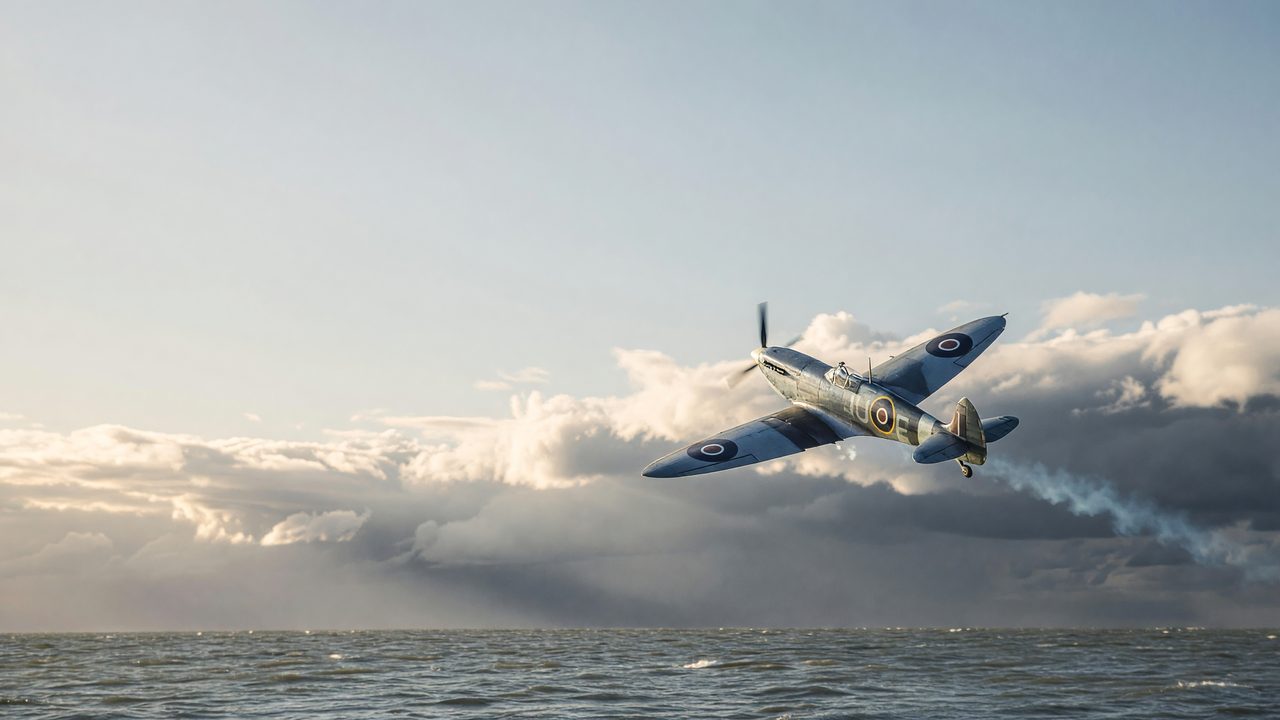
The Stopgap That Won the Sky
When the Fw 190 arrived, Britain needed a new fighter in months—not years. The answer was a marriage of old airframe and radical engine that became the war’s most important Spitfire.
The Butcher Bird Arrives
In September 1941, the Focke-Wulf Fw 190 entered combat over the Channel. RAF pilots flying the Spitfire Mk V discovered, often at the cost of their lives, that the new German fighter held a decisive edge in speed, climb, and roll rate at the altitudes where most dogfights occurred. The crisis was severe enough that Fighter Command curtailed daylight operations over occupied Europe that November. When raids resumed in the spring of 1942, losses remained punishing. The Mk V, superb in its own right, could no longer guarantee air superiority.
The RAF’s long-term answer was the Spitfire Mk VIII—a redesigned fuselage, revised systems, and the new Rolls-Royce Merlin 60-series engine. But redesign takes time. Work on the two-stage, two-speed supercharged Merlin had begun in summer 1941, with experimental flying aboard the sole Mk III prototype that September—the same month the Fw 190 went operational. From that test program emerged three planned marks: the high-altitude Mk VII, the refined Mk VIII, and something faster.
Desperation Engineering
What the Air Fighting Development Unit needed was not perfection. It needed parity, immediately. Supermarine’s solution was brutally practical: bolt the Merlin 61 into a Mk Vc airframe and change as little else as possible. Rolls-Royce converted two Mk VCs into prototypes; the first flew on 26 February 1942. AFDU test reports confirmed what engineers had hoped—the performance jump was not incremental. Supermarine test pilot Jeffrey Quill, who knew the Spitfire as well as anyone alive, called it a “quantum leap.”
Full production began in June 1942. The following month, No. 64 Squadron at Hornchurch received the first operational Mk IXs. From drawing board to front-line squadron in roughly four months: an achievement that speaks to both British industrial urgency and the terrifying pressure of aerial defeat.
What Changed Under the Cowling
The Merlin 61’s two-stage supercharger was the heart of the transformation. Unlike the single-stage Merlin 45 in the Mk V, which delivered peak power within a relatively narrow altitude band, the two-stage unit compressed intake air twice—first at low altitude, then again through a second stage and intercooler. A two-speed gearbox allowed the pilot’s engine to maintain boost across a far wider altitude range. The result was roughly 1,560 horsepower from the Merlin 61, against the Mk V’s 1,440.
The numbers, drawn from contemporary AFDU testing and production records, tell the story plainly. Where the Mk V topped out near 369 mph and struggled above 37,000 feet, the F.Mk IX reached approximately 409 mph at 28,000 feet, climbed at roughly 4,000 feet per minute, and carried a service ceiling of 43,000 feet. In July 1942, an early production Mk IX was flown against a captured Fw 190A. The two aircraft proved closely matched—a verdict that restored the RAF’s confidence to resume the daylight offensive.
Three engine sub-variants followed. The F.Mk IX used the Merlin 61 for general-purpose fighting. The LF.Mk IX, fitted with the Merlin 66 optimized for lower altitudes, became the most numerous sub-type, with more than 4,000 built. The HF.Mk IX, with the high-altitude Merlin 70, served where the thin air demanded every available horsepower.
The Workhorse of the Air War
Production totals confirm the Mk IX’s dominance. Castle Bromwich Aircraft Factory alone built 5,095; Supermarine’s Southampton works added 561, and Rolls-Royce converted 282 older Mk V airframes. More than 5,600 Mk IXs rolled off the lines—making it the most numerous Spitfire variant by a wide margin. When the purpose-built Mk VIII finally arrived later in 1942, its performance closely mirrored the improvised Mk IX, vindicating the stopgap approach.
The type bore the weight of combat from 1942 onward. Circus, Ramrod, and Rodeo raids over France resumed behind its elliptical wings. On 30 July 1942, a Mk IX claimed the variant’s first confirmed victory over an Fw 190. In September, Spitfire pilots intercepted a Junkers Ju 86R reconnaissance aircraft at 43,000 feet over Southampton—the highest-altitude air combat of the European war. By October 1944, Mk IXs of No. 401 Squadron, RCAF, became among the first Allied fighters to down a Messerschmitt Me 262 jet.
Most Mk IXs carried the “C” wing—two 20mm cannon and four .303-inch machine guns, or four cannon in the heaviest configuration. Later production introduced the “E” wing with .50-caliber Brownings, and many late-war aircraft received the cut-down rear fuselage and bubble canopy that gave pilots the all-around vision their predecessors had lacked.
Why it matters to you
The Mk IX story is a lesson in powerplant management dressed in wartime urgency. The two-stage Merlin did not simply produce more horsepower—it produced usable horsepower across the altitude band where the fight actually happened. That is the same principle behind modern turbocharged piston engines and turbine bleed-air systems: matching available power to the environment you are operating in, not chasing a single peak number on a spec sheet. The Mk VIII was the “correct” long-term design, with a strengthened airframe and refined systems—but correct does not help when enemy fighters are shooting down your bombers today. Supermarine and Rolls-Royce chose the minimum viable change that restored combat effectiveness, then iterated. As a pilot, that mindset translates directly: when performance is inadequate, identify the single bottleneck—here, altitude-critical engine power—and address it before redesigning everything else. The Mk IX was not the most elegant Spitfire. It was the one that arrived in time.