The Stick Goes Dead
"The engine is just a fan. It keeps the pilot cool. When it stops, you can see them sweat."
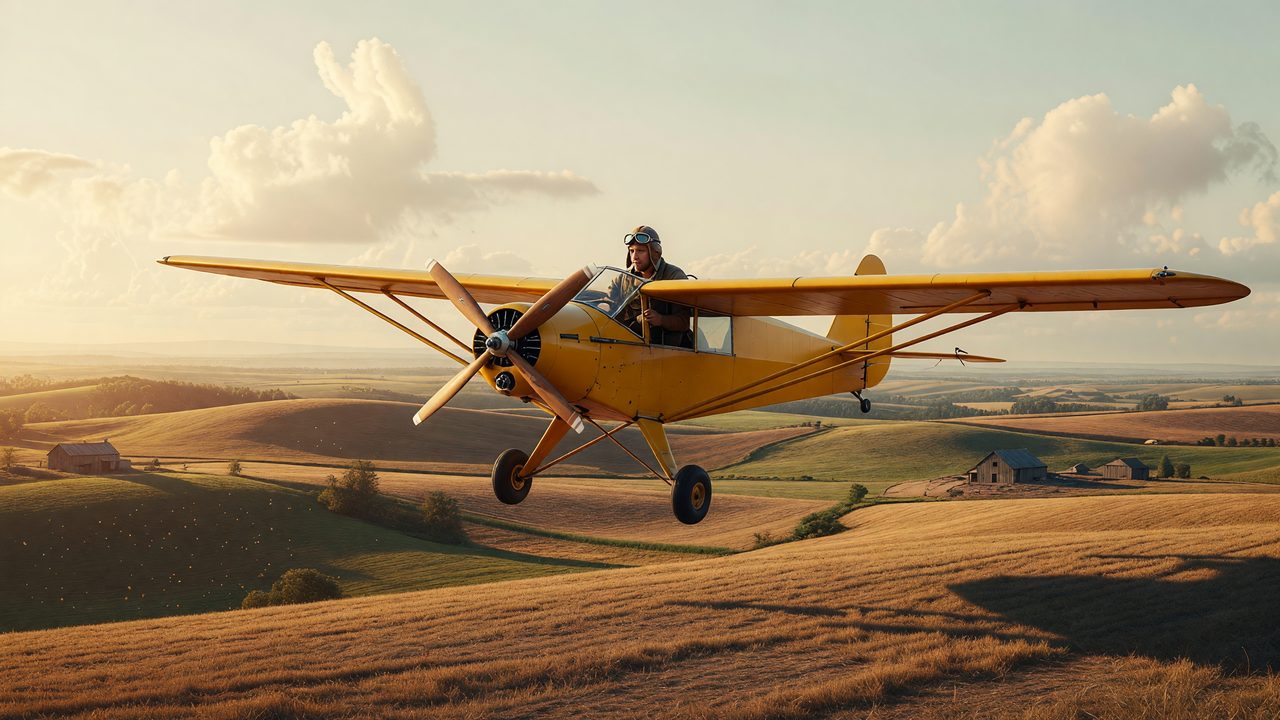
The Stick Goes Dead
When power quits—whether in a J-3 Cub or a spacecraft—the same ancient discipline applies: manage what energy remains, choose your landing point early, and fly the machine all the way to the ground.
A Word Older Than Flight
Long before anyone left the ground under power, British sailors spoke of a "dead stick" when a vessel's tiller had lost its steering blade—the oar that translated the helmsman's intent into motion. A ship with a dead stick still had momentum, but no reliable means to direct it. Early aviators borrowed the phrase for a condition every pilot dreads: the engine shut down, the propeller windmilling to a stop, and the airplane committed to gravity alone. Aviation lore preserved the nautical image because the problem is the same at sea or in the sky. You are moving, but you cannot add thrust. What remains is judgment, geometry, and the willingness to act while there is still altitude to spend.
Simple on Paper, Unforgiving in the Air
A deadstick landing, in its purest form, is exactly what the name implies: touchdown with the engine secured and the propeller still. The textbook sequence fits on an index card. Establish best glide speed. Pick a suitable field. Configure for landing. Fly a stabilized approach and touch down at the lowest controllable airspeed. The FAA's Airplane Flying Handbook, in its chapter on emergency procedures, treats engine failure as the archetypal forced landing—the immediate descent that follows when flight cannot continue. In theory, the maneuver is arithmetic. In practice, it is a test of whether a pilot can hold composure when the noise stops.
The handbook is blunt about what goes wrong. Pilots who cannot accept the emergency delay action. Fear becomes panic. And perhaps most treacherous of all, the desire to save the airplane leads to the turn back toward the runway—the so-called impossible turn—when altitude and airspeed are already insufficient. The FAA warns that stretching a glide by hauling back on the elevator, slowing below the published best-glide speed, trades survivable energy for a stall and a crash short of the field. Deadstick flying is not about heroics. It is about trading altitude for distance at the one airspeed that gives you the most forward motion per foot lost.
From Hayfield to Orbit
The most celebrated deadstick arrival in aerospace history did not involve a propeller at all. On March 16, 1966, Gemini VIII command pilot Neil Armstrong and pilot David Scott achieved the world's first space docking, linking their capsule to an Agena target vehicle. Shortly after the first docking, a stuck OAMS thruster on Gemini VIII sent the joined spacecraft into a roll that took roughly thirty minutes to bring under control. Armstrong fought the motion while out of contact with Mission Control. After undocking, the spin accelerated. Recognizing that the fault lay in their own spacecraft, Armstrong shut down the primary thruster system and fired the Reentry Control System at the nose to arrest the rotation—burning through most of that precious propellant in the process. NASA's Gemini VIII Mission Report documents the consequence: with reentry control partially depleted, mission rules required an immediate abort. Armstrong executed a ballistic reentry to a predetermined splashdown point in the Pacific. The flight lasted ten hours and forty-one minutes instead of the planned three days. Armstrong and Scott walked away from a spacecraft that had been seconds from an uncontrollable spin. The vehicle was different. The physics were not. Power was gone. Energy was finite. A landing point had been chosen under duress, and a pilot flew it to completion.
The Same Skill at Every Altitude
Whether the failure occurs in a Cub at a thousand feet above a Midwestern bean field or in a capsule a hundred miles up, the pilot's job collapses to the same verbs: stabilize, prioritize, commit. Wind matters. Field selection matters. The discipline to resist the seductive turn toward the runway matters. Student pilots practice simulated engine failures until the sequence feels reflexive—pitch for glide speed, scan for terrain, plan the pattern without power. Rated pilots revisit the drill in recurrent training because the accident record shows that experience does not grant immunity. The engine does not care about your certificate.
Why it matters to you
Best glide speed is not a suggestion printed in your POH for idle curiosity. It is the airspeed at which your aircraft achieves its highest lift-to-drag ratio—the speed that maximizes distance traveled for every foot of altitude surrendered. Every type has a published figure, and the FAA expects you to know it, establish it within practical tolerances, and hold it through the entire emergency approach. Practicing engine-out procedures is not a checkride formality; it is the recurrent rehearsal of the oldest bargain in aviation. You cannot manufacture thrust, but you can manage what you have left. When the stick goes dead, that management is how a pilot earns their pay.