The Steady Hand: How the S.E.5a Became Britain's Deadliest Workhorse
"Fast, steady, and boring—which is exactly what a fighter pilot needs"
The Steady Hand: How the S.E.5a Became Britain's Deadliest Workhorse
Stable, fast, and forgiving in the dive, the Royal Aircraft Factory’s inline-engined fighter turned aerial marksmanship into a squadron weapon—and outlasted the rotaries that stole the headlines.
When the Royal Flying Corps went hunting for a successor to the nimble Sopwith Pup in 1916, engineers at the Royal Aircraft Factory at Farnborough bet on horsepower and structure rather than on the last ounce of snap roll. Henry Folland, John Kenworthy, and Major Frank Goodden shaped the Scout Experimental 5 around the new Hispano-Suiza 8A V-8, a water-cooled inline that promised steady thrust where rotary engines spat and surged. Prototype A4561 lifted from Farnborough on 22 November 1916. The promise was real, but the price was steep: Goodden died in January 1917 while testing a second prototype. His loss forced hard changes. Strengthened wings and revised fittings addressed the structural weaknesses that had nearly killed the program before it reached the front. What emerged was not the lightest kite in the fleet, but a machine built to survive the violence of combat diving.
The first production S.E.5s crossed to France with No. 56 Squadron on 7 April 1917, arriving in the grim middle act of Bloody April, when Allied scouts were being hunted in skies that favored the new German Albatros fighters. Within weeks the improved S.E.5a appeared, its 200-horsepower geared Hispano-Suiza 8B giving pilots the speed to press an advantage and the torque characteristics that crews could manage day after day. Museum and archival records chart a steady rollout through the summer and autumn of 1917 as squadrons traded mixed fortunes for a fighter that could be flown hard without demanding constant correction. Where rotary-engined mounts demanded a pilot’s full attention merely to keep the nose pointed, the S.E.5a’s inline ran with a comparative hush—less bark across the propeller arc, more room in the cockpit to think about geometry, lead, and escape routes.
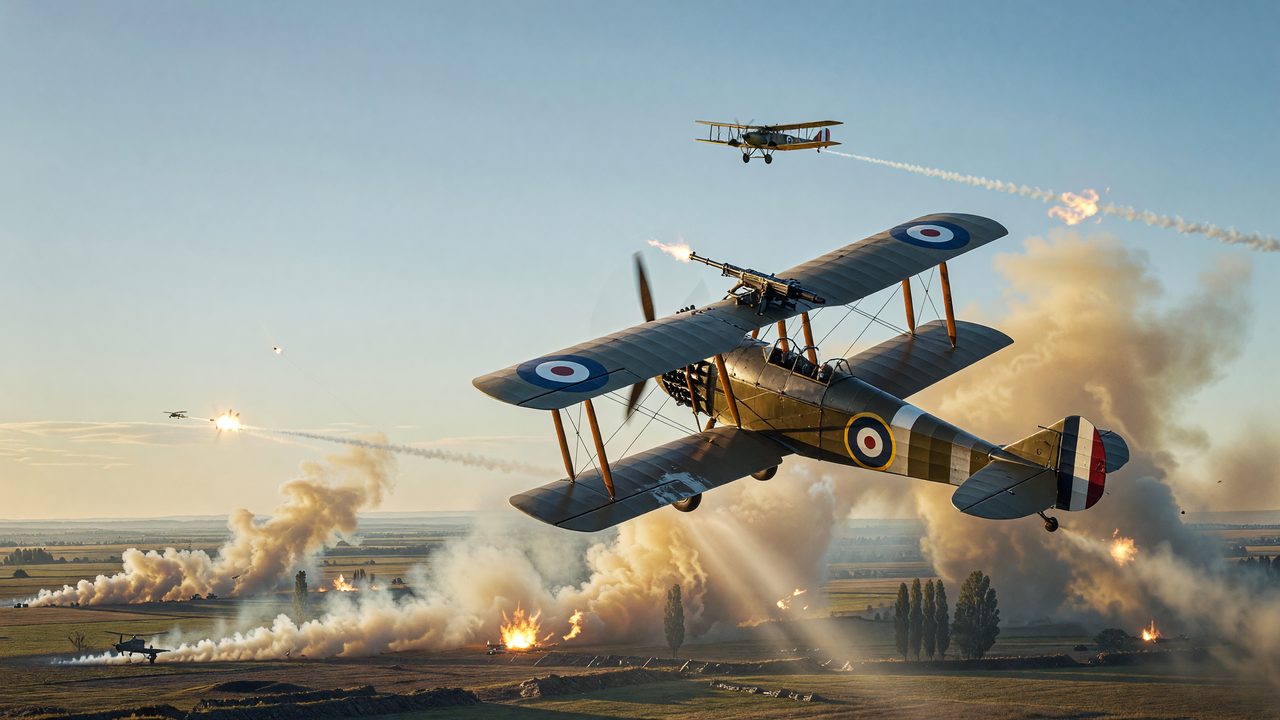
Pilots who had wrestled the Sopwith Camel’s gyroscopic torque often described the S.E.5a as almost sedate on the controls, yet that very steadiness made it a superb gun platform. The Camel could flick into a killing turn; the S.E.5a could be driven down at high speed without the wing failures that haunted aggressive dives in lighter, more temperamental types. Armament reinforced the design philosophy. A fixed Vickers machine gun fired through the propeller arc, synchronized to chew a predictable line ahead of the nose. Above the upper wing, a Lewis gun rode on a Foster mounting that let a pilot slide the weapon to a vertical position for reloading—and, more importantly, to angle fire upward while stalking from below, raking an enemy’s belly where armor and self-sealing tanks were thinnest. It was an unglamorous tactic, but it converted stability into hits.
Production never moved as smoothly as the airframe flew. Early Hispano-Suiza deliveries lagged, and squadrons waited while engines sat in crates. The Wolseley Viper—a reliable licence-built derivative—finally eased the bottleneck and kept front-line units supplied. By the Armistice, 5,205 S.E.5 and S.E.5a fighters had been built, equipping more than twenty British squadrons on the Western Front and beyond. Among the pilots who mastered the type, South African ace Anthony Beauchamp-Proctor claimed fifty-four victories in the S.E.5a, the highest score any pilot achieved on the type—a record documented in squadron histories and ace databases such as The Aerodrome. Alongside the Camel, the S.E.5a helped claw back air superiority over the trenches in 1918, not by winning every turning fight, but by arriving in numbers, staying airworthy, and letting trained gunners shoot.
Why it matters to you
The S.E.5a was easier to fly than the Camel, yet many novices initially preferred the Pup’s familiar docility—or fantasized about the Camel’s legendary agility. The lesson for today’s training cockpit is the same one Beauchamp-Proctor and his squadron mates learned over the Somme: combat effectiveness often favors the platform that frees your eyes and hands for sight picture, not the one that demands constant compensation. In instrument training we call it aviate, navigate, communicate—in that order. The “boring” stability of the S.E.5a was deadlier than flashy turn rate because it let pilots keep a stable sight picture through entry, burst, and recovery. When you practice precision approaches or stabilized constant-rate descents, you are rehearsing the same advantage: a viceless, predictable aircraft does not win admiration in the hangar, but it wins the fight you actually fly.