The Sky Bridge That Fed a City
"Easter Parade"
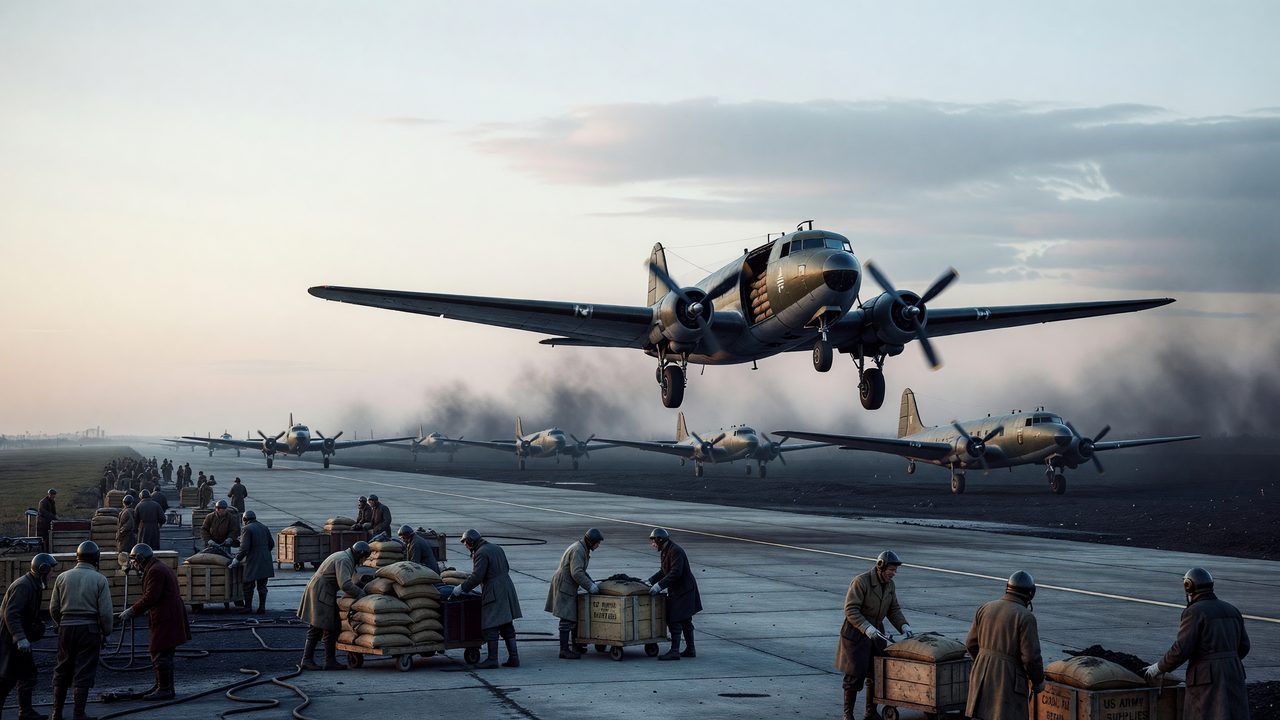
The Sky Bridge That Fed a City
When Stalin sealed Berlin in 1948, Allied pilots answered with round-the-clock logistics—and proved that disciplined flight operations could sustain two million people without firing a shot.
On June 24, 1948, Soviet forces closed every rail line, canal, and road into the western sectors of Berlin. The blockade was not a declaration of war; it was a siege dressed as “technical difficulties,” designed to starve the city until the Western Allies abandoned their currency reforms and their hold on a divided Germany. President Harry S. Truman refused to retreat. Military governor Gen. Lucius D. Clay asked whether the U.S. Air Force could deliver coal—the fuel that would keep Berliners alive through the coming winter. Lt. Gen. Curtis E. LeMay’s answer, preserved in USAFE historical accounts cited by the Allied Museum, became the operation’s creed: “We can deliver anything.” Two days after the blockade began, the first transports of Operation Vittles touched down in a city that had no other lifeline.
What followed was not improvisation but industrial-scale air transport. In August 1948, LeMay placed Maj. Gen. William H. Tunner in command of the Combined Airlift Task Force. Tunner had already mastered the brutal arithmetic of sustained air logistics over the Himalayas—the “Hump” that supplied China during World War II—and he brought that same relentless standardization to Berlin. The early Douglas C-47s gave way to the C-54 Skymaster, whose ten-ton payload quadrupled the smaller transport’s capacity and let one aircraft type set the rhythm for the entire fleet. Coal, the heaviest and most essential cargo, rode predominantly in those four-engine workhorses. British crews added Avro Yorks, Handley Page Hastings, and even Short Sunderland flying boats, which alighted on the Havel See carrying salt Berlin desperately needed. At Tempelhof—the principal American field, carved from a 1920s parade ground in the heart of the city—allied engineers laid three modern concrete runways able to absorb the pounding of an endless stream of arrivals. RAF aircraft used Gatow in the British sector. Three narrow twenty-mile corridors over East Germany remained the only routes in; aircraft stacked by altitude and interval, guided by radar and ground-controlled approach, kept the bridge open through fog, snow, and Soviet harassment.
Tunner’s genius was procedural as much as tactical. Crews were forbidden to wander far from their aircraft during turnaround; mobile canteens, weather cars, and maintenance trucks met them at the ramp. The average ground time fell to roughly forty-nine minutes—an astonishing figure for heavy transports in a combat-adjacent environment. Roger G. Miller’s Air Force history To Save a City documents how that discipline, combined with instrument procedures that allowed operations in weather that would have grounded a lesser effort, turned a desperate gamble into a reliable pipeline. By spring 1949 the airlift was moving nearly nine thousand tons per day—well above the minimum the city required to survive.
The operation’s peak came on Easter Sunday 1949, when Tunner ordered a maximum effort dubbed the “Easter Parade.” In twenty-four hours, American and British crews flew 1,383 sorties and delivered 12,941 tons—triple Berlin’s daily minimum. The message to Moscow was unmistakable: the air bridge could outlast the blockade. Joseph Stalin lifted the siege on 12 May 1949, reopening surface routes. The Allies did not declare victory and stand down. Clay kept Vittles running until 30 September 1949, stockpiling reserves so Berlin could weather a renewed closure through winter. Over eighteen months, 2.3 million tons of coal, food, and medicine reached West Berlin solely by air—an accomplishment the National Air and Space Museum rightly calls unprecedented in history. The price was measured in wreckage and grief: between sixty-five and eighty-six pilots, aircrew, and civilian workers lost their lives to weather, fatigue, and accident.
Why it matters to you
The Berlin Airlift was not a heroic exception to how professional aviation works; it was a master class in the skills you still train today. Tunner’s principles—single-type fleet standardization, strict turnaround discipline, precise spacing and flow in congested airspace, and instrument procedures that keep aircraft moving when VFR optimism would shut the operation down—are the ancestors of modern high-density IFR operations, airline hub turns, and military air mobility. When you brief a stabilized approach, respect minimums, and treat checklists and crew resource management as non-negotiable, you are practicing the same operational logic that once kept a blockaded city alive. LeMay promised delivery; Tunner and thousands of crews made it measurable, repeatable, and safe enough to sustain two million people. That is the standard professional flight operations still chase: not one perfect landing, but a system that works tomorrow, and the day after, in weather you cannot choose.