The Sky Belongs to Anyone Who Can Afford the Radio
"In August 2014, a small, carbon-fiber aircraft with an in..."
The Sky Belongs to Anyone Who Can Afford the Radio
The Bayraktar TB2 did not invent unmanned combat. It proved that lethal medium-altitude flight no longer required a superpower’s budget—and rewrote what student pilots must understand about who commands the air.
A Carbon Test on a Turkish Range
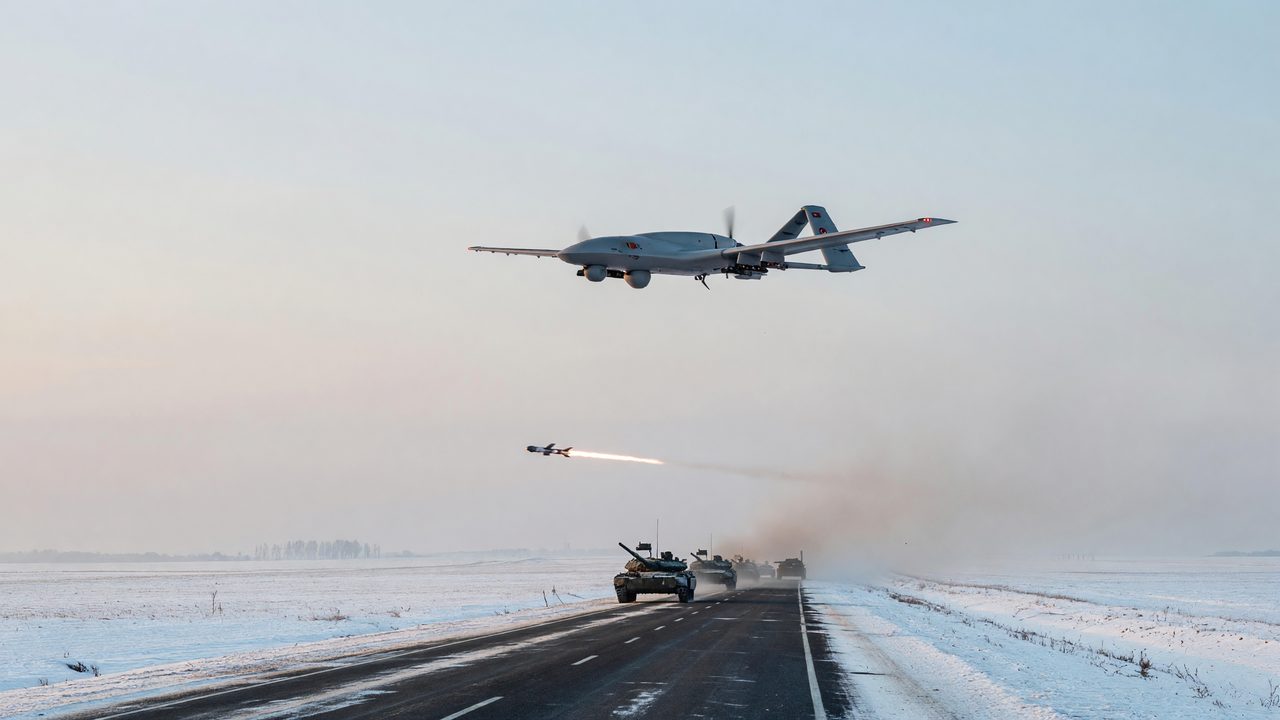
In August 2014, a small aircraft lifted from a Turkish test range on its first fully autonomous flight. The airframe was carbon fiber, the tail an inverted V, the propeller a pusher spinning aft of the fuselage. The machine looked more like an oversized model than a weapon system. That was part of the point.
The Bayraktar TB2 emerged from Baykar Makina under the technical direction of Selçuk Bayraktar, whose team had spent a decade studying battlefield lessons from Israeli and American unmanned systems. Turkey wanted an indigenous answer—not a leased platform, not a foreign dependency. The TB2 arrived barely three years after the company’s earlier TB1 had entered service, a compressed development cycle that signaled how urgently Ankara viewed unmanned aviation. Baykar delivered its first production set the same year as that maiden flight. By December 2015, test aircraft were firing Roketsan laser-guided micro-munitions, proving the sensor-to-shooter chain in live conditions.
On paper, the specifications were modest. Baykar Defense published a compact profile: a 100-horsepower engine, a twelve-meter wingspan, and four hardpoints carrying MAM-C or MAM-L smart bombs. IFRI analysts noted an operational radius on the order of 150 kilometers. HistoryNet later recorded more than 400,000 accumulated flight hours by November 2021 and endurance approaching twenty-seven hours—numbers that placed the TB2 firmly in the medium-altitude, long-endurance category without approaching the scale or cost of American MALE platforms.
Export, Not Specification, Made History
What distinguished the TB2 was not any single performance figure. It was serial production married to an export market. Nations that could not field Global Hawks or Reapers could still field eyes and triggers overhead.
Ukraine understood that early. In January 2019, Kyiv ordered twelve Bayraktar TB2 systems—a procurement decision that would read as prophecy three years later. When Russia launched its full-scale invasion in February 2022, Ukrainian TB2 crews put the aircraft to work over Kherson and along exposed road columns. Video from the conflict showed strikes on surface-to-air missile systems and armored vehicles. The drone became a public emblem of resistance, its silhouette stenciled on walls and stamped on postage stamps. A platform designed in Ankara was shaping morale in Kharkiv.
Azerbaijan had demonstrated the operational model two years earlier. During the 2020 fighting in Nagorno-Karabakh, TB2s worked as nodes in a networked kill chain, pairing their laser designation with loitering munitions to destroy tanks and artillery positions. Relatively inexpensive aircraft were dismantling expensive ground formations. The lesson was not that drones were new on the battlefield. It was that a mid-tier defense industry could produce them at scale—and sell them abroad.
Democratizing the Overhead Fight
The TB2 did not invent drone warfare. Predators and Reapers had already written that chapter. Israel’s Hermes and Heron families had refined it. What Baykar contributed was accessibility. A country need not command a global logistics tail or a trillion-dollar defense budget to hold persistent surveillance and precision strike at medium altitude.
That shift carries implications far beyond any one conflict. Air superiority once meant fleets of manned fighters and AWACS aircraft orbiting for hours. The TB2 suggested a parallel architecture: distributed sensors, smaller signatures, lower unit cost, and losses that hurt the budget less than the narrative. When one airframe went down, another could replace it. The economics favored the buyer who understood integration—linking drones to artillery, to signals intelligence, to social media information operations—as much as the buyer who understood aerodynamics.
For pilots trained in traditional cockpits, the TB2 is a reminder that the contested volume of airspace now extends from surface to medium altitude in layers, each layer owned by a different system with different rules of engagement.
Why it matters to you
The engineering choices visible in that August 2014 prototype—lightweight composite structure, an inverted V-tail for stability and packaging, a pusher propeller reducing nose obstruction for sensors—are the same families of trade-offs you encounter in modern general aviation and training aircraft. Every design balances endurance against payload, drag against cooling, and stall behavior against surveillance coverage. The TB2 simply pushed those compromises toward loiter time and target tracking rather than passenger comfort.
When you study performance charts, weight-and-balance limits, or the aerodynamics of high-aspect-ratio wings, you are reading the same physical language that made a twelve-meter carbon drone credible over Kherson. Remote pilots and manned pilots now share airspace under different certificates but under identical physics. Understanding how a medium-altitude platform stays aloft for twenty-seven hours, how it sheds ice, how it recovers from lost link, and how its operator manages energy across a long mission sharpens the judgment you bring to every hour in your own aircraft. The TB2 changed war by proving that overhead power could be manufactured and exported. It should also change how seriously you take the engineering fundamentals behind every flight, manned or not.