The Rebel Who Rewrote Desert Air Combat
"Seventeen kills in one day. No Western Allied pilot ever scored that many in twenty-four hours."
The Rebel Who Rewrote Desert Air Combat
Hans-Joachim Marseille turned North Africa into his proving ground—and proved that mastery of energy, not raw speed, could make a Bf 109 lethal beyond any textbook.
In the summer of 1940, Hans-Joachim Marseille looked less like a future legend than a pilot on the edge of a court-martial. The twenty-year-old Berliner arrived in the Battle of Britain with superb natural reflexes and a temperament that clashed with everything the Luftwaffe expected. He loved American jazz, chafed at parade-ground discipline, and collected reprimands the way other pilots collected victories. His early combat record was thin and costly. By the time he left the Channel front, Marseille had survived engagements that might have ended the careers of more cautious men—but he had not yet found the war he was built to fight.
That war waited in North Africa. Transferred to I./JG 27, Marseille joined a fighter wing operating over the Western Desert’s vast horizons and blinding light. Here, against British Commonwealth squadrons flying Hurricanes and Spitfires, the restless lieutenant finally aligned talent with opportunity. Unit records and casualty reports preserved in the World War II Database document his steep climb from promising novice to the wing’s dominant scorer. The desert offered room to maneuver, repeated daily contact with experienced opponents, and a culture within JG 27 that—under the mentorship of veterans such as squadron leaders who valued results over regulation—gave Marseille space to refine an intensely personal fighting style.
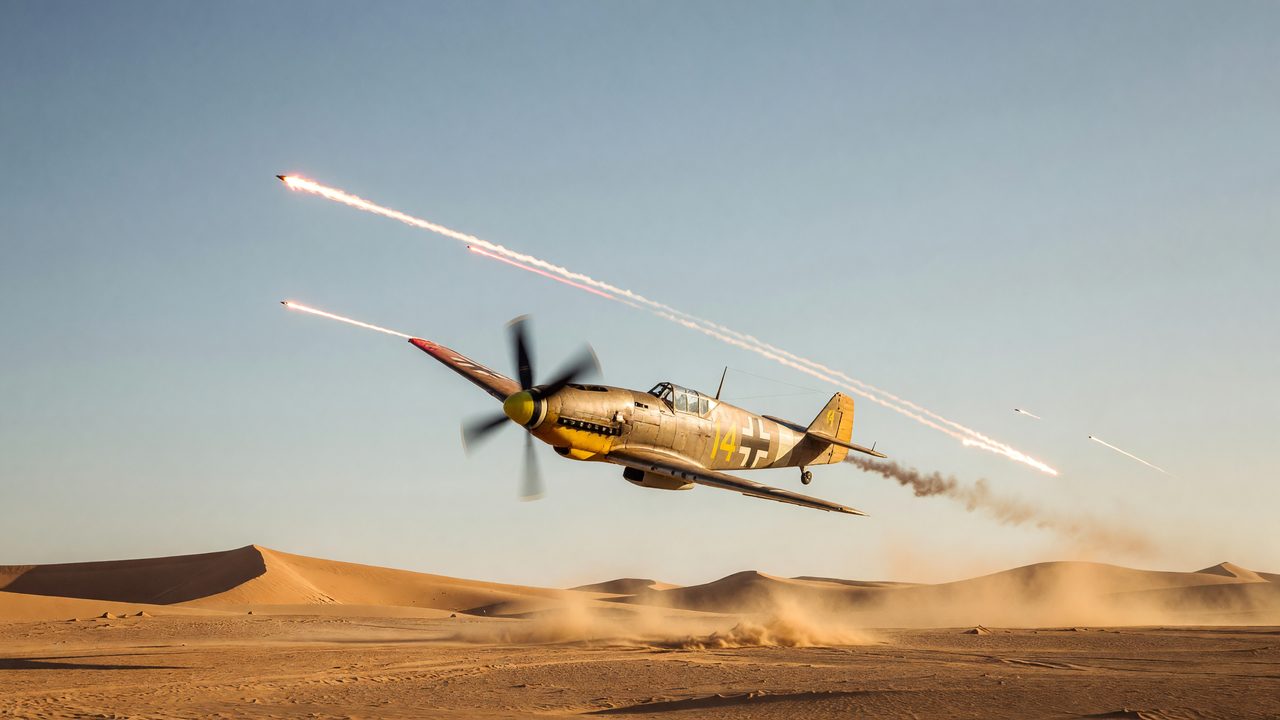
His mount became one of the most recognizable fighters of the war: a Messerschmitt Bf 109F-2 bearing the yellow nose and the number “14” that identified his aircraft across the African front. Century of Flight’s ace chronology records the statistical arc that followed. Marseille did not win by diving through formations in textbook slashing attacks. He specialized in high-deflection shooting—leading targets at angles where most pilots saw only a blur of wings and sand—and in maneuvers that traded the 109’s straight-line speed for a tighter turning radius at the critical moment. He would reduce power and deploy flaps to pull inside an opponent’s turn, holding sight picture long enough to place bursts where the enemy’s flight path and his own converged. It was audacious, energy-expensive work that demanded precise judgment of closure rate, angle off, and the brief window before a slow, flap-burdened fighter became a sitting target.
The numbers eventually spoke for themselves. On 1 September 1942, Marseille claimed seventeen Allied aircraft destroyed in three sorties—a single-day tally without parallel in the Western Desert campaigns and one of the most extraordinary daily scores recorded on the Western Front. His confirmed victory total reached 158, all but seven scored against British Commonwealth forces, making him the most successful ace of the Western Front in World War II. Fellow pilots and ground crews nicknamed him the “Star of Africa,” a title that appeared in contemporary accounts and later historical treatments, including Colin D. Heaton’s The Star of Africa: The Story of Hans Marseille (Zenith Press, 2012), which draws on unit documentation and survivor testimony to reconstruct both his combat methods and his off-duty reputation as a charismatic, undisciplined celebrity within the Afrika Korps fighter community.
Marseille’s brilliance burned with terrible brevity. On 30 September 1942, shortly after taking off from Fuka, his Bf 109’s engine caught fire—likely from mechanical failure rather than enemy fire. He bailed out at low altitude, but his body struck the aircraft’s vertical stabilizer. He fell to the desert floor without his parachute fully deployed. He was twenty-two years old. German unit records noted the loss immediately; Allied pilots who had faced him across the turning fights above the Sahara recognized that a singular adversary was gone.
Why it matters to you
Marseille’s throttle-and-flaps combat technique works as a cautionary lesson in energy management, not a template to copy. In a modern training airplane, abruptly slowing below corner speed with full flap at high angle of attack bleeds energy you may never recover; stall/spin awareness and load-factor limits exist because that exact mistake still kills pilots. What made Marseille an exception was not the maneuver itself but the precision behind it: he knew exactly how much speed to sacrifice, for how many degrees of turn, against which opponent, at which range—then he exited before he became the slow, predictable target. That is the transferable skill. Whether you are flying a Cessna 172 on a slow-flight check or briefing a high-deflection intercept in an advanced trainer, the question is the same: do you understand your aircraft’s energy state well enough to spend it deliberately and buy it back before someone else cashes in? Marseille spent it like a master. Most pilots who try without his eye for geometry, timing, and exit planning merely donate altitude, airspeed, and options to the other cockpit.