The Physicist at the Arm Controls
"She went to space with a Stanford PhD and a five-person crew."
The Physicist at the Arm Controls
Before Sally Ride flew, NASA’s astronaut corps looked like a test-pilot club. Her Stanford doctorate and a six-day shuttle mission changed who belonged in the crew quarters—and what they did once the payload bay doors opened.
A New Kind of Astronaut
When Sally K. Ride reported to Johnson Space Center in 1978, she arrived as a physicist, not a fighter jock. NASA’s official biography records a Stanford Ph.D. and research in astrophysics and free-electron laser physics—credentials that would have disqualified her a decade earlier, when the agency recruited almost exclusively from military test-pilot ranks. That year marked a deliberate break: NASA opened the corps to scientists and engineers who could operate experiments, satellites, and the shuttle’s Canadian-built Remote Manipulator System. Ride was one of thirty-five candidates in the Class of 1978, six of them women. She earned her place through the same selection boards and the same brutal training syllabus as everyone else. Gender made headlines; physics made the cut.
The shift rewrote the idea of “crew quarters.” Challenger’s middeck and flight deck were designed for mixed teams of pilots and mission specialists sleeping, eating, and working shoulder to shoulder on flights lasting a week or more. A Stanford researcher in that chain of bunks and lockers signaled that the orbiter was no longer a military cockpit with passengers attached—it was a flying laboratory whose crew included people whose primary job was to manipulate hardware outside the spacecraft.
STS-7: Complexity at the Controls
On June 18, 1983—two decades after Valentina Tereshkova became the first woman in space—Challenger lifted off on STS-7 with five astronauts aboard, the largest shuttle crew NASA had yet flown. NASA’s history office describes the mission as the most complex shuttle flight attempted to that point. Commander Robert L. Crippen, pilot Frederick H. Hauck, and mission specialists Ride, John M. Fabian, and Norman E. Thagard faced a crowded timeline: deploy two commercial communications satellites, operate experiments, and conduct the first retrieval of a Shuttle Pallet Satellite using the robotic arm.
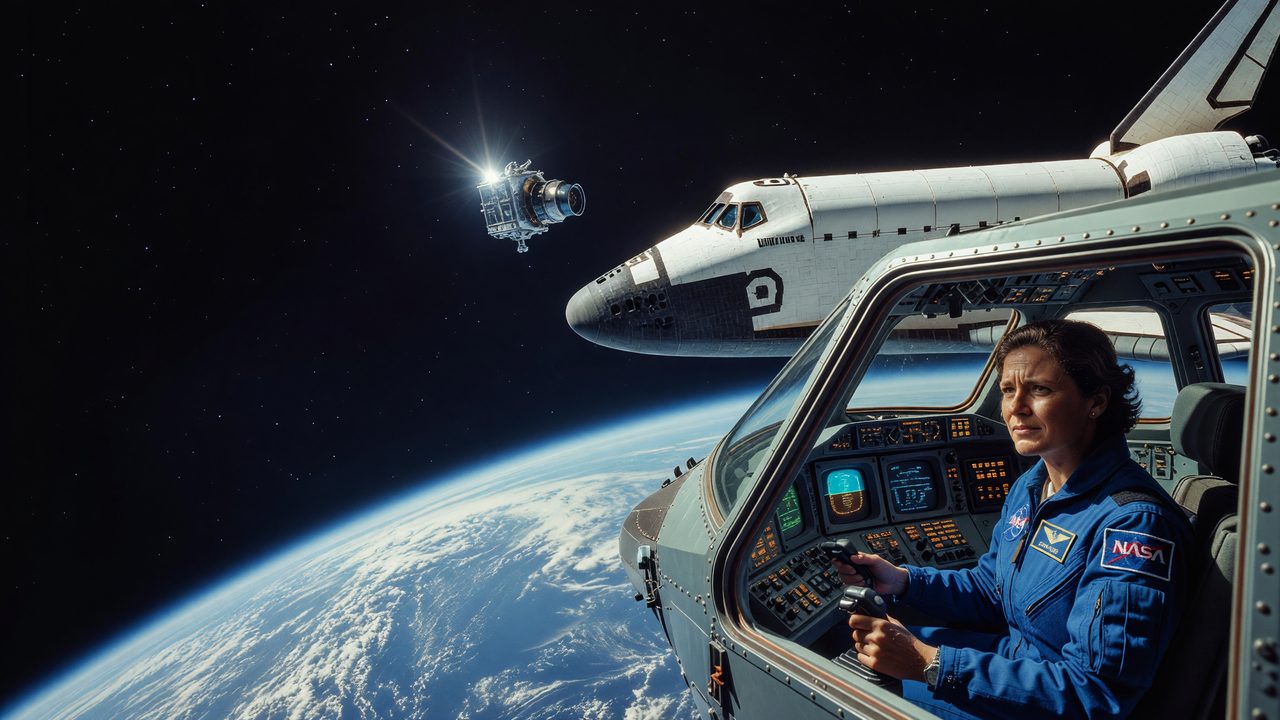
Ride’s assignment put her at the RMS controls. Working with Fabian, she helped deploy the SPAS-01 pallet satellite, then used the arm to capture it again after the free-flyer had circled Challenger and photographed the orbiter against Earth’s curve—the first such in-orbit portrait of the shuttle. For six days the crew proved that precision remote operations were not a pilot-only skill. A mission specialist with a science background could translate joystick inputs across time delay and mechanical slop into clean captures and deployments—a lesson that would outlive the shuttle program itself.
From Orbit to Investigation
Ride flew again in October 1984 on STS-41G, another five-person Challenger mission that added Earth-observation and refueling demonstrations to her flight time. She might have flown more, but on January 28, 1986, Challenger broke apart seventy-three seconds after launch. President Ronald Reagan appointed the Rogers Commission to investigate. Ride served on that board, bringing orbital experience to questions of hardware, process, and organizational culture. Nearly two decades later, after Columbia was lost during reentry in February 2003, NASA again convened an independent accident investigation. Ride joined the Columbia Accident Investigation Board—the only person, according to agency records, to serve on both shuttle disaster investigations. She understood the vehicle from the inside and the institution from the review table.
A Lasting Trajectory
Ride left NASA in 1987 and spent years at Stanford and in public outreach before founding Sally Ride Science, an organization dedicated to keeping girls engaged in science and engineering. She died on July 23, 2012, at age sixty-one, with her partner of twenty-seven years beside her. The first American woman in space had long since become something larger: proof that the right qualifications for crew quarters were competence, training, and temperament—not a single demographic template left over from the Mercury era.
Why it matters to you
Ride’s RMS work on STS-7 established a template pilots still train against in spirit, if not in hardware: translating a remote vehicle’s movement into precise outcomes while your own platform moves beneath you. Satellite servicing, cargo berthing at the International Space Station, and increasingly capable remotely piloted aircraft all demand the same disciplined scan—monitor the effect of each input, anticipate lag, and resist the urge to overcorrect. Whether you are flying a crosswind landing or practicing stabilized approaches, the core skill is identical: separate intention from execution, work the system deliberately, and trust that mastery belongs to whoever puts in the reps—not to whichever seat they happened to inherit. Ride proved that at the end of a fifty-foot arm in low Earth orbit. Modern flight training asks you to prove it every time you touch the controls.