The Phantom That Refused to Be One Thing
"In 1953, McDonnell Aircraft lost the Navy's Day Fighter Competition to the Vought F8U Crusader."
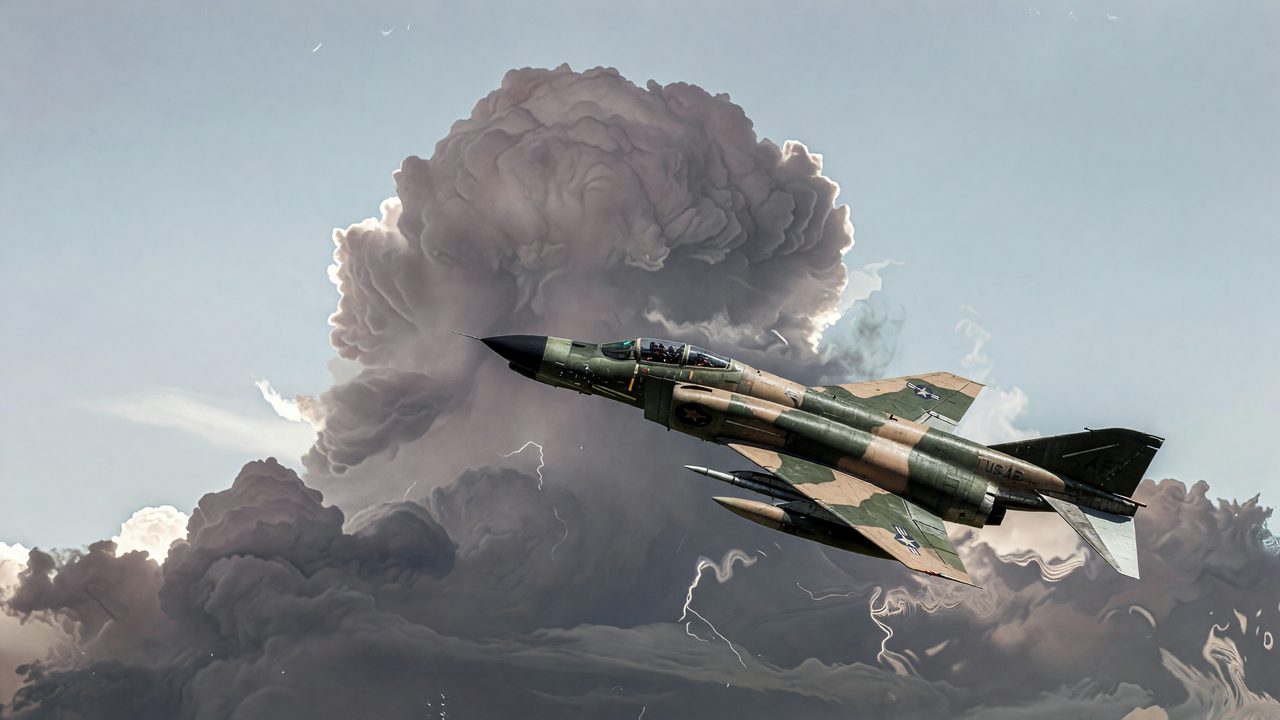
The Phantom That Refused to Be One Thing
McDonnell’s F-4 was never beautiful, never specialized, and never quite what anyone ordered — yet it became the most successful Western supersonic fighter ever built.
Listening Before Drawing
In the early 1950s, carrier aviation faced a hard question: what should replace the fighters already wearing out on deck? Herman Barkey, chief engineer on what would become the McDonnell F-4 Phantom II, did not retreat into a drafting room to guess. According to development accounts preserved in the American Aviation Historical Society Journal (Vol. 53, No. 2, Summer 2008) and the Heatblur F-4E manual’s historical background — which traces back to a Navy Bureau of Aeronautics Letter of Intent from 1954 — Barkey and his team went directly to the fleet. They talked to Navy pilots and maintainers up and down the waterfront. The answer came back with blunt consistency: the next airplane had to do everything.
On 18 October 1954, the Navy issued McDonnell a Letter of Intent for two prototype aircraft. What emerged was not a tidy single-seat gunfighter. The design matured into a two-seat, all-weather interceptor built around radar-guided AIM-7 Sparrow missiles — and, in its earliest conceptual form, no internal cannon at all. The prototype, designated F4H-1, lifted off on its first flight on May 27, 1958. It was angular, muscular, and visually awkward. Pilots and ground crews noticed immediately. As Naval History Magazine observed in “A Highly Visible Phantom” (August 2003), the airplane’s appearance was impossible to ignore — and rarely admired.
Records, Then a Fight Over Ownership
The Phantom did not need beauty to prove itself. In a concentrated burst of flight-test achievement, it claimed fifteen world aviation records. On December 6, 1959, it reached an altitude of 98,556 feet — a number that still signals how far jet performance had leaped in a single generation. McDonnell had built an airframe and propulsion package that could climb, accelerate, and carry weight in combinations no previous carrier fighter could match.
That success drew attention far beyond the flight line. Secretary of Defense Robert McNamara, pursuing commonality across the services, pushed a reluctant U.S. Air Force to adopt the Navy design. In 1962 the type entered Air Force service as the F-4C. Aviation-History.com’s survey of McDonnell Douglas history, drawing on René Francillon’s corporate chronicle McDonnell Douglas Since 1920, frames the Phantom as a case study in interservice politics as much as engineering: one airframe, two cultures, and a procurement fight the airplane ultimately won by simply performing.
Vietnam Taught What Missiles Could Not
Combat over Southeast Asia exposed a design assumption the fleet would not forgive. Sparrows and Sidewinders were the future — until they were not. In close, swirling dogfights, early missiles failed at rates that stunned aircrews. Without an internal gun, Phantom drivers improvised. SUU-16 gun pods hung under fuselages as a field fix, but they were heavy, draggy, and clumsy compared with a properly integrated weapon. The lesson was expensive and unmistakable: beyond-visual-range theory and close-in survival are not the same problem.
The Air Force’s F-4E answered with an internal M61 Vulcan cannon — a direct engineering response to combat data, not to peacetime doctrine. The Phantom that went to war as a missile platform came home, in its most enduring variant, as a fighter that could still bite at knife-fight range.
One Airframe, Many Missions
If Vietnam corrected the Phantom’s armament, it never narrowed its mission set. The same basic airframe served as fleet interceptor, strike aircraft, reconnaissance platform, and Wild Weasel suppressor of enemy air defenses. It carried the U.S. Navy, Marine Corps, and Air Force through decades of Cold War tension. Eleven allied nations flew it. The Blue Angels and the Thunderbirds both chose it as their public face — a remarkable vote of confidence for an airplane nobody ever called pretty.
More than 5,195 Phantoms rolled off McDonnell’s lines, making it the most numerous Western supersonic fighter ever produced. Long after its silhouette stopped dominating carrier decks and NATO ramp space, the type’s influence persisted in every discussion about multirole design: one aircraft, many tasks, traded off against weight, complexity, and crew workload.
Why it matters to you
Barkey’s method — ask the people who will fly and fix the airplane what it must do, then build for that reality — is still the foundation of useful cockpit design. Modern training reinforces the same split the Phantom learned in Vietnam: missiles and datalinks excel at range, but close-in maneuvering still demands gun-discipline, sight picture, and energy management you cannot outsource to a pod bolted on late. When you brief a mission profile today, you are practicing the Phantom’s central wager: versatility has a cost in weight and systems, but specialization can cost more when the fight arrives in the wrong corner of the envelope. The ugly airplane that did everything left that engineering habit in the fleet — and in the way you are taught to think about what your aircraft is actually for.