The Night They Turned On the Lights
"On 31 October 2000, from the same launch pad at Baikonur ..."
The Night They Turned On the Lights
On 2 November 2000, three men crossed a hatch and began a human presence in orbit that has not stopped since—a shakedown cruise that turned a bare assembly of modules into the first permanent home in the void.
From Gagarin's Pad to a New Threshold
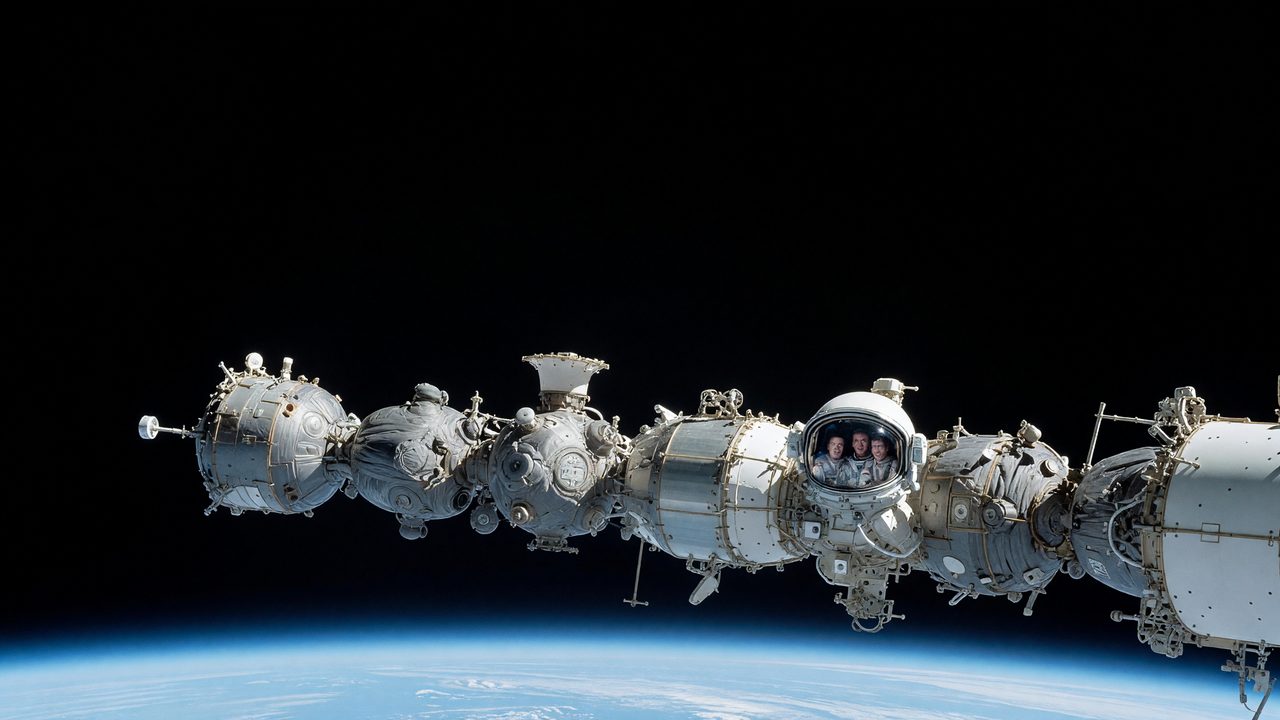
At approximately 2:53 a.m. Eastern time on 31 October 2000, a three-stage Soyuz rocket rose from the Baikonur Cosmodrome in Kazakhstan—the same launch complex from which Yuri Gagarin departed nearly four decades earlier on humanity's first orbital flight. Aboard the capsule were Expedition Commander William Shepherd of NASA, Soyuz Commander Yuri Gidzenko of Roscosmos, and Flight Engineer Sergei Krikalev of Roscosmos. Two days of rendezvous maneuvers followed. On 2 November, Gidzenko guided the Soyuz to the aft port of the Zvezda Service Module. Ninety minutes after docking, Shepherd opened the hatch. The crew stepped inside the International Space Station and, in that moment, inaugurated what NASA would later describe as continuous operation of the world's first truly international space laboratory.
What they entered was not yet a laboratory in any comfortable sense. According to NASA's research office, the station at the start of Expedition 1 consisted of the U.S. Unity node and the Russian Zarya and Zvezda modules—less than 200 cubic meters of pressurized volume, roughly the space of a one-bedroom apartment, powered by only about three kilowatts. Previous shuttle logistics flights had left clothing, laptop computers, cables, and electrical gear aboard, but the complex remained, in practical terms, an unfurnished outpost on the edge of Earth's atmosphere. Shepherd, Gidzenko, and Krikalev had four months to make it livable.
A Crew Built for Firsts
The men who undertook that task carried credentials no ordinary voyage could demand. Shepherd, a U.S. Navy captain making his fourth spaceflight, became the first American to command a long-duration station mission. Before his crew assignment, he had served as deputy space station program manager and led the redesign of the troubled station effort—he knew the hardware's history because he had helped reshape its future. Gidzenko, a lieutenant colonel in the Russian Air Force on his second flight, had commanded the Mir space station across a 179-day mission and understood the rhythms of sustaining life inside a Russian orbital hull. Krikalev arrived with 484 days of spaceflight already logged across four previous missions, making him the world's most experienced space traveler at the time. He also held a distinction no one else could claim: he had already visited this station once, having flown aboard Space Shuttle Endeavour on STS-88 in December 1998 to help mate Zarya and Unity during the initial assembly flight. When he crossed the hatch in November 2000, he became the first person to board the ISS twice.
Shepherd and Krikalev had trained together for nearly five years; Gidzenko joined the crew in 1997. Their partnership would be tested not in dramatic emergencies but in the patient work of activation—exactly the kind of operational discipline NASA's October 2000 press kit emphasized as the mission's central purpose.
Making a Home in Hardware
The Expedition 1 agenda read like the checklist for commissioning a ship that had never before sailed with a permanent crew. In their first weeks aboard, the trio activated Zvezda's computers, the Vozdukh air-purification system, the Elektron oxygen generator, and a water supply that produced drinking water as a byproduct of oxygen generation. They set up sleeping quarters, unpacked supplies, and established communications with flight controllers in Houston and Korolev, outside Moscow, using Russian systems in Zarya and Zvezda and early U.S. S-band equipment in Unity. They outfitted the Crew Health Care System, the station's onboard medical bay, and installed exercise hardware delivered on the preceding shuttle flight.
The work did not stop at life support. During their stay, the crew hosted three visiting space shuttle missions that delivered the station's large U.S. photovoltaic arrays and, in February 2001, the Destiny laboratory module. They also received and unloaded two unmanned Russian Progress resupply vehicles (M1-4 and M-44). In December, Gidzenko and Krikalev conducted an internal spacewalk inside Zvezda's transfer compartment, repositioning a docking probe to prepare for future assembly. Shepherd, cross-trained for the activity, monitored from inside. By the time Expedition 2 arrived aboard Space Shuttle Discovery during the STS-102 mission in March 2001, the cluster of modules Shepherd's team had inherited had become a functioning home—one that could hand off the watch without leaving orbit empty.
Science in the Skeleton Station
Research during Expedition 1 was deliberately modest in scope yet foundational in purpose. NASA records show the crew worked on approximately 50 science and technology investigations, many devoted to documenting the station's acceleration, vibration, and acoustic environments and to studying the crew's physiological adaptation to weightlessness. Experiments ranged from protein crystal growth and Earth photography to treadmill studies measuring how exercise affected both human bodies and the fragile structure around them. The Plasma Kristall-3 investigation, a collaboration between German and Russian institutions, examined how charged dust particles form crystal lattices in microgravity—work that would continue across the station's lifetime. Crew health monitoring also began in earnest, including early studies of viral shedding that later informed understanding of health risks on long-duration missions.
As NASA's research integration office later noted, Expedition 1's greatest scientific accomplishment was not any single experiment but the proof that sustained inquiry could proceed aboard a platform still growing, still vibrating with the tremors of its own assembly, still learning what it meant to be a laboratory at 17,500 miles per hour.
Why it matters to you
The legacy of that October launch from Baikonur reaches into every cockpit where pilots train today. Expedition 1 was, at its core, a commissioning flight: three specialists from two nations activating unfamiliar systems under time pressure, cross-checking one another's work, and maintaining situational awareness inside an environment that did not forgive assumption. That is crew resource management in its purest form—the same discipline airline and military crews practice when handing off an aircraft, running abnormal procedures, or coordinating across language and cultural boundaries. The station's early vibration and physiology studies also foreshadowed how aviators learn to manage human performance under stress: understanding how environment shapes the body, how exercise and rest interact with complex machinery, and how meticulous documentation of a vehicle's behavior prevents small anomalies from becoming catastrophes. When you brief a flight, run a checklist, or brief a partner on an unfamiliar panel, you are exercising the same operational muscle Shepherd, Gidzenko, and Krikalev flexed when they turned on the lights aboard humanity's first permanent address in orbit—and proved that international crews could live, work, and survive together in the endless night.