The Mooney M20: Speed Baked Into the Airframe
"The Johnson Bar: proof that steam locomotives and retractable gear speak the same language."
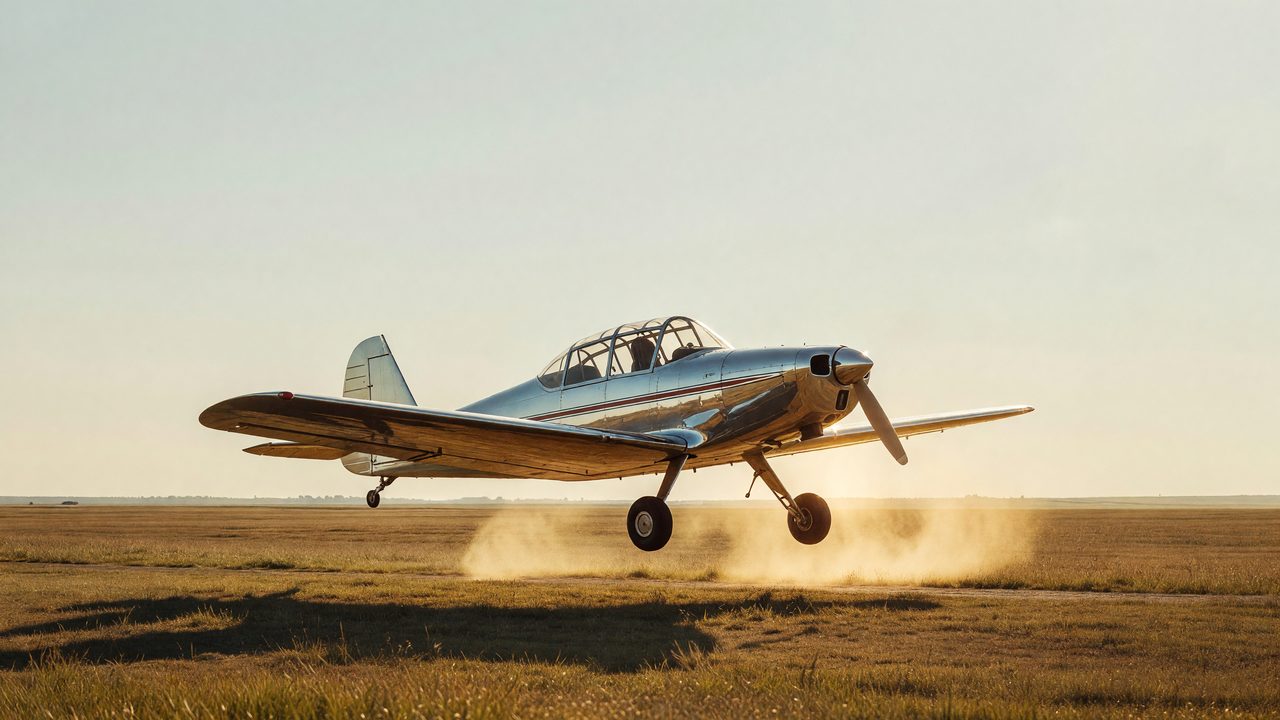
The Mooney M20: Speed Baked Into the Airframe
How a Kerrville four-seater turned 150 horsepower into 170 mph—and kept doing it for seven decades.
A twentieth design that finally clicked
Albert Mooney had been sketching airplanes since the 1920s, but by early 1953 his single-seat M-18 Mite was winding down and his company was packing for Kerrville, Texas. With the move came room to finish what would become his twentieth—and most enduring—design. The M20 lifted off on September 3, 1953, a low-wing, four-place monoplane with tricycle gear and a silhouette that looked fast sitting still.
Certification took longer than the flight test program. On August 24, 1955, the Civil Aeronautics Administration issued Type Certificate (Aircraft Specification) No. 2A3, approving the Model M20 as a four-place, landplane in the Normal Category. Mooney International Corporation technical publications and serial-number records trace the lineage from that first approval forward through dozens of letter-suffix variants. Plane & Pilot Magazine’s M20 chronology places the type squarely at the postwar moment when private pilots wanted cross-country capability without surrendering every knot to drag.
Horsepower modest, performance not
The original M20 paired a 150-horsepower Lycoming O-320 with a airframe disciplined enough to reach roughly 170 miles per hour. In 1955 and 1956, that pairing was the talk of the ramp: competitors often needed more displacement or more fuel to match the cruise. Mooney sold only ten airplanes the first year and reportedly lost money on each one, yet the formula was right. Production climbed through the late 1950s as word spread that the airplane was both economical to feed and unwilling to loaf in the flight levels.
Those earliest ships carried wooden structure in the wings and tail—a weight-saving choice that would soon give way to harder lessons about moisture, rot, and airworthiness directives requiring metal replacements in many surviving tails. The wooden era did not last long.
From wood to aluminum, and a lever with a past
In January 1960, Ralph Harmon left McDonnell Aircraft in St. Louis to run Mooney engineering. He insisted on aluminum wings and tail surfaces; by year’s end the all-metal M20B was flying. The transition was swift and permanent. Harmon’s metal M20C and its descendants refined control-surface travel, cooling, and gross weight while preserving the family’s signature swept vertical fin and tight fuselage lines.
Mechanically, early retractable-gear Mooneys announced themselves the moment you slid into the left seat. Instead of a crank or an electric switch, the pilot reached for a long manual lever—the “Johnson bar”—to raise and lower the main gear. The name came straight from railroad vocabulary: on steam locomotives, a Johnson bar was the hand lever that set the valve gear for forward or reverse motion, latched in detents and meant to be worked positively, with one hand, under load. Al Mooney, who had grown up around industrial machinery and railroad idiom, borrowed the term for an aviation control that behaved the same way. Pull, push, feel the detents, confirm the position. No ambiguity.
Three runs, one stubborn idea
Bankruptcy, new owners, and recessions interrupted manufacturing more than once, yet the M20 refused to disappear. Serial production unfolded across three distinct runs—roughly 1955 through 1971, 1974 through 2008, and again from 2014 until the line went quiet in 2019—with more than 11,000 airframes completed in all. Along the way the letters changed: Ranger, Super 21, the 201, turbocharged 231 and Bravo, Ovation, Acclaim. Horsepower rose, cabins stretched, avionics glassed over. Roy LoPresti’s drag-reduction work on the M20J “201” turned the same basic mold into a syllabus entry for efficiency tweaks. Through every iteration, the premise held: a clean, stiff, lightly built airplane rewards pilots who fly it precisely.
Why it matters to you
If you have never flown a Johnson-bar Mooney, the lesson is still worth carrying into any retractable-gear checkout. The mechanism is manual, positive, and unforgiving of neglect: you are the actuator, the latch, and the backup system. That demands the same discipline railroad engineers brought to a reversing lever—verify the detent, confirm the indication, and never assume the gear is where you last left it in your mind. Modern trainers teach electric and hydraulic retraction with checklist flows and red-over-green logic; the Johnson bar adds kinesthetic memory. Your hand learns weight and travel; your eyes cross-check the panel and, when available, the view through the wheel wells. Whether you fly a glass-panel Ovation or a Cherokee with a simple handle, the Mooney’s railroad-born lever is a reminder that landing gear is a flight-control system, not a convenience. Fly the airplane all the way to the tiedown, and let the history make you a sharper systems pilot.