The MiG-21 Fishbed: The Soviet Century's AK-47
"Fishbed-C,"
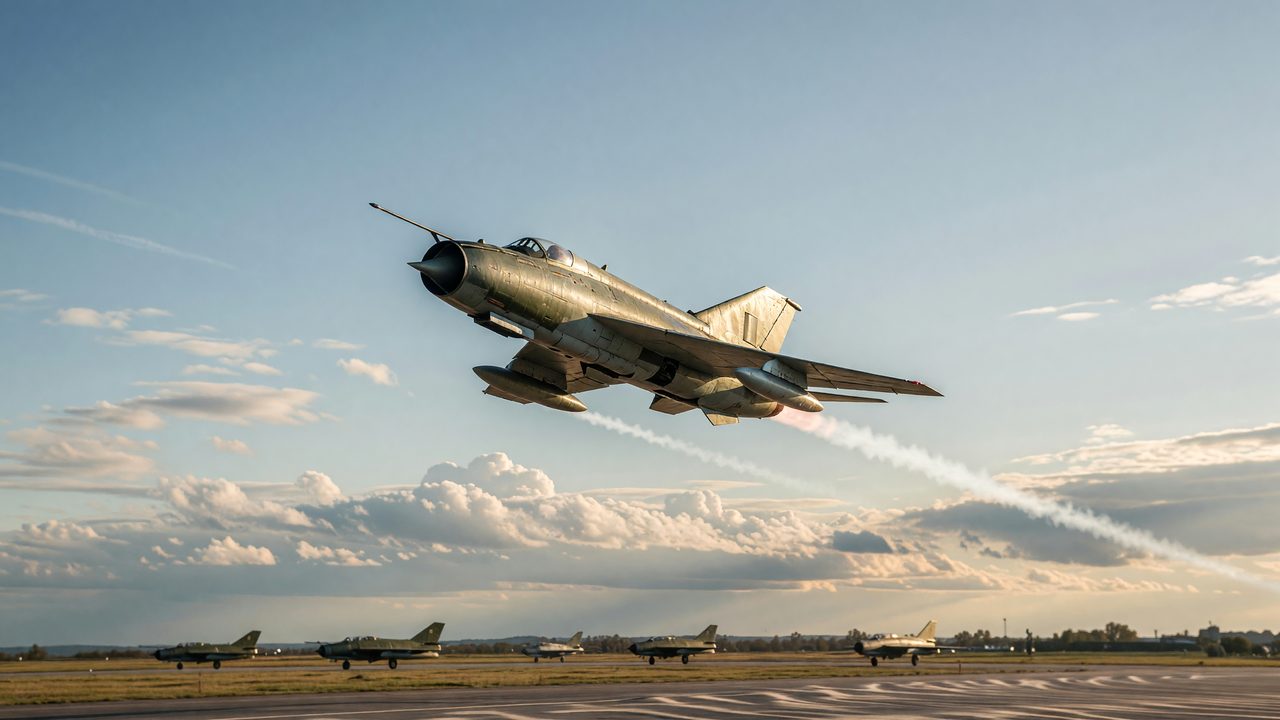
The MiG-21 Fishbed: The Soviet Century's AK-47
More than eleven thousand copies of one supersonic fighter left Soviet factories and license lines across four continents — and the design choices inside that airframe still shape how pilots think about speed, weight, and energy today.
In the spring of 1953, the Soviet state issued a requirement that read like a dare: build a lightweight day fighter that could reach Mach 2 without bankrupting the treasury or the pilot training pipeline. The Mikoyan-Gurevich design bureau answered with a lineage of experimental machines. The Ye-1 proved the concept; the Ye-6, which first flew in 1958, refined it into something the Voenno-Vozdushnye Sily could actually deploy. Production deliveries to Soviet front-line units began in the fall of 1959. Within a decade, a silhouette that would become as recognizable as a Kalashnikov receiver was crossing international borders by the crate.
NATO called the early production variant Fishbed-C. The MiG-21F-13 was a study in deliberate austerity. A single Tumanskii R-11F-300 turbojet with afterburner drove the aircraft. A sharp nose intake swallowed the supersonic airflow through a hydraulically actuated centerbody cone — the kind of variable geometry that TsAGI wind-tunnel work had made practical for sustained supersonic cruise. The wings were cropped deltas, each fitted with a single fence to tame spanwise flow at high angles of attack. The MiG-21F-13 had one internal NR-30 cannon (60 rounds) plus two underwing hardpoints for K-13 (AA-2 Atoll) missiles. According to Jane's All the World's Aircraft and MILAVIA specification tables, takeoff weight hovered near 7,100 kilograms, and at 40,000 feet the Fishbed could touch Mach 2.05. The CIA's English translation of the MiG-21F-13 flight manual, Instruction GK-021B, Book III, preserves the Soviet engineers' own language for operating that envelope — a document that reads less like poetry and more like a contract between metal and mathematics.
Minimalism bought reach. The Fishbed was cheap to build, cheap to maintain relative to contemporary Western fighters, and cheap enough to export by the hundreds. Licensed production in China, Czechoslovakia, and India multiplied Soviet output until the global fleet exceeded anything the West had fielded in the supersonic age. AirVectors.net, drawing on Mikoyan OKB records, traces how the basic cell evolved without abandoning its skeleton: the MiG-21PF added radar and a heavier nose; the MiG-21PFM introduced blown flaps to tame landing speeds; the MiG-21bis capped the line with the more powerful R-25-300 engine, an improved RP-22 radar, and look-down engagement capability against low-flying targets. Each increment stacked capability onto a fuselage that never pretended to be spacious.
The wars followed the production numbers. MiG-21s sparred over North Vietnam, dueled in Middle Eastern skies, swept across African bush battlefields, and carved contrails over South Asia. The type was not a gentle teacher. Its delta wing bled energy in sustained turning flight; pilots who clung to the habits of lighter subsonic trainers found themselves hanging on the hook while an adversary repositioned. Cockpit ergonomics were famously hostile — switches buried in logic only a factory test pilot could love, sight pictures that punished inattention, and a flight control philosophy that demanded respect rather than sympathy. Yet in skilled hands the Fishbed remained lethal. Vietnamese and Arab air forces proved that numbers, discipline, and ground-controlled intercept could turn an austere airframe into a serious threat against more sophisticated opponents.
No other supersonic fighter has been built in such quantity or deployed across so many conflicts. The MiG-21 was the AK-47 of the jet age: not the finest instrument in the orchestra, but the one you heard everywhere.
Why it matters to you
The MiG-21's lesson is not nostalgia — it is physics you still fly. That 1953 requirement for a lightweight Mach-2 fighter forced Soviet engineers to trade comfort for performance: a variable intake cone for stable supersonic airflow, a delta planform for structural efficiency at speed, and a power-to-weight budget that left no room for forgiveness. Modern training aircraft and personal airplanes inherit the same arithmetic. When you manage energy in a steep turn, judge whether you can outclimb terrain, or respect that a clean airframe at altitude behaves differently than the same ship down low, you are applying the same discipline Fishbed pilots learned the hard way. The MiG-21 did not reward hope. It rewarded pilots who understood their aircraft's limits before the fight — and that remains the difference between a sortie and a statistic.