The Man Who Wrote the Rules of the Sky
"The professor who wrote the syllabus of the dogfight"
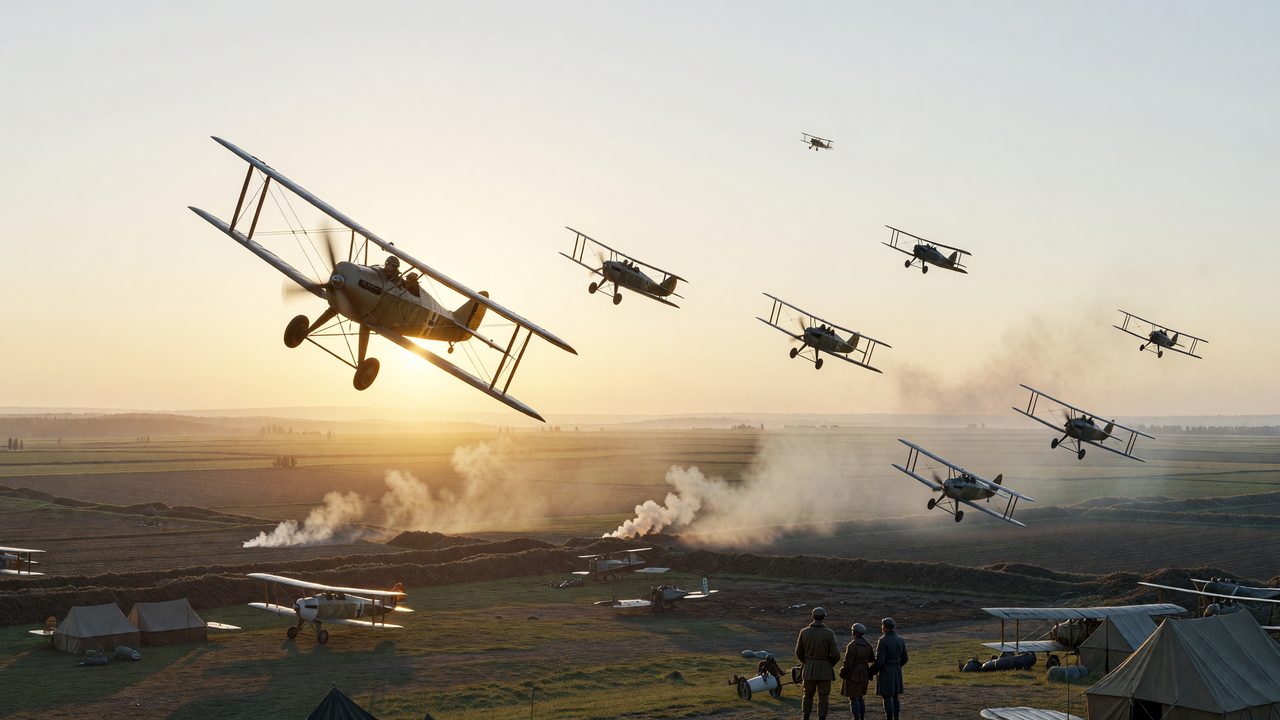
The Man Who Wrote the Rules of the Sky
Before fighter schools, squadron doctrine, or NATO tactics manuals, one German captain turned aerial improvisation into a written code—and changed combat aviation forever.
Born on 19 May 1891 in Giebichenstein, near Halle in Saxony, Oswald Boelcke was the fourth of six children in a schoolmaster's household. Athletic and restless, he entered military service through a telegraph battalion and officer training at the Kriegsschule in Metz in 1911 and received his commission in 1912, assigned to a telegraph battalion. When war loomed, he pushed into aviation and earned his pilot's badge roughly two weeks after hostilities opened in August 1914. His early war, recorded in An Aviator's Field Book, was the work of a reconnaissance pilot in two-seaters—often with his brother Wilhelm in the rear cockpit—mapping trenches and reporting artillery fire. It was useful, disciplined flying. It was not yet the calling that would make his name immortal.
That calling arrived in 1915. Posted to Feldfliegerabteilung 62 near Douai, Boelcke encountered another rising pilot: Max Immelmann. Both men mastered the Fokker Eindecker, among the first fighters to carry a forward-firing machine gun synchronized with the propeller. In the spring and summer of 1915 they hunted together over the Western Front, each victory sharpening a shared instinct that raw courage was not enough. When both reached eight confirmed kills, they became the first aviators awarded the Pour le Mérite, in January 1916. Germany's highest military honor had gone to soldiers and sailors; now it went to men who fought in the third dimension.
By then Boelcke was already thinking like an instructor. Immelmann preferred personal rivalry to theory, but Boelcke pressed for something more durable: written guidance that any pilot could apply. During the summer of 1916, while serving on staff and helping reorganize Germany's air arm, he distilled his combat experience into the Dicta Boelcke—eight concise rules that transformed scattered tricks into doctrine. Attack only after securing an advantage, and when possible keep the sun at your back. Carry an attack through once begun. Fire at close range, with the enemy squarely in your sights. Watch your opponent constantly; do not be fooled by ruses. Strike from behind. If attacked from above, do not turn away from a lesser foe—meet the threat head-on. Never forget your line of retreat over hostile territory. And fight as a unit: attack in groups of four or six, and do not crowd the same target. Johannes Werner, whose 1933 biography drew on family papers, preserved these dicta as the first systematic fighter manual any air force issued—two years before Britain and France produced comparable documents.
In August 1916 the German High Command acted on Boelcke's broader vision and authorized dedicated fighter units, the Jagdstaffeln. Boelcke received command of Jasta 2 and the rare privilege of choosing his own pilots. Among them was a young cavalry officer, Manfred von Richthofen, not yet famous but intensely observant. For six weeks Boelcke drilled his men in the Dicta by day and proved them in combat by night—or rather, whenever the weather over the front permitted. He raised his personal score to forty victories, making him Germany's leading ace at the time of his death. More important, he built a school. Jasta 2 would become one of the war's most lethal squadrons, its alumni spreading Boelcke's methods across the Luftstreitkräfte.
On 28 October 1916, that school ended in an instant. After a minor mid-air collision with another German aircraft damaged the upper wing of his Albatros, Boelcke crashed while attempting to land. He died on impact. Even his enemies recognized what had been lost. British airmen dropped a wreath over his aerodrome bearing a note: "To the memory of Captain Boelcke, our brave and chivalrous opponent." Jasta 2 was renamed Jasta Boelcke in his honor. Richthofen, who would surpass his mentor's victory tally, carried forward the tactical grammar Boelcke had taught him.
Why it matters to you
Every modern fighter pilot still lives inside Boelcke's first rule: secure the advantage before you attack. Altitude, speed, sun angle, and positioning were his currency in 1916; today they appear as energy state, radar geometry, and weapons envelope before the first missile leaves the rail. But in beyond-visual-range combat, where contacts live on scopes long before they fill a canopy, his fourth dictum may matter just as much: keep your eye on your opponent and never let yourself be deceived by ruses. Chaff, electronic jamming, formation tactics designed to mask the real shooter, and datalink-fed phantom tracks are the Great War's feints rewritten for the jet age. BVR kills are still won by pilots who establish advantage first—then refuse to be fooled while they close the shot. Boelcke never flew with radar or afterburners, yet his Dicta remain the grammar of every merge, every intercept, and every disciplined egress you will ever fly.