The Man Who Would Not Fire Past 250 Yards
"He wouldn't salute, he wouldn't bunk with officers, and he wouldn't miss—Malta's most terrifying guardian."
The Man Who Would Not Fire Past 250 Yards
George "Buzz" Beurling arrived on Malta a rejected enlistee and left as Canada's deadliest fighter pilot — by refusing to fight the war anyone else’s way.
George Frederick Beurling grew up in Verdun, Quebec, with his eyes fixed on the sky. He sold model airplanes to pay for flying lessons and earned a private pilot certificate in 1939, the year Europe went to war. When he presented himself to the Royal Canadian Air Force, recruiters turned him away — twice — citing inadequate formal education. Beurling did not wait for a third invitation. He sailed for England, found a path into wartime flying, and eventually talked his way aboard a ship bound for the most dangerous fighter station on earth.
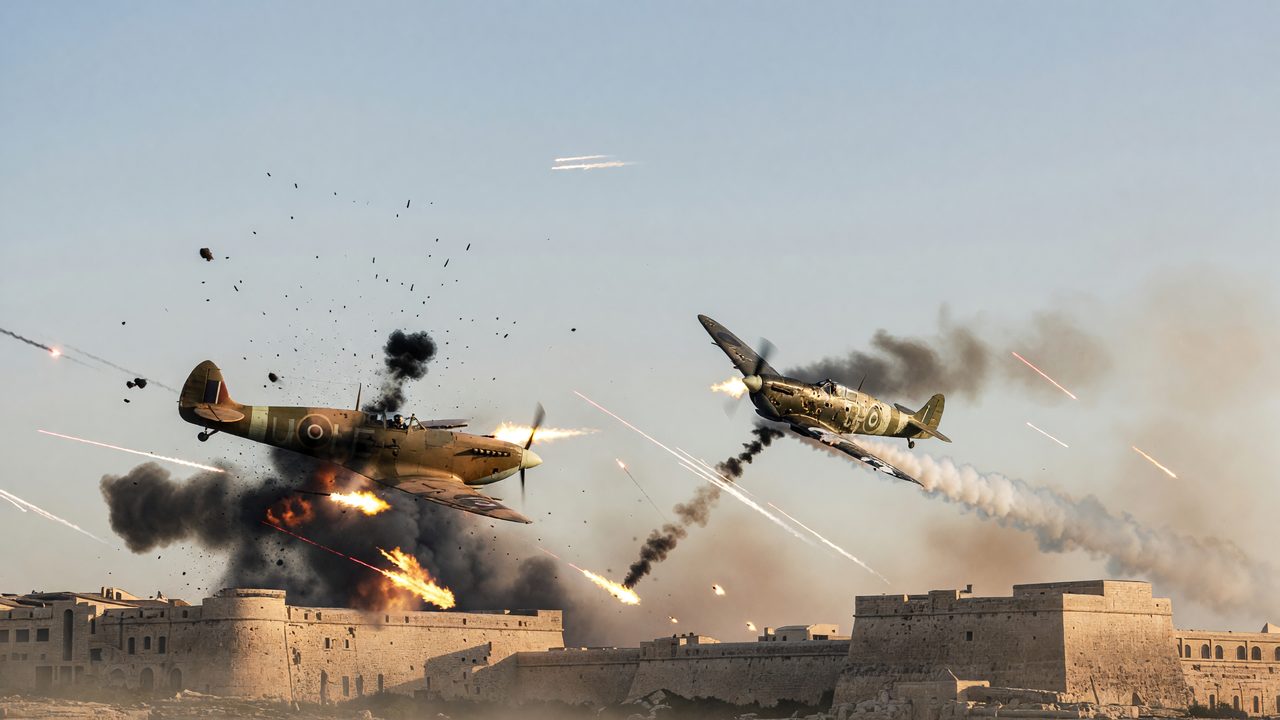
He stepped ashore on Malta on 9 June 1942. The island had been under siege for months. Luftwaffe and Regia Aeronautica bombers hammered its harbors and airfields daily. Every Spitfire that reached Malta was precious. Beurling joined an RAF Spitfire squadron and climbed into a Mark Vc — a capable machine, but one that demanded pilots who could shoot.
Close enough to matter
Where RAF formation doctrine emphasized mutual support and disciplined vic attacks, Beurling operated as a lone wolf. He broke from the gaggle, climbed to altitude alone, and waited. When enemy aircraft appeared, he did not hose the sky with long-range bursts. He held fire until he was inside 250 yards, then used deflection shooting — leading a turning target so his bullets arrived where the enemy would be, not where it had been. At that range, a two-second burst could be decisive. Beyond it, he considered shooting a waste of ammunition and a confession of poor gunnery.
The results were staggering. During a fourteen-day period in July 1942 over the beleaguered island, Beurling claimed twenty-seven Axis aircraft destroyed. Over roughly four months on Malta, the Air Force Museum of Alberta records seventeen confirmed victories — a figure that understates the chaos of confirmation procedures during the siege but still places him among the elite of the Mediterranean air war.
The Niclot Doglio fight
His most celebrated engagement came on 27 July 1942. Furio Niclot Doglio, one of Italy’s leading aces, led a formation over Malta. Beurling engaged him in a turning fight at close range and shot down Gelli and then Doglio in the same engagement. The victory announced that Beurling was not merely lucky or aggressive — he could outthink and outshoot experienced opponents in the most demanding geometry aerial combat offers.
The cost was written on his body and his record. Shrapnel wounds, dysentery contracted in primitive field conditions, and chronic insubordination marked his Malta tour. Squadron commanders valued his kills; they did not always value the pilot who produced them. Beurling was a poor soldier by barracks standards and a superb predator by cockpit standards — a distinction that followed him through the remainder of the war.
Thirty-one confirmed
Released from service in 1944, Beurling held thirty-one confirmed aerial victories — the highest score of any Canadian fighter pilot of the Second World War. He wore the Distinguished Service Order, the Distinguished Flying Cross, and the Distinguished Flying Medal. His own account of the Malta siege, written with journalist Leslie Roberts and published by Oxford University Press in 1943 as Malta Spitfire: The Story of a Fighter Pilot, remains a primary window into the daily rhythm of Spitfire operations under siege: scramble times measured in minutes, dispersals pocked by bomb craters, and gunnery practiced until the lead felt instinctive.
After the war, Beurling searched for another air force that would let him fly. He was accepted into the fledgling Israeli Air Force and was killed on 20 May 1948, while ferrying a Canadian-built Noorduyn Norseman toward the new state. He was twenty-six years old.
Why it matters to you
Beurling’s lone-wolf tactics and his refusal to fire beyond 250 yards were not recklessness — they were a deliberate rejection of the spray-and-pray habits that wasted ammunition and missed targets. Standard RAF doctrine trained pilots to fight as formations, maintaining mutual cover and engaging at ranges where volume of fire could compensate for imperfect sight pictures. Beurling inverted that logic. He accepted the risk of fighting alone because it gave him the freedom to maneuver for a single, high-probability shot. He accepted the risk of closing to 250 yards because he understood that bullets only count when lead, range, and timing align.
Modern pilots do not train for air-to-air gunnery in Spitfires, but the underlying skill endures: know your weapon’s effective envelope, do not shoot until the solution is valid, and prefer one disciplined correction over a dozen hopeful ones. Whether you are flying a traffic pattern, shooting an instrument approach, or managing energy in a training aircraft, Beurling’s lesson is the same. Precision at the right moment beats activity at the wrong distance. The Falcon of Malta did not win by firing more. He won by firing last — and firing close.