The Mach 0.935 Club
"Savannah's answer to speed and altitude."
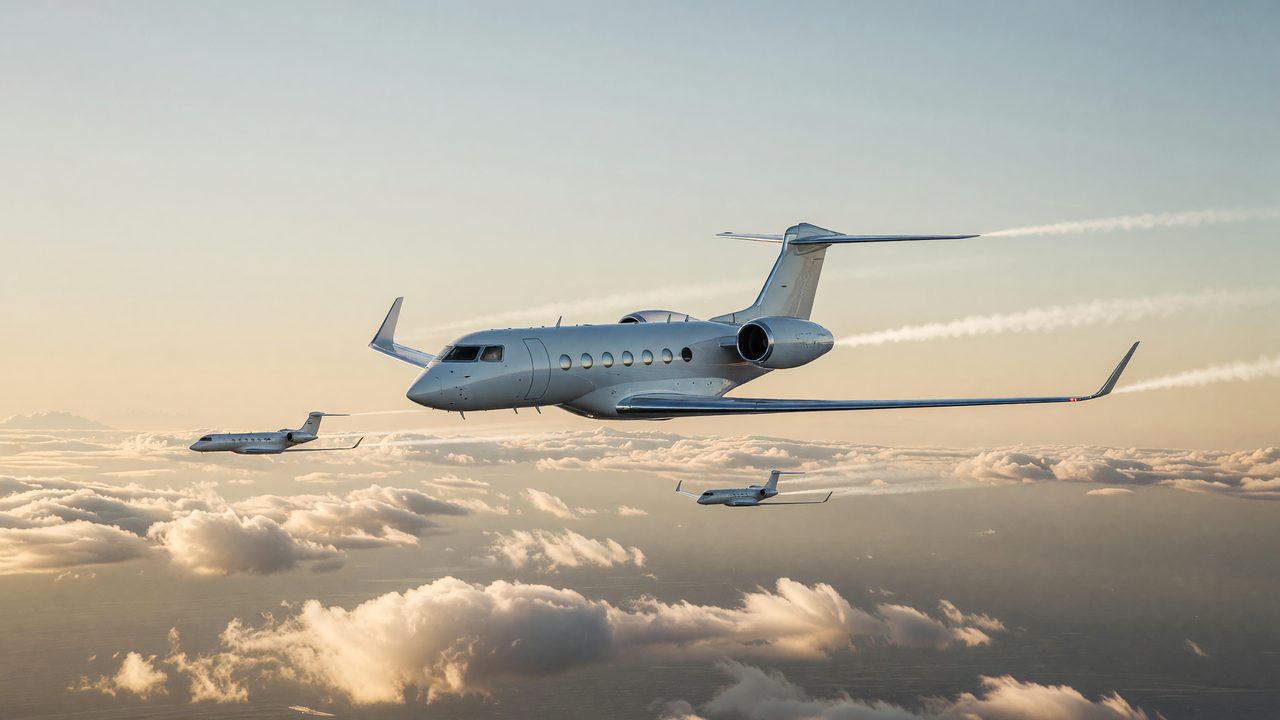
The Mach 0.935 Club
At altitudes where the tropopause thins and the sky turns indigo, a handful of civilian jets cruise closer to the speed of sound than any airliner. Gulfstream built the club—and then raised the dues.
Chasing the Holy Grail
In March 2008, Gulfstream Aerospace unveiled the G650 before thousands of employees, customers, and suppliers gathered in a new manufacturing building at Savannah. The company had spent five years on a design aimed at two numbers that had never been combined in a production business jet: Mach 0.925 and 7,000 nautical miles of range. For pilots accustomed to planning long trips at Mach 0.80 or 0.82, the target was audacious. At FL510, Mach 0.925 translates to roughly 550 knots true airspeed—fast enough to compress a transatlantic crossing by hours, yet slow enough to remain firmly subsonic.
The G650 rolled out under its own power in September 2009 and flew for the first time that November. On May 2, 2010, a test aircraft reached its maximum operating Mach number of 0.925 for the first time. The program was not without difficulty—certification took longer than planned, and the aircraft received a provisional type certificate in November 2011 before full approval arrived—but the engineering direction was clear. Gulfstream intended to make speed a product feature, not an accident of altitude.
The Benchmark Arrives
The Federal Aviation Administration issued the G650’s type certificate on 7 September 2012, verifying the airworthiness of an aircraft that Gulfstream marketed as the fastest certified civilian aircraft then in production. Power came from two Rolls-Royce BR725 engines, each producing 16,900 pounds of thrust. On 27 December 2012, Gulfstream delivered the first fully outfitted G650 to a U.S. customer, closing the loop on a program that had redefined what “fast” meant in the flight levels.
For a generation of corporate pilots transitioning from older Gulfstreams or competing large-cabin jets, the G650 introduced a new planning vocabulary. Maximum operating Mach number—Mmo—was no longer an academic limit buried in the AFM; it was a selling point printed on brochures. The aircraft could sustain Mach 0.90 over thousands of nautical miles, a capability demonstrated during flight test when one airframe flew a 5,000-nautical-mile closed circuit over the Atlantic at that speed in nine hours and forty-five minutes. Mach 0.925 became the number to beat.
Ten Feet and a Tenth of a Mach
At NBAA-BACE in October 2019, Gulfstream unveiled the G700, its new flagship. The aircraft was not a clean-sheet design but a deliberate evolution: roughly ten feet of fuselage stretch, a redesigned wing with new high-speed winglets, and a pair of Rolls-Royce Pearl 700 engines rated at 18,250 pounds of thrust each. Gulfstream retained the G650’s fly-by-wire architecture and paired it with the Symmetry Flight Deck already proven on the G500 and G600, including active control sidesticks. The result pushed maximum operating speed to Mach 0.935—one hundredth of a Mach beyond its predecessor, a margin that sounds trivial until you consider the aerodynamic and thermal demands of sustaining it at 51,000 feet.
According to Gulfstream’s published specifications, the G700 offers a maximum range of 7,750 nautical miles at long-range cruise (Mach 0.85) and 6,650 nautical miles at high-speed cruise (Mach 0.90). The stretched cabin—up to five living areas and the largest cross-section in the company’s portfolio—added weight and drag that the new wing and engines had to overcome. European regulators documented the type as the Gulfstream GVI/GVIII-G700 in EASA Type Certificate Data Sheet No. EASA.IM.A.169, confirming the aircraft’s place in a growing family of ultra-long-range jets sharing a common engineering lineage.
Records, Certification, and Delivery
The G700’s path to the ramp proved longer than initially forecast. After a certification campaign that extended well beyond the original 2022 target—delays widely attributed to heightened FAA scrutiny across the industry—the agency granted type certification on 29 March 2024. Gulfstream announced that the approval confirmed performance improvements including shorter takeoff and landing distances than originally projected. Customer deliveries followed in April 2024, with the first two aircraft handed over to U.S.-based owners later that month.
Together, the G650 and G700 families have claimed more than fifty world speed records, according to Gulfstream—a tally built on point-to-point flights between city pairs separated by oceans and continents. Each record is a logged testament to what happens when Mmo climbs and range does not retreat: Savannah to Tokyo, London to Beijing, Teterboro to Dubai, flown at speeds that shrink calendar time for the executives in the cabin and sharpen the demands on the crews up front.
Why it matters to you
You will likely never hand-fly a G700 to Mach 0.935, but the tradeoffs that created the Mach 0.935 Club are the same ones you manage every time you pick a cruise power setting. Speed costs fuel—nonlinearly, and steeply, as drag rises near Mmo. Gulfstream’s own range charts show the G700 surrendering more than a thousand nautical miles when cruise speed steps from Mach 0.85 to Mach 0.90. That is the cost-per-nautical-mile question in its purest form: how much range, and how much fuel burn, are you willing to spend for each knot gained?
Flight planning software encodes this dilemma as cost index—a dial that balances time value against fuel price. Corporate crews flying ultra-long-range jets at the top of the speed envelope live at the extreme end of that dial, where a few hundredths of Mach translate into hours saved and thousands of gallons consumed. Understanding that relationship—why a ten-foot stretch demanded a new wing before another speed record was possible, and why operators who pay for Mach 0.90 do not always fly there—prepares you to make smarter choices in whatever aircraft you fly. The number on the airspeed indicator may differ, but the physics do not.