The Long Shot: P-38s, Codebreakers, and Yamamoto
"On the one-year anniversary of the Doolittle Raid, eighteen P-38s flew 600 miles to kill the architect of Pearl Harbor."
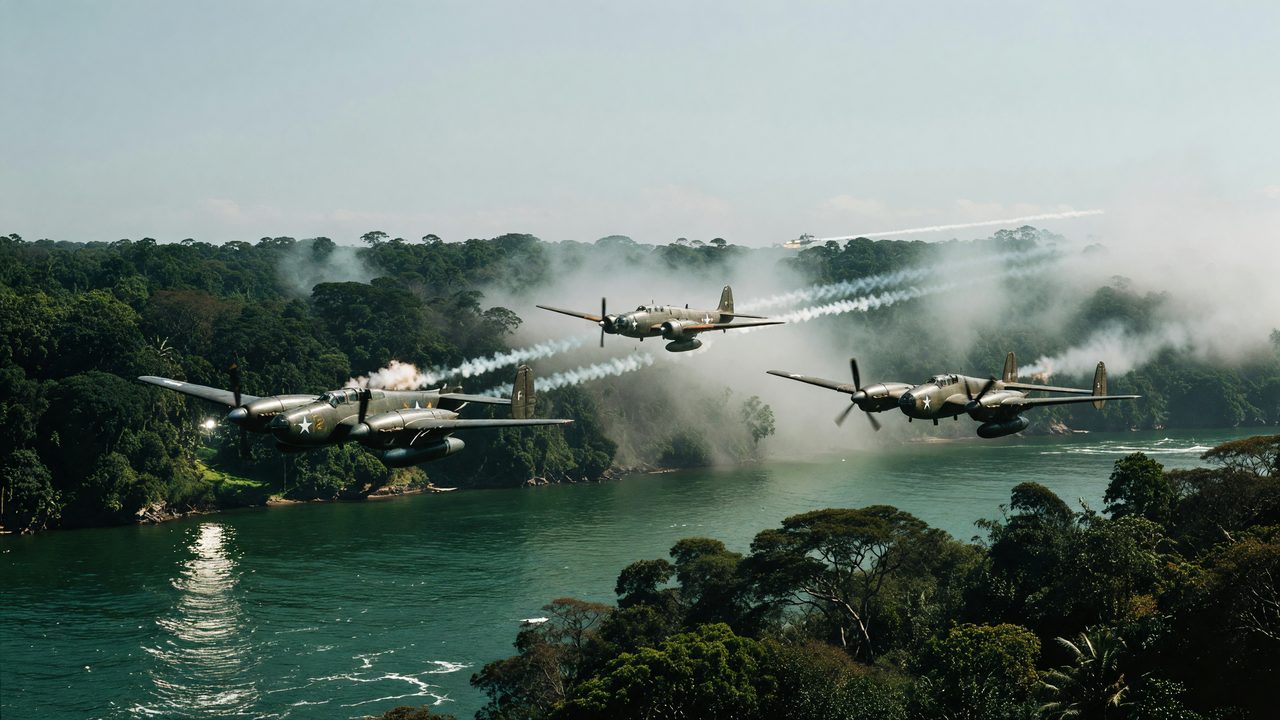
The Long Shot: P-38s, Codebreakers, and Yamamoto
When Pacific codebreakers handed American commanders the itinerary of Japan’s greatest naval strategist, only one fighter in the theater had the fuel to reach him—and the twin-engine endurance to bring its crews home across a thousand miles of open ocean.
Intelligence Becomes a Weapon
On 14 April 1943, U.S. Navy cryptanalysts decoded a detailed travel schedule: Admiral Isoroku Yamamoto, architect of the Pearl Harbor attack and commander of the Combined Fleet, would fly from Rabaul to the forward airstrip at Ballale, near Bougainville, on 18 April. The intercept was a strategic gamble. Killing Yamamoto would not win the war, but it would shatter Japanese morale and prove that American codebreaking could reach into the enemy’s highest councils. Admiral Chester Nimitz weighed the risk of exposing Magic intelligence against the opportunity, then authorized the strike. His dispatch to Admiral William Halsey, preserved in U.S. Naval History and Heritage Command records (H-018-2), turned a decoded timetable into an operational order.
Why Only the Lightning Could Go
The problem was geometry. Henderson Field on Guadalcanal lay roughly four hundred miles from the intercept point over southern Bougainville. A round trip, with fuel for combat and formation flying, demanded near a thousand miles of airborne endurance. No single-engine fighter in the South Pacific could carry enough gas. The Lockheed P-38 Lightning could. Its twin Allison V-1710 engines drank fuel independently from a central tank, giving pilots manageable balance as external stores burned off. For Operation Vengeance, eighteen aircraft of the 339th Fighter Squadron fitted oversized 330-gallon drop tanks beneath the fuselage—ferry tanks far larger than the standard 165-gallon externals—transforming the Lightning from an interceptor into a long-range assassin. A ComAirSols intelligence bulletin from 1943, held at the Air Force Historical Research Agency and analyzed in DTIC monograph ADA623450, documents how carefully planners matched fuel load, cruise speed, and time-on-target against Yamamoto’s published arrival window.
Four Hundred Miles at Wave Height
Major John W. Mitchell led the strike package airborne before dawn on 18 April. Four Lightnings turned back with mechanical trouble; fourteen pressed on. Mitchell’s navigation plan was austere and exact: run outbound at minimum altitude over the Solomon Sea, hugging the wavetops to stay below Japanese radar, navigating by dead reckoning and clock. For hours the formation droned north while coral atolls and jungle coastlines slid past at deck level. No radio chatter. No second chances. The P-38s reached the intercept point at about 0934–0935 local, roughly 25 minutes before Yamamoto’s scheduled 0800 Tokyo-time arrival at Ballale—they climbed and the Japanese formation appeared: two Mitsubishi G4M “Betty” bombers escorted by six A6M Zero fighters.
Ninety Seconds Over Ballale
Mitchell’s plan split the force. A covering element engaged the Zeros while a killer flight of four Lightnings bored in on the bombers. In the converging melee of cannon fire and tracers, both Bettys went down into the jungle. Search parties later found Yamamoto’s body still strapped in his seat, his seat belt intact, his samurai sword clutched in his hands. Whether one pilot or two delivered the decisive burst into the admiral’s aircraft remained disputed among the American aviators themselves, but the operational result was not. Japan had lost its most celebrated naval commander, and the United States had demonstrated something warfare had never seen before: the deliberate, intelligence-driven aerial killing of an individual enemy leader. The National WWII Museum’s account of Operation Vengeance frames the mission as a hinge point in how commanders thought about air power—not merely as a blunt instrument against fleets and factories, but as a precision tool guided by signals intelligence.
The P-38 was already feared across the Pacific for its speed, twin-engine survivability, and heavy armament clustered in the nose. After Bougainville, it carried something else: the proof that range and reliability could be as decisive as firepower.
Why it matters to you
Modern training treats fuel planning as paperwork. Operation Vengeance shows it as mission design. The P-38’s twin-engine layout gave Mitchell’s pilots something no single-engine fighter could offer that day: the ability to complete a four-hundred-mile over-water leg, fight at altitude, and still have margins for the return—on one engine if necessary. The oversized drop tanks were not an afterthought; they were the enabling technology, and their weight and burn sequence shaped cruise speed, climb performance, and the moment the formation could safely jettison externals before the attack. You practice the same logic on every cross-country: calculate total fuel required, identify the point of no return, and understand how configuration changes your envelope. The Lightnings that reached Bougainville did so because planners treated range as a first-class requirement, not a hope. That discipline—know your fuel, know your abort points, know what your aircraft can carry and still perform—is as non-negotiable in a training aircraft as it was over the Solomon Sea in April 1943.