The Lightest Knife in the Sky
"The only fighter of the war that made both Soviet and French pilots agree it was unbeatable below 15,000 feet."
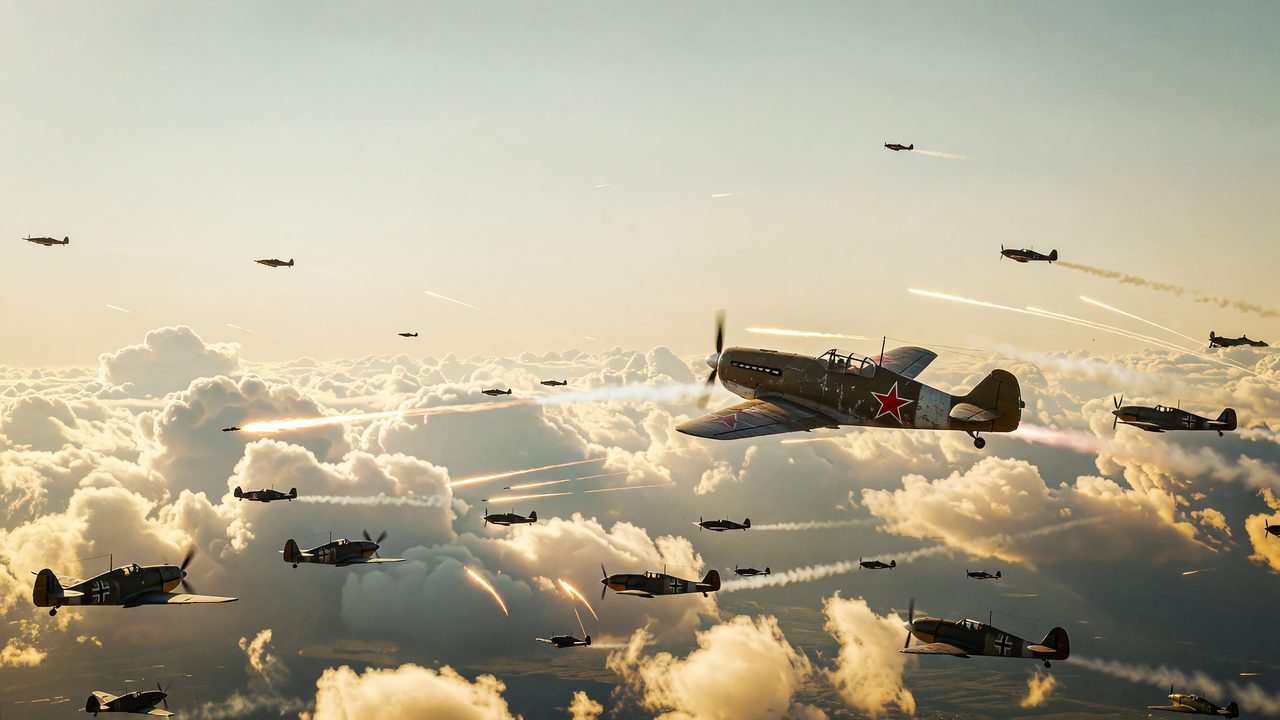
The Lightest Knife in the Sky
Alexander Yakovlev built the Yak-3 by refusing the compromises that made German fighters heavier — and frontline pilots turned that obsession into air superiority.
Weight as a weapon
By the spring of 1943, the air war over the Eastern Front had settled into a brutal arithmetic. German designers had chased speed, range, and firepower by adding guns, fuel, and horsepower — and every addition cost weight. Messerschmitt Bf 109 variants now tipped past three tonnes; the Focke-Wulf Fw 190 approached four. Soviet pilots felt the penalty in every vertical turn: the heavier machine bled energy, climbed slower, and answered the stick a beat late.
Alexander Yakovlev chose the opposite path. In December 1942, with the Kuban air battles still raging, his bureau began reshaping the Yak-1 around a single principle: maximum performance at minimum mass. The team shrank the wing from 17.5 to 14.5 square meters. Heavy wooden wing spars gave way to light duralumin ones. Radiators were buried in the fuselage and wing; the tailwheel retracted; every component faced a ruthless weight audit. The same Klimov VK-105PF engine that powered the Yak-1 would drive the new machine — but the airframe around it would weigh 300 kilograms less.
In late April 1943, Yakovlev reported the results to the State Defense Committee. Combat weight: 2,650 kilograms against the Yak-1’s 2,950. Maximum speed: 660 kilometers per hour — seventy more than its predecessor, with no engine change. Stalin reportedly asked, “How did you do it?” Yakovlev answered plainly: lighter structure, smaller wing, cleaner aerodynamics. When asked whether maneuverability exceeded the Germans’, he did not hedge. “Far better.”
What the pilots felt
Numbers on a test card rarely move a frontline squadron. The Yak-3 moved them immediately. Pilots praised its lightness at the controls, its snap roll, and its willingness to tighten a turn when an Fw 190 could only skid wide and lose speed. Yakovlev, in his memoir A Designer's Notes (Цель жизни), preserved letters from combat units that read less like technical reports than love notes to a machine that finally matched Soviet tactics.
One account from a regimental commander described Lieutenant Alexander Ershov, a twenty-two-year-old former instructor with barely a month at the front. In a single engagement, eight Yak-3s met thirty Fw 190s. Ershov reportedly sheared one Focke-Wulf’s tail with his wing, then shot down another with gunfire. The next day, flying as a pair against sixteen Fw 190s, he claimed three more. Ershov himself wrote back to Yakovlev that the Yak-3 was “unquestionably the favorite aircraft of our pilots now.” Factory director I.S. Levin, in The Fearsome Years (Грозные годы), recorded similar frontline letters — including one from a guard unit that fought outnumbered seven or eight to one in June 1944 and still destroyed seven enemy aircraft, crediting both pilot skill and the new fighter’s qualities.
Allies and adversaries agreed
The French pilots of the Normandie-Niemen Regiment had flown British, American, and French types before the Yak-3 arrived at their airfield in August 1944. François de Joffre recalled circling the new fighters with “eyes burning with admiration,” praising the view, the maneuverability, and the precision of the guns. A Normandie pilot’s published account, quoted in Yakovlev’s memoir, described the Yak-3 as a low-altitude interceptor that rarely climbed above 5,000 meters — because that was where it was supreme. Near the ground, the Yak out-turned the “Fritz”; German pilots who tried to follow tight vertical maneuvers often bled off speed and crashed trying. The implication was clear to anyone reading between the lines: Luftwaffe pilots were effectively warned to avoid low-altitude dogfights with Yaks.
With the more powerful VK-107 engine, state trials pushed speeds past 700 kilometers per hour — Levin’s factory records cite 720 km/h with the VK-107A. Yakovlev sent Stalin a model of the high-speed variant in late 1944; the dictator kept it on his desk beside other aviation trophies. Gordon and Khazanov’s bureau history, OKB Yakovlev, places the Yak-3 at the end of a family line that proved quantity production and combat agility could coexist — more than 35,000 Yakovlev fighters of all marks left Soviet factories during the war.
Built on the assembly line, not just the drawing board
Superior design meant little if the front received one Yak-3 a month. In September 1943, the State Defense Committee assigned serial production to a Saratov plant rebuilding from wartime damage. Levin organized conveyor-line assembly — wings, fuselages, fuel tanks, and final assembly moving on synchronized hourly rhythms with signal boards tracking each station. The factory ran Yak-1 and Yak-3 production in parallel without cutting total output; by July 1944, Yak-3s represented ninety-eight percent of the plant’s fighter deliveries. Labor productivity on the new type eventually improved to the point where manufacturing cost dropped sharply. The lightest fighter of the war had to arrive in hundreds, not dozens.
Why it matters to you
Yakovlev’s lesson is not nostalgia for wood-and-fabric construction — it is physics you still fly every day. Weight drives stall speed, climb rate, roll authority, and how quickly you can reverse a bad energy state. His team bought combat superiority not with a bigger engine but with disciplined mass reduction: metal spars where structure mattered, a smaller wing where excess area only added drag and inertia, and aerodynamic cleanup that let the same horsepower go farther. When you brief a flight or run a weight-and-balance sheet, you are making the same trade German designers got wrong and Yakovlev got right: every kilogram you do not need is maneuvering fuel you do not have to burn. The Yak-3 did not win because it was the fastest fighter in the sky. It won because it was the lightest where dogfights were actually fought — and in a turn, lightness is still the hardest advantage to outrun.