The Last Link: How Gemini XII Finished the Road to the Moon
"America is in space to stay."
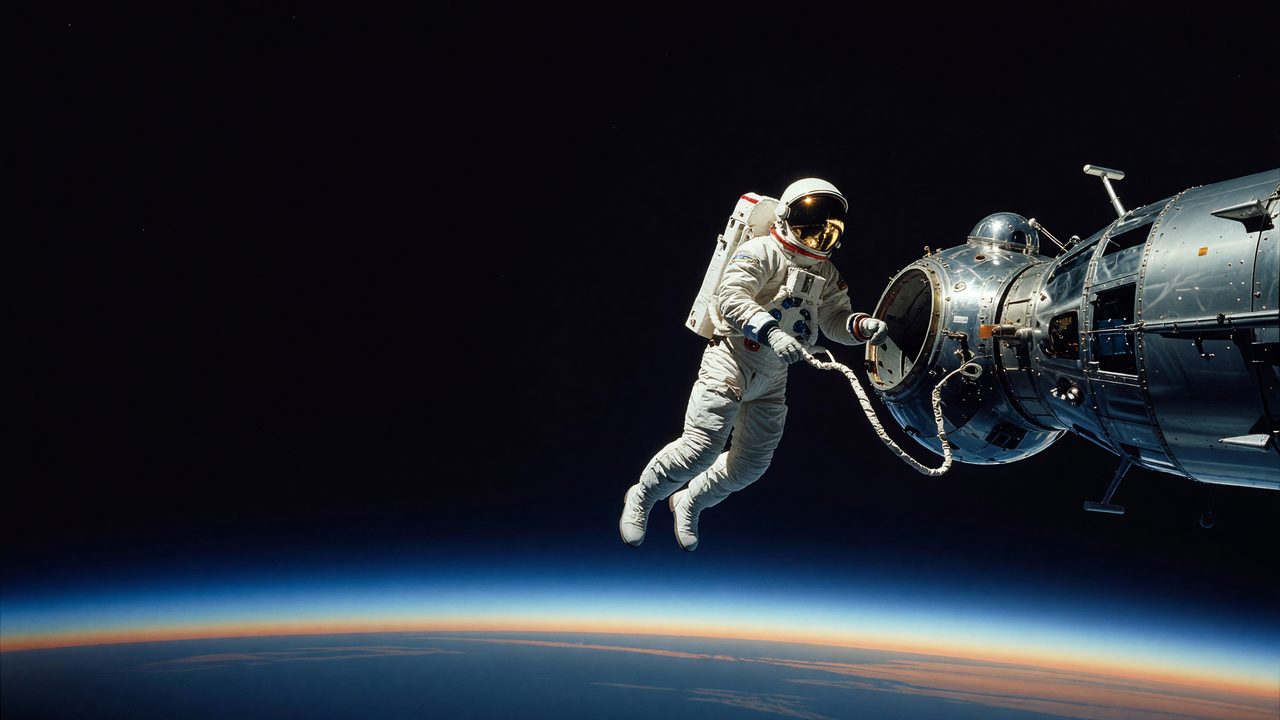
The Last Link: How Gemini XII Finished the Road to the Moon
In four days above Earth, James Lovell and Buzz Aldrin closed out Project Gemini—and proved that the hardest parts of a lunar voyage were no longer theoretical.
A Program With Everything to Prove
By the autumn of 1966, NASA had already squeezed extraordinary mileage from a spacecraft barely large enough for two men to sit shoulder to shoulder. Project Gemini existed for one overriding purpose: to answer the questions Apollo could not afford to get wrong. Could astronauts survive days in weightlessness? Could one spacecraft find another in orbit, dock with it, and fly as a single vehicle? Could a man leave his ship, work outside, and come back with enough strength and clarity to keep flying? Gemini XII was the final examination.
On November 11, a Titan II rocket lifted the tenth and final crewed Gemini mission from Launch Complex 19 at Cape Kennedy. Command pilot James A. Lovell, Jr., already a veteran of Gemini VII, shared the cramped cabin with pilot Edwin E. "Buzz" Aldrin, Jr. Their agenda was deliberately ambitious. Every technique Apollo would demand—rendezvous, docking, long-duration flight, extravehicular activity, controlled reentry—had been tested piecemeal across eleven preceding missions. Gemini XII would knit the remaining threads together.
When the Radar Faltered, the Math Held
The mission's first critical hurdle was rendezvous and docking with an Agena target vehicle already waiting in orbit. It was the maneuver a lunar mission would depend on: the Lunar Module, returning from the Moon's surface, would have to meet the Command Module in space with no room for error. On Gemini XII, the rendezvous radar behaved erratically, feeding unreliable data to the crew. Rather than abort the attempt, Aldrin fell back on procedures rooted in his doctoral research in orbital mechanics at MIT—manual computations and sight-based guidance that let the crew close the gap under their own judgment.
The docking succeeded. For Apollo planners at the Manned Spacecraft Center, that moment mattered as much as any photograph from the flight. A pilot who understood the geometry of intercept trajectories had just demonstrated that rendezvous was a skill, not merely a sensor function. NASA's later mission summary would record Gemini XII as the flight that capped the program's mastery of orbital rendezvous—the last major uncertainty struck from the lunar checklist.
Five Hours Outside the Hatch
Extravehicular activity had been Gemini's most stubborn problem. Earlier missions had left astronauts exhausted, overheated, and fighting their suits. Aldrin approached the challenge differently. Before launch, he trained extensively in neutral buoyancy—working underwater in a pressurized suit that simulated weightlessness, rehearsing each movement until it became deliberate rather than desperate. NASA's internal newsletter, the MSC Roundup, would later describe Gemini XII as closing out an achievement-packed program; Aldrin's three separate excursions, totaling five hours and forty-eight minutes, gave that claim its hardest evidence.
Tethered to the spacecraft, he installed a handrail on the Agena, retrieved experiments, and practiced the kind of purposeful mechanical work a lunar explorer would one day perform on the surface. The crew also conducted a tethered gravity-gradient experiment, letting the joined Gemini-Agena stack drift in a stable attitude, and captured ultraviolet photographs of stars above Earth's atmosphere. The message to Houston was unambiguous: a trained astronaut could work productively in the void.
Home to the Wasp
After nearly four days aloft—ninety-four hours and thirty-four minutes by the mission clock—Gemini XII turned toward Earth. On November 15, an automatically guided reentry brought the spacecraft through the atmosphere and into the Atlantic. Lovell and Aldrin splashed down just three miles from their target point, close enough that the recovery ship USS Wasp was already in sight. Precision mattered. Apollo command modules would face the same demand: arrive where the Navy expected you.
From the White House that day, President Lyndon B. Johnson declared that with Gemini's completion, "America is in space to stay." The numbers behind his confidence were concrete. In roughly twenty months, ten astronaut crews had flown twelve Gemini missions, logging nearly one thousand hours in orbit. Long-duration flight, spacewalking, rendezvous, docking, controlled reentry—each technique Apollo needed had now been flown, debriefed, and refined. The bridge was built. The Moon was next.
Why it matters to you
The legacy of that November lift from Launch Complex 19 still shapes how pilots train today. When Aldrin's rendezvous radar failed, he did not surrender the mission to malfunction—he fell back on fundamentals he had drilled until they were instinct. That is the same discipline behind partial-panel instrument flying, lost-comm procedures, and every other backup plan you memorize before a checkride: automation is a gift, not a guarantee. Aldrin's neutral-buoyancy rehearsals, meanwhile, established a principle every flight school now takes for granted—that the most dangerous tasks should be practiced in a forgiving environment before you stake your life on them. Whether you are a student nailing your first cross-country or a rated pilot refreshing on emergency flows, Gemini XII is a reminder that difficult operations yield to preparation, clear procedures, and the willingness to do the math yourself when the equipment stops cooperating.