The Invisible Wall: How Radio Echoes Saved an Island
"Great Britain is an island again."
The Invisible Wall: How Radio Echoes Saved an Island
Before Britain could win the Battle of Britain in the sky, a physicist and an Air Marshal had to prove that an aircraft could be seen without being seen — and that an island nation could defend itself again.
In the early 1930s, the question haunting the Air Ministry was not whether bombers could reach London, but whether anyone could stop them in time. Germany was rearming. Civilian aviation was shrinking the oceans. Against a fleet of unseen attackers, Britain’s fighter force looked hopelessly outnumbered. What the country needed was an early warning system — something that could reach beyond the horizon and buy precious minutes for interceptors to climb and engage.
The conventional answer was sound detection: giant concrete “sound mirrors” along the coast, crude ears straining for engine noise. They were slow, weather-limited, and nearly useless against fast, high-altitude aircraft. A bolder path lay in radio. In mid-February 1935, Robert Watson-Watt submitted a memorandum to the Air Ministry titled “Detection and Location of Aircraft by Radio Methods.” In measured prose, he argued that radio energy reflected from an aircraft might be detected and measured — not by building a death ray, as some officials had half-jokingly proposed, but by listening for the echo.
Air Marshal Sir Hugh Dowding, already shaping Britain’s future air defence, grasped the implication immediately. He authorised £10,000 for a proof-of-concept demonstration. The test had to be simple, cheap, and undeniable.
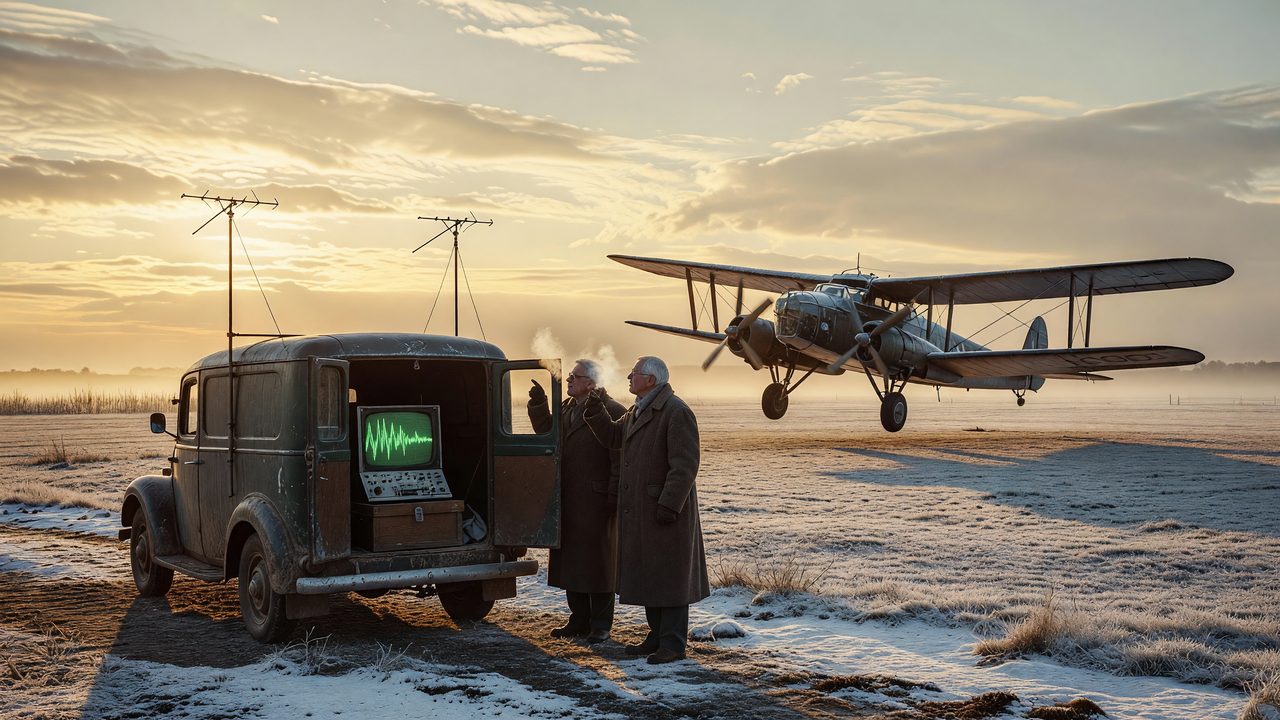
After the mid-February memorandum, Dowding and the Tizard Committee demanded a practical demonstration; on the morning of 26 February 1935, a converted Morris van stood in a field near Weedon, Northamptonshire. Inside, Watson-Watt’s colleague Arnold Wilkins watched a cathode ray oscilloscope wired to two dipole antennas. There was no bespoke transmitter. Instead, the team borrowed the BBC’s Empire Service signal from Daventry: a continuous 10 kilowatt broadcast on 49-metre wavelength, bathing the countryside in radio energy. An elderly Handley Page Heyford bomber, serial K6902, flew predetermined passes from 6,000 feet down to 1,000 feet, slicing through that invisible beam.
On the second pass, Wilkins saw it: a rhythmic beating on the trace, the aircraft’s reflected echo pulsing against the steady carrier. Detection held to roughly eight miles. Watson-Watt turned to A.P. Rowe and spoke a line that would echo through the war to come: “Great Britain is an island again.” The sea no longer meant isolation from air attack; it meant a defensible perimeter, provided you could see what was coming.
What followed was not a laboratory curiosity but an industrial sprint. Chain Home — the codename for Britain’s coastal radar chain — translated the Daventry principle into towering transmitter masts and crossed receiving arrays strung along the eastern and southern shores. Operating on metric wavelengths, the stations could not yet deliver pinpoint altitude or discriminate every friendly blip from a hostile one. That limitation mattered less than range and reliability. When war came, the network fed plots into Dowding’s Filter Room at Bentley Priory, where controllers fused radar tracks, observer reports, and radio intelligence into a single air picture. Pilots were not sent hunting at random; they were vectored onto incoming formations with minutes to spare.
During the summer of 1940, Chain Home became the invisible wall Luftwaffe crews never quite breached. German commanders underestimated what the masts meant, sometimes dismissing them as navigation hazards rather than sensors. They were wrong. Each echo on a cathode ray tube represented time — time for Spitfires and Hurricanes to climb, time for sector stations to concentrate force, time for a nation that could not afford attrition to fight on its own terms. The system was crude by modern standards, vulnerable to jamming and attack, yet it changed the arithmetic of air defence.
Why it matters to you
The engineering principles pioneered in Watson-Watt’s memorandum — transmitting energy, reading its reflection, and turning that echo into actionable position data — are still embedded in the aircraft you fly today. Your transponder answers interrogations from secondary surveillance radar. Weather radar paints precipitation by the same basic logic of transmitted pulse and returned signal. TCAS listens for replies from other aircraft to build a traffic picture when your eyes cannot. None of it is magic; it is disciplined use of radio energy, timing, and interpretation. The Daventry experiment is a reminder that situational awareness begins before you see the target — and that the pilot who understands what the box on the panel is actually measuring, and what it cannot, makes better decisions than the one who merely trusts the picture. Chain Home taught Britain to fight with information. That lesson is still the first skill of safe flight.