The Immortals: Three Airframes That Refused to Retire
"Three aircraft, three centuries of combined service, and no retirement date in sight."
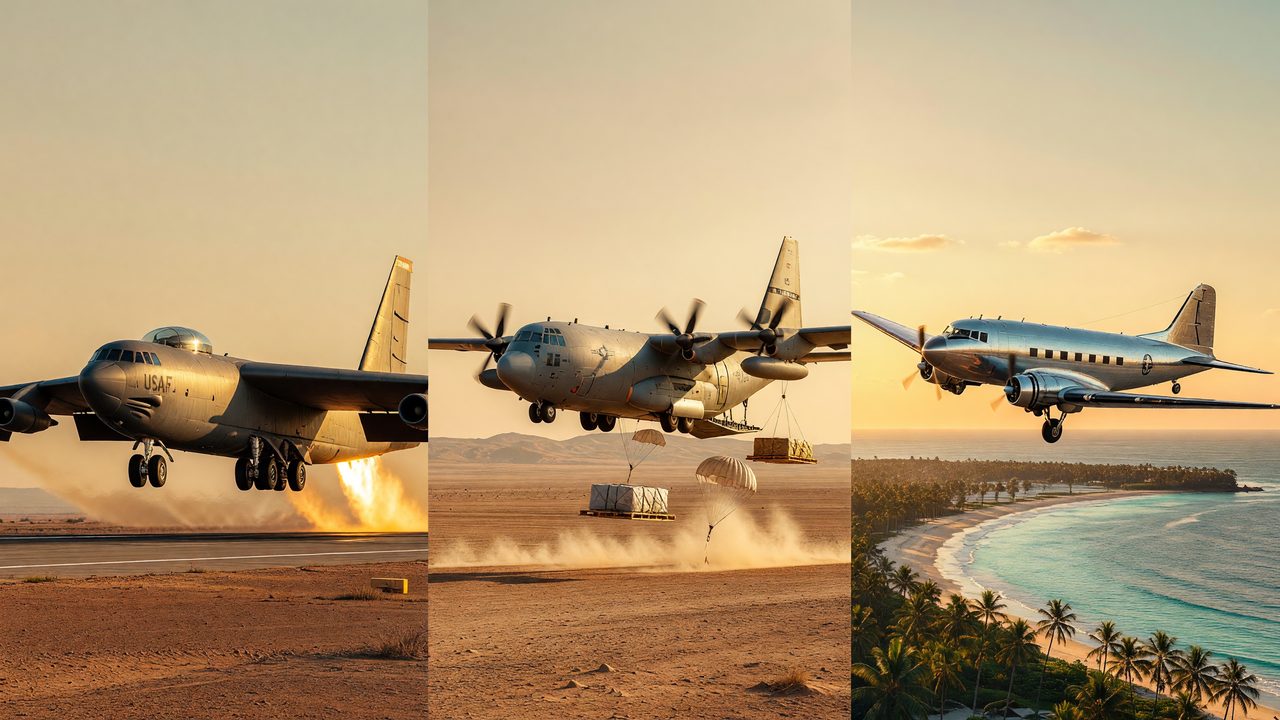
The Immortals: Three Airframes That Refused to Retire
Seventy years after the Cold War’s defining bombers and transports first took wing, the B-52, C-130, and DC-3 still earn their keep — a lesson in engineering that outlasts every replacement programme.
On 29 June 1955, a Boeing B-52 Stratofortress joined Strategic Air Command’s operational roster. The event marked the arrival of America’s long-range nuclear bomber — the aircraft that would patrol the edges of the Soviet empire for decades. Seventy years on, according to U.S. Strategic Command, the B-52’s story is not winding down but extending: Pentagon planners intend to keep the type flying into the 2050s, approaching a full century of service. The youngest B-52H airframes rolling off Wichita production lines in the early 1960s are now older than many pilots’ grandparents, yet the “BUFF” — Big Ugly Fat Fellow, in crew-room shorthand — remains a credible strategic and conventional weapon.
That longevity rests on deliberate reinvention rather than frozen design. The Air Force Nuclear Weapons Center’s current B-52H fact sheet describes a modernisation path that swaps eight ageing Pratt & Whitney TF33 turbofans for Rolls-Royce F130 engines and replaces legacy radars with active electronically scanned array (AESA) systems. The airframe that once delivered free-fall nuclear weapons over Arctic routes now carries precision-guided conventional munitions, conducts maritime surveillance, and anchors the airborne leg of the nuclear triad. Each upgrade preserves what worked — a high-wing, eight-engine layout with generous internal volume and a flight deck crews already know — while retiring what time has made obsolete.
The Lockheed C-130 Hercules entered the story slightly earlier. It first flew on 23 August 1954 and reached U.S. Air Force squadrons in 1956. Lockheed Martin’s corporate history records more than 2,500 Hercules built across more than seventy variants, making it the longest continuously produced military aircraft in history. FlightGlobal noted in July 2024 that the type remains in production seven decades after its maiden flight — a distinction no rival transport can claim. The C-130J Super Hercules, with its six-blade propellers and digital avionics, serves roughly seventy nations in roles its designers never fully anticipated: tactical airlift, aerial refuelling, hurricane hunting, and firefighting with modular retardant tanks slung into the cargo bay.
What explains such reach is adaptability baked into the original blueprint. The Hercules was conceived as a rough-field tactical lifter — high wing, rear ramp, straight-forward systems — and that simplicity invited modification. Gunships, airborne hospitals, ski-equipped polar resupply aircraft, and gunship variants all emerged from the same fuselage section. Where specialised replacements appeared, they typically served a single niche; the C-130 absorbed niche after niche and kept flying.
The Douglas DC-3 predates both military immortals and outlasts them in civilian corners of the map. It lifted off on 17 December 1935 — deliberately on the thirty-second anniversary of the Wright brothers’ first flight at Kitty Hawk — and changed commercial aviation by making scheduled passenger service reliably profitable. More than 16,000 military and civil examples left factories worldwide. The Royal Aeronautical Society, surveying the type in 2025, observed that more than eighty years after its debut, DC-3s still haul cargo and passengers along remote routes where jet economics fail and runway infrastructure never arrived. Polished aluminium examples bank over tropical coastlines; bush operators depend on them where parts interchangeability and forgiving stall behaviour matter more than cruise speed.
Together, these three platforms embody a design philosophy easy to state and hard to execute: conservative structural margins, modular mission adaptability, and engineering simplicity that tolerates incremental modernisation. None was built as a temporary stopgap. Each solved a fundamental problem — strategic reach, tactical lift, economical transport — so thoroughly that successors struggled to offer enough advantage to justify wholesale retirement.
Why it matters to you
When you study aircraft systems or walk a preflight around a trainer, you are touching the same logic that kept the B-52, C-130, and DC-3 airborne for seventy years and more. Structural simplicity is not nostalgia; it is maintainability in the field and a lower cost per flying hour. Mission adaptability — understanding why a high wing, a wide fuselage, or a rear cargo door became a fifty-year advantage — trains you to read airframes as platforms, not as fixed job descriptions. Conservative engineering margins, the habit of designing for loads and environments worse than the brochure promises, are what let an H-model Stratofortress accept new engines without redesigning every spar cap. The study hook is direct: platforms outlast replacements when the original team traded peak performance for durability, volume, and room to grow. That is a design briefing worth carrying into every cockpit you will ever occupy.