The Hour Over Portland: How a Gear Light Rewrote the Cockpit
"Resource Management on the Flightdeck,"
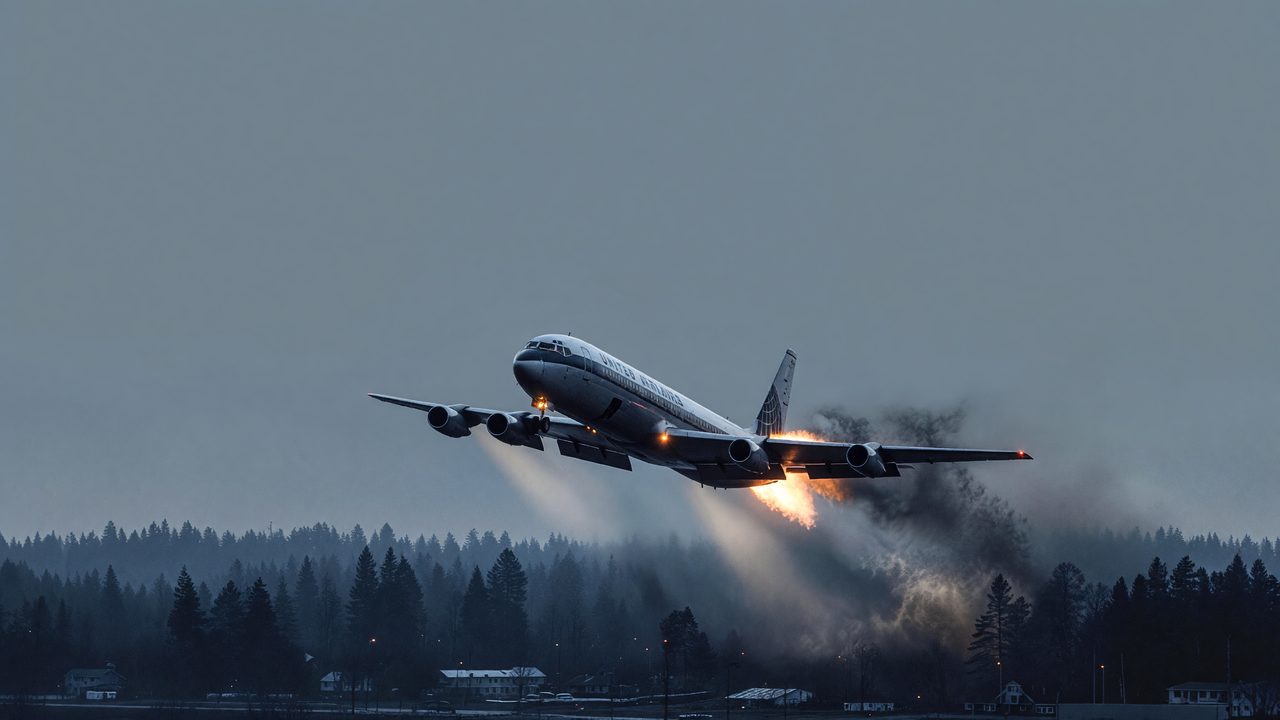
The Hour Over Portland: How a Gear Light Rewrote the Cockpit
United Airlines Flight 173 did not fall from the sky because of a broken landing gear. It fell because a crew could not speak—and a captain could not hear.
On the evening of 28 December 1978, United Airlines Flight 173, a McDonnell Douglas DC-8-61 registered N8082U, was on final approach to Portland International Airport when the crew heard an abnormal sound and felt a vibration. The captain elected to go around. In the circuit that followed, the main-gear green lights failed to illuminate (the nose gear indicated green, and the right main gear was in fact down and locked). What should have been a brief troubleshooting exercise became something else entirely: nearly an hour of circling over suburban Oregon while the captain focused on the gear.
The first officer and flight engineer watched the fuel gauges drift. They mentioned fuel. They mentioned it again, in the muted language of a hierarchy that still treated the left seat as sovereign. The captain, absorbed in the indicator light and the mechanics of the problem, did not treat fuel as the emergency it was becoming. When the engines finally flamed out from exhaustion, the DC-8 descended into a wooded area east of the airport. Ten people died. Investigators would confirm what the crew had feared and what the captain had refused to accept: the landing gear had been down and locked the whole time.
The National Transportation Safety Board laid the catastrophe bare in Aircraft Accident Report NTSB-AAR-79-7. The board cited the captain’s failure to monitor fuel and his preoccupation with the landing gear. It cited the crew’s failure to communicate fuel state with enough force to redirect the captain’s attention. The airplane was serviceable. The accident was human.
A Workshop, a Label, a Mandate
The industry had seen fragments of the problem before—crews who deferred to authority, captains who confused command with infallibility, specialists who held critical information without pressing it into the open. Flight 173 made the pattern impossible to ignore. In 1979, NASA convened a landmark workshop, Resource Management on the Flightdeck, drawing together government regulators, airline operators, and researchers steeped in human factors and organizational psychology. The proceedings, published as a NASA conference paper and later traced in Robert Helmreich and colleagues’ University of Texas study on the evolution of CRM training, gave the movement a name: Cockpit Resource Management. The wording would shift—crew replacing cockpit as attitudes matured—but the idea held. The flight deck was not a solo performance. It was a team managing finite resources: fuel, time, attention, authority, and the courage to disagree.
United Airlines moved first. In 1981, the carrier launched the first comprehensive CRM training program, borrowing from corporate management practice to teach assertiveness, leadership, and structured teamwork where tradition had taught deference. Pilots learned that a first officer’s job was not to wait to be asked, and a captain’s job was not to silence doubt. The Federal Aviation Administration, examining the Portland accident and the research that followed, eventually mandated CRM for air carriers—a regulatory acknowledgment that safety lived as much in conversation as in hydraulics.
From Hierarchy to Team
CRM did not erase captain’s authority. It redefined it. The left seat remained accountable for the flight, but authority became something exercised through inquiry, not insulation. Checklists, briefings, and callouts were formalized; so were the softer skills—listening, cross-checking, and the disciplined willingness to say “unable” or “we need to land now” when data demanded it. What began in the wreckage of a DC-8 over Portland taught aviation something counterintuitive to generations raised on the romance of the lone pilot: the captain’s chair is not a throne. It is the first seat in a team.
Decades of accident data since have reinforced the lesson. Gear malfunctions still occur. Fuel mismanagement still appears in reports. What changes, when CRM works, is whether the cockpit functions as a crew—whether the person with the information speaks, and the person with the authority acts on it.
Why it matters to you
Whether you are building hours in a two-seat trainer or operating as captain on a turbine crew, the chain that doomed Flight 173 is the reason CRM remains on syllabi and in checkrides today: fixation on one problem while a quieter emergency grows; hints instead of clear statements; concern voiced but not heard. Modern accident investigations still document those patterns—not because crews are careless, but because human beings under stress revert to hierarchy unless trained otherwise. Your job in any cockpit is to practice what Portland lacked: state limits plainly, invite challenge, and treat every other qualified brain on board as a resource you cannot afford to waste. The gear may be down. The fuel may not be. The article is ready above — original prose grounded in the NTSB report, FAA lessons-learned analysis, the 1979 NASA workshop, and Helmreich et al., within the 600–850 word target.