The Hopeless Diamond That Rewrote Radar
"Hopeless Diamond"
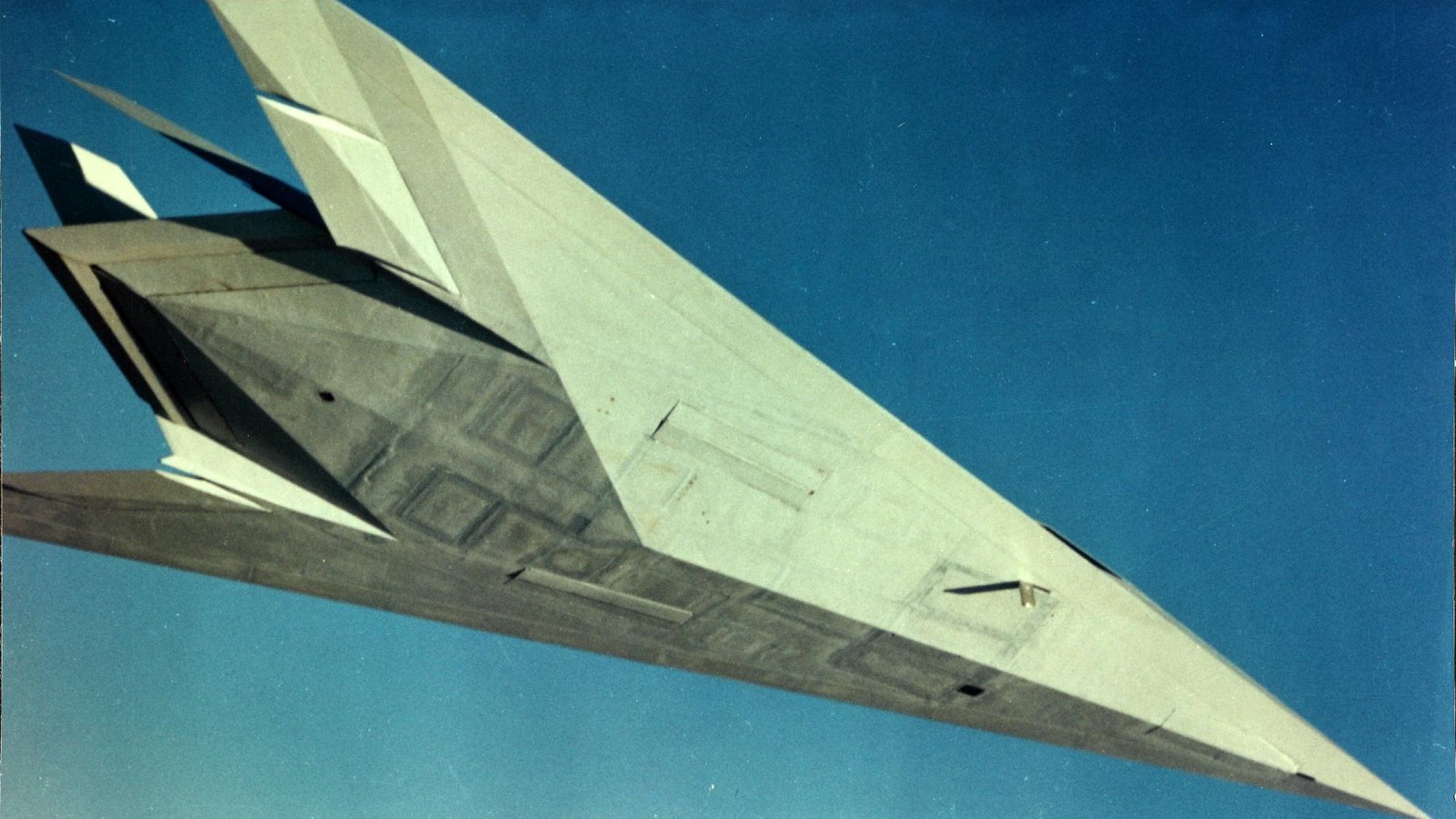
The Hopeless Diamond That Rewrote Radar
On a December morning at Groom Lake, an aircraft so ugly it earned a cruel nickname proved that physics—not paint—could make a warplane disappear.
When Radar Met Mathematics
For most of the Cold War, survival in hostile airspace meant flying low, fast, and hoping. Radars owned the sky. Then a Soviet physicist, working far from the American aircraft industry, handed the West an unexpected key.
Pyotr Ufimtsev published his work on electromagnetic diffraction in 1962. The paper described how radar energy behaves when it strikes an object—not as a simple bounce, but as a complex scattering problem. The U.S. Air Force translated it. At Lockheed’s Skunk Works, the equations fed a computer program called Echo 1. Mathematician Bill Schroeder and program manager Ben Rich did not set out to build a prettier airplane. They set out to build one whose shape would send radar returns somewhere other than the receiver.
The Defense Advanced Research Projects Agency had already been probing the idea through a program nicknamed Project Harvey. What emerged was the Experimental Survivability Testbed—an effort to test whether an aircraft could be designed from first principles to defeat detection. Lockheed won the competition with a bid so symbolic it barely registered on a ledger: one dollar. The real money would come later, and much of it from Lockheed’s own pocket.
Flat Panels and a Cruel Nickname
The result looked nothing like contemporary fighters. Have Blue was a compact, faceted machine—flat, tilted panels joined at sharp angles like a gem cut for deception rather than beauty. Testers called it the “Hopeless Diamond,” and the name stuck. It was not elegant. It was deliberate.
Each facet was positioned so that incoming radar energy would reflect away from the transmitter, much as a hall of mirrors can send a flashlight beam anywhere but back to your eyes. The approach traded aerodynamic grace for electromagnetic discipline. Have Blue was a proof-of-concept, not a weapon system—but it was the first practical combat stealth aircraft, the ancestor of everything that would follow.
Two demonstrators were built. Lockheed invested roughly ten million dollars of its own funds; classified Air Force money added about twenty million more. For a Skunk Works program operating under tight security, that was both a gamble and a statement of conviction.
Vanishing Acts Over the Nevada Desert
On 1 December 1977, Have Blue lifted off from Groom Lake, Nevada. Test pilot Bill Park was at the controls for that first flight. Ken Dyson would also fly the aircraft through its test series. The program’s purpose was not airshow spectacle but measurement: how did real air-defense radars respond to this strange shape?
The answer reshaped expectations. Against the ground-based systems arrayed to find it, Have Blue effectively vanished. Only the T-38 chase plane appeared on radar screens—a chase aircraft in plain sight while the experimental airframe beside it did not register. It was not perfect invisibility. It was practical survivability, demonstrated in flight, under conditions that mattered to war planners.
DARPA’s goal had been a first flight by the end of 1977. Have Blue met it. The XST program, as the effort was also known, had produced evidence that stealth was not laboratory fantasy but an engineering discipline.
Two Crashes, One Revolution
The test campaign was brief and costly. The first Have Blue crashed in 1978. The second Have Blue was lost on 11 July 1979. Eighteen months of trials were enough. The demonstrators had done their job: they proved that an aircraft could be all but invisible to the radars of its era, and that the proof could be repeated under operational test conditions.
What followed is the lineage every modern pilot recognizes. The lessons of Have Blue flowed directly into the F-117 Nighthawk, the world’s first operational stealth attack aircraft. The same design philosophy would later inform the Northrop B-2 Spirit and, in successive generations, the shaping and materials science behind fifth-generation fighters. Faceting gave way to more refined contours, but the underlying idea—control the radar cross-section as carefully as lift and thrust—remained.
Why it matters to you
You will never fly a Have Blue, but you fly in a world it created. Every time you study how weather radar paints precipitation, how transponders reply to interrogation, or how terrain and aspect change what ATC sees on a scope, you are touching the same physical reality Ben Rich’s team exploited: electromagnetic energy goes where geometry sends it. Stealth pioneers did not defeat radar with magic. They defeated it with angles, materials, and disciplined tradeoffs—the same kind of systems thinking you apply when you manage your aircraft’s detectability, choose how to work with—or work around—surveillance, and understand why two aircraft on the same frequency can produce wildly different returns.
The Hopeless Diamond was ugly, short-lived, and twice destroyed. It also rewrote the assumption that if an airplane flew, radar would find it. That assumption died in the Nevada sky on a December morning in 1977—and the aircraft you train in today still carry its inheritance in every carefully shaped surface and every lesson about what the sky can, and cannot, reveal.