The Gooney Bird's Ledger
"On a December afternoon in 1935, precisely thirty-two yea..."
The Gooney Bird's Ledger
On a December afternoon in 1935, Douglas Aircraft proved that an airliner could earn its keep without a mail contract—and changed aviation economics forever.
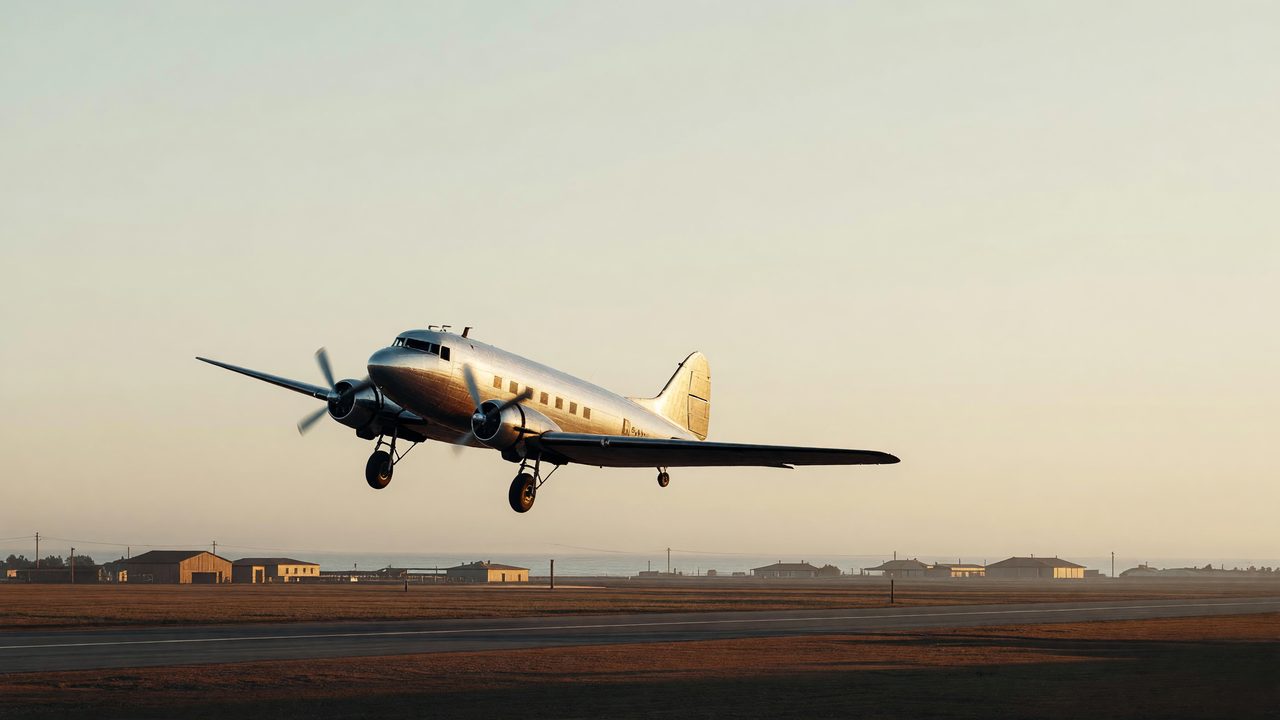
Thirty-two years had passed since the Wright brothers first stirred the sands of Kitty Hawk when a new silver ship rose from Clover Field in Santa Monica, California. Douglas Aircraft Company vice president and chief test pilot Carl A. Cover lifted the Douglas Sleeper Transport into the sky over the Pacific on December 17, 1935, and with that unremarkable afternoon takeoff, the DC-3 era began. The airplane that would later wear the DC-3 designation was not born as a warbird or a museum piece. It was born as a business proposition.
Before the DC-3, American airlines had learned to fly on government mail subsidies. Passenger revenue alone rarely covered the cost of operating a fleet across a continent. The Douglas Sleeper Transport changed the arithmetic. Configured for daytime service, it carried twenty-one passengers; at night, fourteen could sleep in berths. For the first time, an airliner could move enough paying customers across long distances to stand on its own feet financially. American Airlines took delivery in July 1936, and by the end of that year the DC-3 had woven itself into the sinews of American commerce. As the Smithsonian National Air and Space Museum notes in its collection record on the type, the DC-3 became the standard transport aircraft of the world—a judgment borne out not by rhetoric but by the number of operators who chose it when their own money was on the line.
The airplane earned that trust through conservative, purposeful engineering. Douglas gave the DC-3 a strong, multiple-spar wing and all-metal construction—design choices that favored durability and predictable handling over novelty. The Centennial of Flight Commission, in its essay on the type, places the DC-3 at the hinge of commercial aviation: the machine that made airline travel a practical reality for the traveling public rather than a subsidized experiment. Cover's first flight, chronicled in aviation history accounts including Vintage Aviation News's December 2024 retrospective on the anniversary, marked the moment when the industry stopped asking whether passengers could be carried profitably and started asking how many routes a single airframe could serve.
War would test every rivet of that formula. The U.S. Army Air Forces adopted the civil design as the C-47 Skytrain, and Douglas Aircraft Company historical documentation preserved in the Boeing Archives—Boeing acquired Douglas in 1997—records the staggering scale of production that followed. More than thirteen thousand examples would be built across all military and civil variants. C-47s hauled paratroopers, towed gliders, supplied beachheads, and evacuated the wounded. The same wing that had carried mail clerks and businessmen across the American interior now carried the weight of a global conflict. When peace returned, the airframe did not retire. It became a cargo hauler, a missionary transport, a skydiving shuttle, and a bush-country lifeline—roles that demanded the same virtues the original designers had baked in: payload, range, and the ability to absorb abuse.
Ninety years after Cover's first flight, faithful old Gooney Birds still grace skies from Alaska to the Antarctic. That longevity is not sentiment. It is evidence that Douglas got the fundamentals right.
Why it matters to you
The engineering principles pioneered in the DC-3 are still embedded in the aircraft you fly today. Multiple load paths through a wing structure, metal airframes built for fatigue life rather than short-term lightness, and design choices that favor stable handling across a wide center-of-gravity envelope—all of these trace a direct line from Santa Monica to your training airplane. When you study weight-and-balance limits, contemplate structural load factors, or practice flying an approach in gusty crosswinds, you are exercising judgments that the DC-3 era made central to commercial aviation. The Gooney Bird did not merely win a war or open a continent. It taught the industry that an airplane pays its way only when every system—structure, performance, economics—works together as a single, sober calculation. That is still the standard worth holding yourself to on every preflight.