The Ghost Wing: Northrop’s B-2 and the Return of the Flying Wing
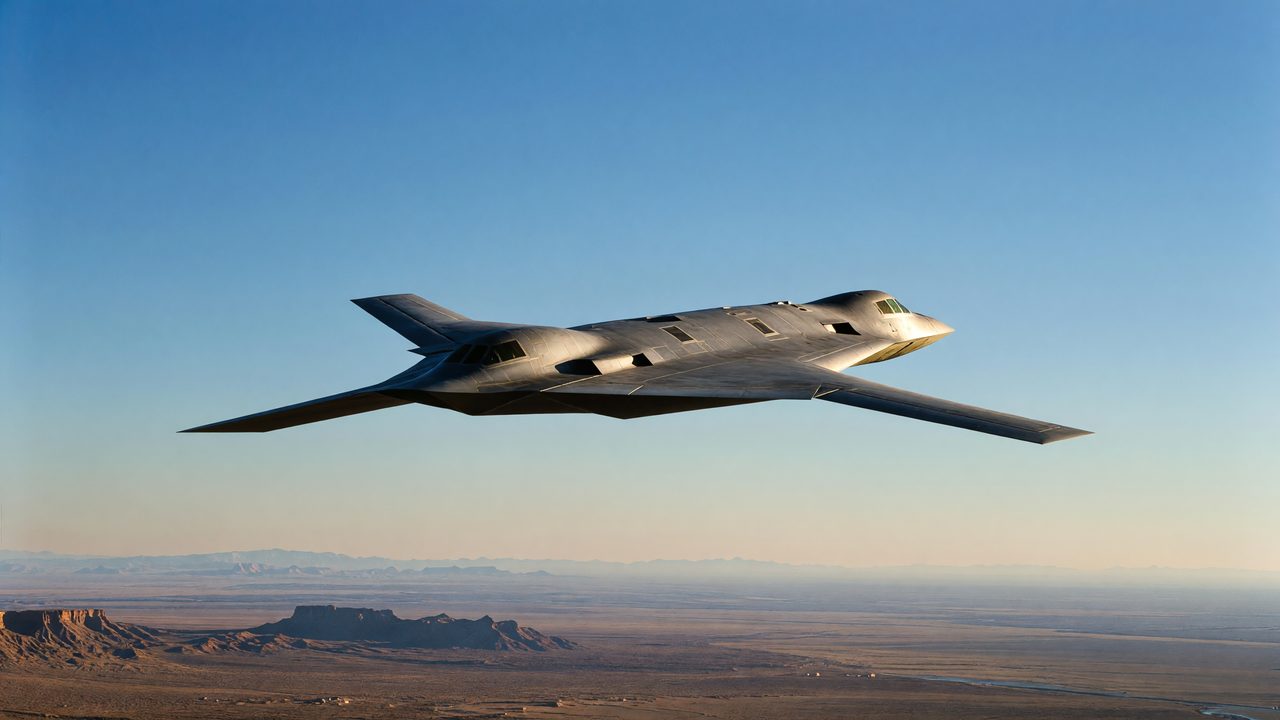
"On 17 July 1989, a bat-like silhouette rose from Palmdale..."
The Ghost Wing: Northrop’s B-2 and the Return of the Flying Wing
On a summer morning in 1989, a bat-shaped bomber lifted from the Mojave without a fuselage, without a tail, and without a sound—and proved that Jack Northrop’s most stubborn dream had finally come home.
A Lineage Refused to Die
The flying wing did not arrive overnight. In 1946, Jack Northrop’s XB-35 lumbered into the California sky on the strength of contra-rotating propellers and sheer conviction. By the late 1940s, the jet-powered YB-49 offered a glimpse of what a wing-alone bomber might become—until the Air Force turned elsewhere and Northrop’s vision was shelved. Four decades later, the Advanced Technology Bomber competition reopened the question. On 20 October 1981, the Pentagon awarded Northrop the contract over a Lockheed/Rockwell team. What emerged was not a revival so much as a reinvention: a 172-foot-span aircraft with no conventional fuselage, no vertical tail, and a radar cross-section that program officials would later compare to that of a small bird.
Born in Secrecy, Revealed from Above
Engineering proceeded behind the fences of Plant 42 at Palmdale. When the Air Force permitted the first public rollout on 22 November 1988, security dictated what the crowd could see: essentially a head-on view of a dark, angular mass. The airplane’s aft geometry—its engine bays, exhaust management, and the fine details of its low-observable shaping—remained hidden from ground observers. Aviation Week editors, flying overhead, photographed what the staged event would not show. The message was clear: this was not a bomber designed for pageantry. It was designed to disappear.
Northrop Grumman’s technical data sheet describes a wingspan of 52.4 meters, a two-person crew station, and four General Electric F118-GE-100 turbofans buried deep within the wing structure. That burial was not merely packaging. It reduced infrared and acoustic signatures while keeping the exterior contours uninterrupted. The skin itself—built from carbon-reinforced plastic and assembled with an eye toward seamless, radar-absorbent surfaces—turned the entire airframe into a single sculpted object rather than an assembly of reflective parts.
First Flight: Palmdale to Edwards
On 17 July 1989, the bat-like silhouette rose from Palmdale and crossed the Mojave to Edwards Air Force Base in comparative silence. Northrop test pilot Bruce Hinds occupied the commander’s seat; U.S. Air Force Colonel Richard Couch rode as co-pilot, binding the manufacturer’s gamble to the service that would ultimately employ it. Contemporary accounts recorded in aviation history chronicles mark the event as the first flight of the B-2 Spirit—and the first flying wing to enter the path toward operational military service.
The aircraft’s design brief was strategic in the literal sense. Unrefueled range approached 6,000 nautical miles. Payload capacity reached 40,000 pounds of conventional or nuclear ordnance. Those numbers placed the Spirit in a class apart from tactical stealth aircraft: a heavy bomber that could cross oceans, penetrate modern integrated air defenses, and deliver large standoff weapons from a platform shaped for survival rather than speed alone.
From Test Articles to a Tiny Fleet
The program moved deliberately. Northrop Grumman’s historical overview records initial aircraft delivery in 1993 and Initial Operational Capability on 1 January 1997. Only twenty-one B-2s were built. At roughly two billion dollars per airframe, the fleet was always going to be small—a specialized instrument rather than a mass-produced hammer.
That scarcity made each loss acute. In 2008, a Spirit crashed at Andersen Air Force Base, Guam, removing one airframe from an already limited inventory. Yet the type endures. Among acknowledged U.S. aircraft in service, the B-2 remains the sole heavy bomber engineered from the outset to combine large-payload strategic reach with a stealth configuration—a “ghost,” as pilots and planners have long described it, moving through the machine age of precision strike.
Why the Wing Endures
Jack Northrop’s interwar and postwar experiments failed for reasons of stability, control, and an era that demanded identifiable fuselages and tail surfaces. The B-2 succeeded because fly-by-wire flight controls, computational aerodynamics, and composite manufacturing finally solved problems that propellers and slide rules could not. The wing is the fuselage; lift, structure, fuel, weapons, and crew coexist within one continuous form. For student and rated pilots studying aircraft design, that integration is the lesson: efficiency and signature reduction often converge when extraneous surfaces disappear.
Why it matters to you
You will never hand-fly a B-2 on your private pilot checkride, but the engineering principles pioneered on that July morning in 1989 are embedded in the aircraft you fly today. Composite structures, careful surface continuity, and flight-control computers that continually translate pilot intent into stable flight began as exotic bomber technology and migrated outward to trainers, turboprops, and airliners. When you study how stall behavior, adverse yaw, or dutch roll arise from tail surfaces, the flying wing offers the counterexample: stability and control as a software-and-structure problem, not merely a matter of adding vertical fin area. Understanding the Spirit’s history does not prepare you to penetrate hostile airspace. It does sharpen your eye for why modern designers chase clean wings, buried engines, and uninterrupted airflow—and why, sometimes, the most radical airplane in the sky is the one that refuses to look like an airplane at all.