The Ghost Over Hanoi: How the Firebee Flew Where Pilots Could Not
"Bullshit Bomber"
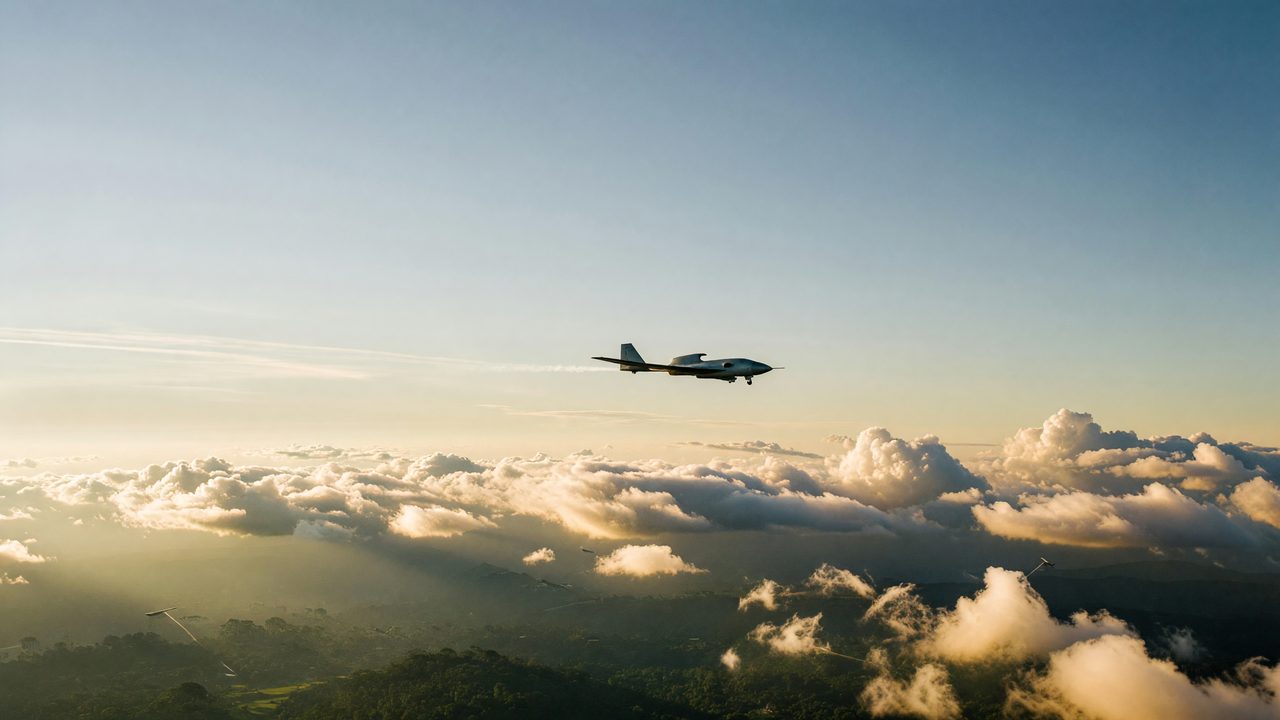
The Ghost Over Hanoi: How the Firebee Flew Where Pilots Could Not
Before today’s remotely piloted aircraft filled the sky, a jet-powered target drone with a parachute and a nickname proved that unmanned flight could survive the most dangerous airspace on Earth.
Born from a Target, Built for Secrets
The Ryan Firebee began life in the late 1940s as something expendable: a subsonic jet target for missile tests and gunnery training. By 1960, the U.S. Air Force saw a different future. Engineers stripped radar returns from the airframe, draped absorbent blankets along the fuselage, and sprayed on anti-radar coatings. A specially shaped screen masked the engine intake. What emerged was the AQM-34 — a reconnaissance platform launched from a Lockheed DC-130 “director” aircraft and steered across hostile territory by operators who never left the cockpit of the mother ship.
Flight testing in 1962 gave the modified Model 147 its operational name: the Lightning Bug. Within two years, Bugs were crossing into North Vietnam and southeastern China, gathering imagery and electronic data while manned reconnaissance crews absorbed mounting losses to surface-to-air missiles.
One Airframe, a Dozen Missions
The Lightning Bug family grew like a tool chest. The Model 147B stretched its wings for high-altitude photography, climbing where few interceptors could follow. Low-level penetrators — eventually standardized as the AQM-34L — hugged terrain beneath enemy radar, their Doppler navigation systems guiding them through valleys that would have been suicidal for a human crew. When an EC-121 signals-intelligence aircraft was shot down over the Sea of Japan in April 1969, killing 31 Americans, the Air Force turned again to the drone. The AQM-34Q electronic-intelligence variant, derived from the high-altitude 147T airframe, carried NSA packages and real-time data links over international waters near North Korea, China, and the Soviet Far East.
Not every sortie collected electrons or film. The AQM-34H — a leaflet-dispensing modification of the 147NC — earned a blunt nickname from the crews who launched it: the “Bullshit Bomber.” It rained propaganda over contested territory while other variants “sniffed” SAM guidance emissions or laid chaff corridors. According to PBS NOVA’s survey of the program, more than 1,000 AQM-34 Firebees flew in excess of 34,000 operational surveillance missions across Southeast Asia between October 1964 and April 1975, launched from bases in Japan, South Vietnam, and Thailand by day and by night.
Recovery by Parachute, Reliability by Design
A mission ended not with a landing roll but with a command from the DC-130: deploy parachute, float down, and wait. Recovery helicopters swept in beneath the canopy and snatched the drone from the sky — a procedure that spared fragile reconnaissance gear the punishment of a ground impact and kept airframes intact for another flight. The numbers justify the choreography. PBS NOVA reports that 83 percent of the Firebees flown during the Vietnam War returned to fly again — a recovery rate that would make any squadron commander envious.
That reliability did not mean invulnerability. GlobalSecurity.org’s operational summary notes that 578 Lightning Bugs were lost across the program’s active years, with more than half destroyed by hostile fire and the remainder claimed by accidents. Still, each recovered airframe represented a crewman who did not have to penetrate the same airspace twice. When manned reconnaissance proved too costly, the Bug filled the gap.
Shelved, Not Forgotten
For all its battlefield utility, the Lightning Bug’s institutional story ended quietly. In 1979, as the Air Force reorganized and transferred unmanned assets from Strategic Air Command to Tactical Air Command, the Firebee fleet was grounded and placed in storage — casualties of a budget fight against manned systems, not of combat failure. The airframes gathered dust while doctrine shifted elsewhere.
Yet the engineering lessons endured. Reducing radar cross-section, hardening navigation for GPS-denied environments, designing airframes for repeated recovery and reuse, and separating the human risk from the intelligence requirement — these were not abstract research topics in Southeast Asia. They were flight-test results written in mission logs. Decades later, when modified Firebees laid chaff corridors at the opening of Operation Iraqi Freedom in 2003, the Vietnam-era pedigree was still visible in the air.
Why it matters to you
The Firebee never carried a student pilot, but the systems philosophy behind its 83 percent recovery rate is woven into the aircraft you train in today. Redundancy, maintainability, and predictable failure modes — the same engineering discipline that let a target drone survive SAM belts over Hanoi — now governs how your avionics degrade gracefully, how your autopilot hands off cleanly, and how your flight manual defines limits you can trust. When you brief a lost-comm procedure or study how modern remotely piloted aircraft integrate with manned traffic, you are tracing a line back to a DC-130 over the South China Sea, a parachute blossoming in the haze, and a helicopter crew fishing a spy from the sky so it could fly tomorrow. Unmanned aviation did not begin with the wars you read about in headlines. It was proven, sortie by sortie, by a machine most pilots of the 1960s never saw — and by statistics that still set the standard for what “reliable” means in hostile air.