The Garage Genius and the Birth of the Predator
"medium-altitude endurance"
The Garage Genius and the Birth of the Predator
In January 1994, a $31.7 million contract and a first flight on the Fourth of July weekend turned an Israeli émigré’s garage experiments into the aircraft that would redefine how wars are watched—and fought.
When James Woolsey took the oath as Director of Central Intelligence in February 1993, the Cold War dragon was dead, but the Balkans were burning. Ethnic war in Bosnia had killed tens of thousands and displaced millions. From Washington, leaders needed to know what was actually happening on the ground—not filtered through rival claims, not glimpsed for a few minutes from orbit. Satellites could not stare. Spy planes meant American crews over hostile terrain. Woolsey, who had studied reconnaissance systems since the Johnson administration, wanted something that could loiter for hours and send live video home. He did not need a new idea. He needed an airplane that already existed, built by a man who worked out of a garage.
That man was Abraham “Abe” Karem. Born in Iraq and raised in Israel, Karem had left a senior engineering post at Israel Aircraft Industries in 1974 because he believed unmanned aircraft were unconquered territory. In Hacienda Heights, east of Los Angeles, he and a tiny team filled a 600-square-foot garage—and its attic—with composite molds, computers, and hand-built parts. Their first demonstrator, the Albatross, weighed barely 200 pounds. DARPA funded it. The follow-on Amber, developed at a dry-lake airfield near El Mirage, California, flew more than 38 hours in 1988. The Pentagon’s joint UAV office canceled Amber anyway. Karem’s company went bankrupt. General Atomics bought the assets in 1990, hiring Karem and eight engineers who knew how to keep a drone aloft for hundreds of hours without crashing—a reliability leap that separated their work from the expensive failures of earlier programs.
The export derivative, the GNAT-750, became the bridge to war. Woolsey remembered Karem from an earlier encounter on missile-basing studies and admired what he called an entrepreneurial engineering mind. When the Clinton administration needed eyes over Bosnia, the CIA acquired two GNAT-750s. Launched from Albania, they carried video cameras over the killing grounds—but their signals had to bounce through a manned motorized glider acting as a relay, because the ground station could not sit far enough away. The concept worked well enough to prove the point: persistent, unmanned surveillance was no longer science fiction. The Department of Defense wanted more.
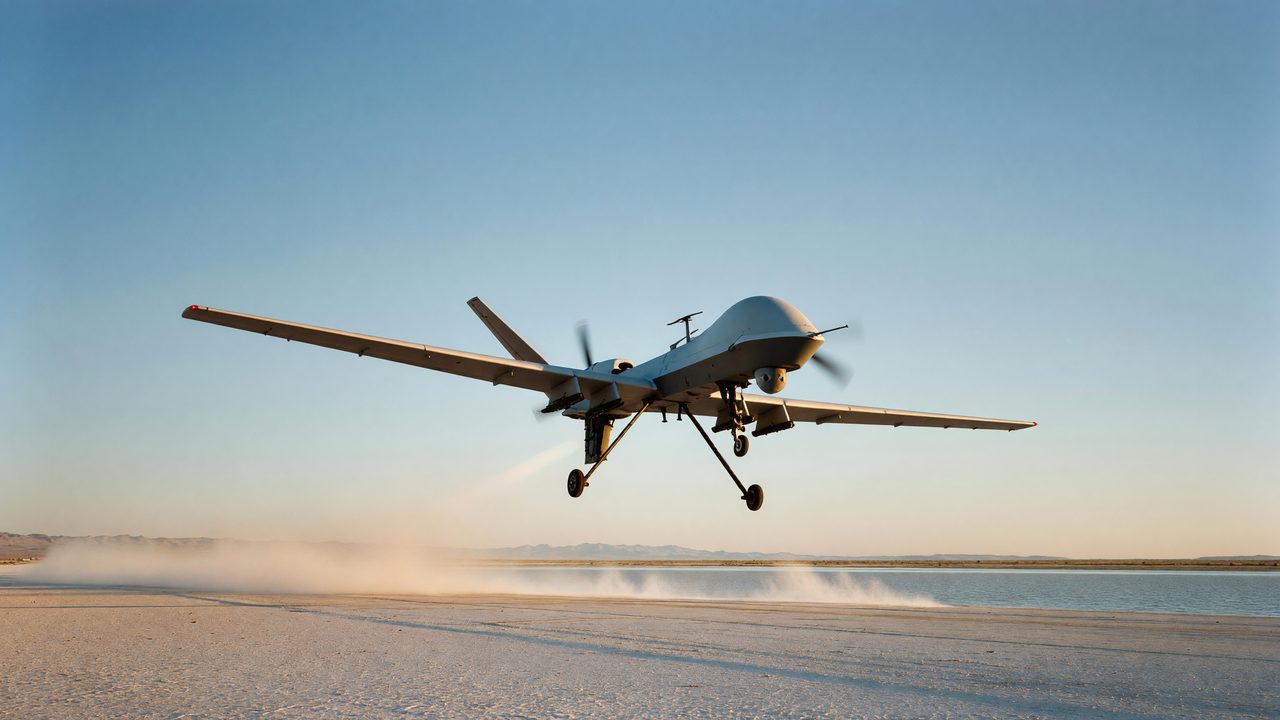
In 1993 the Pentagon opened a competition for a larger “medium-altitude endurance” UAV—one that could carry a satellite antenna and be flown by operators continents away. Karem reshaped the GNAT-750 accordingly: a distinctive upward bulge in the nose for the satcom dish, longer wings, heavier landing gear, and a Rotax piston engine in place of the earlier two-stroke powerplant. General Atomics held an in-house naming contest; the winner was Predator. Four companies entered; General Atomics won. In January 1994 the firm received a $31.7 million contract to deliver three Predators and a ground control station within six months, with more to follow within a year. On July 3, 1994—one day before Independence Day—the first Predator lifted off at El Mirage. Karem himself had left General Atomics a month earlier, eager for new projects, but the airframe was unmistakably his: graphite-epoxy composites, a pusher propeller, downward-canted V-tail, and the patient, sailplane-like proportions of a machine built for hours aloft, not minutes.
The CIA’s Frank Strickland, writing in the agency’s Studies in Intelligence, described the GNAT deployment over Bosnia as the rapid evolution that made the Predator possible—fiscal austerity forcing innovators to move fast, with Woolsey, Karem, and a small government-industry team as the catalysts. The Smithsonian’s profile of Karem and the National Air and Space Museum’s account of the MQ-1L on display in Washington both trace the same lineage: garage prototype to Amber to GNAT to Predator, a drone that looked more like a weekend glider than a weapon until the Air Force hung Hellfires under its wings years later. By then the engineering bet of 1994 had already won. By roughly 2011–2018, the U.S. had fielded hundreds—not thousands—of Predators and follow-on Reapers across the services; the broader U.S. UAV inventory grew toward five figures only when counting many small tactical types.
Why it matters to you
The Predator did not succeed because it was exotic. It succeeded because Karem refused to treat unmanned aircraft like disposable target drones. He designed for hundreds of crash-free hours—systems engineering, configuration discipline, and respect for reliability that manned aviation had taken for granted. Those same principles sit inside the certified piston singles and twins you fly today: conservative structures, redundant logic where it counts, and the insistence that an airplane must stay predictable when the pilot—or the autopilot—is not in the seat. When you brief endurance, fuel, and diversion margins on a cross-country, you are applying the mindset that turned a California garage into a global surveillance fleet. The MQ-1 retired from Air Force service years ago, but the lesson of July 1994 endures: the pilot’s craft is not only hands on the yoke. It is knowing how to build an aircraft that keeps flying when the mission demands it.