The Gap That Sank Convoys — and the Liberators That Closed It
"500 miles"
The Gap That Sank Convoys — and the Liberators That Closed It
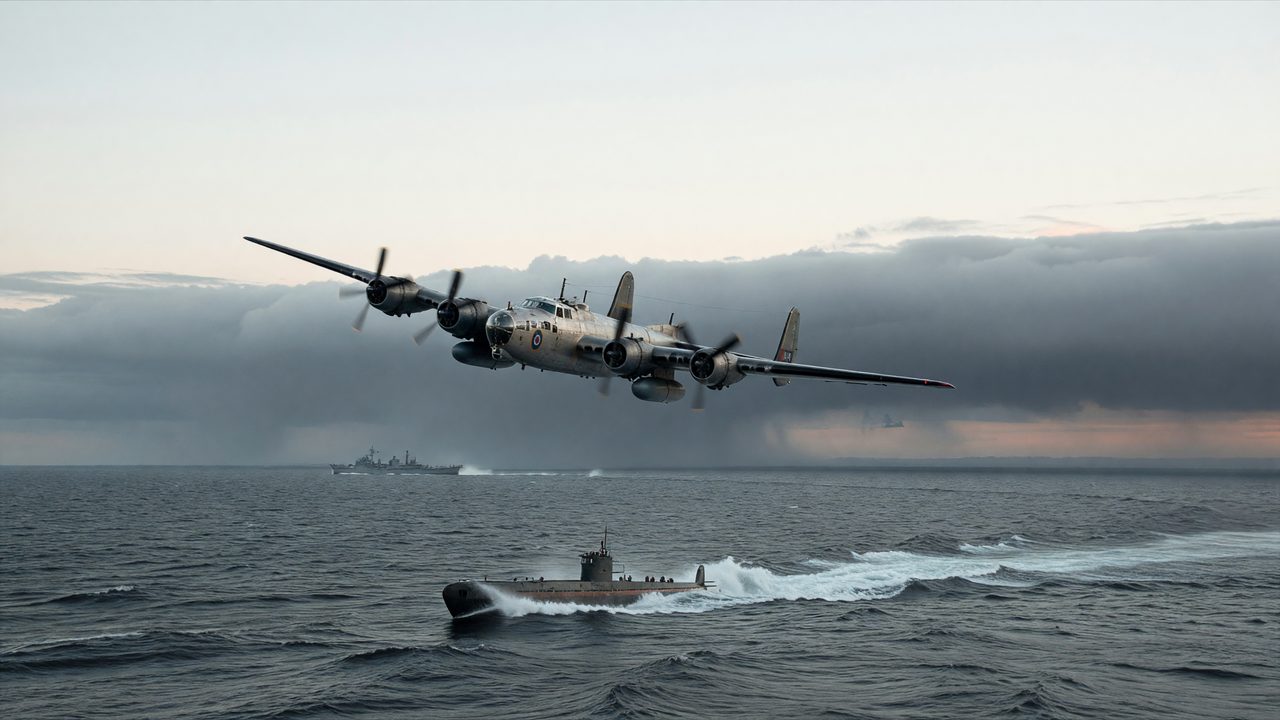
In the spring of 1943, Allied pilots and sailors finally stitched together continuous air cover over the mid-Atlantic — the deadliest stretch of ocean in the war.
For two years, the Battle of the Atlantic turned on a cruel geographic fact. Beyond the reach of shore-based aircraft lay a mid-ocean void — the “air gap” — where U-boats could surface, recharge batteries, and attack convoys with impunity. Destroyers and corvettes could escort ships only so far; once the convoy sailed beyond friendly air cover, the wolf packs waited.
The turning point did not arrive in a single dramatic engagement. It came from two innovations working in concert: the Very Long Range (VLR) Consolidated B-24 Liberator and the escort carrier.
Coastal Command’s engineers modified Liberators to extend their operational radius to roughly 2,500 miles — enough to reach the gap and remain on station for eight hours. That endurance transformed a patrol aircraft from a coastal sentry into an oceanic hunter. The first VLR squadron, No. 120, pioneered the concept, and others followed. Yet the breakthrough unfolded slowly. At the end of March 1943, only twenty VLR aircraft were operational across the command — a thin line stretched across an enormous ocean.
Anglo-American Coordination
The shortage was not merely technical. Anglo-American discussions on anti-submarine warfare, recorded in January 1943, reflected the urgency both nations felt. Air Chief Marshal Sir Charles Portal and his American counterparts understood that closing the gap required more than additional airframes; it demanded coordinated doctrine, shared intelligence, and the patience to accept that range extensions and squadron conversions would take months, not weeks.
Canadian analysis of the period documents the operational friction plainly. RCAF No. 10 (BR) Squadron, operating from Gander, Newfoundland, flew standard-range Liberators while awaiting VLR conversions. Through April and May 1943, those crews patrolled the western approaches and the fringes of the gap, logging hours that forced submarines down even when no kill resulted. The delay in VLR delivery was a strategic bottleneck — every week without full coverage meant convoys sailing blind through the center of the Atlantic.
Black May
May 1943 changed the arithmetic entirely. VLR Liberators, now arriving in greater numbers, worked alongside escort carriers such as USS Bogue (CVE-9) and hunter-killer support groups that could prosecute contacts the aircraft found. The combination was synergistic: aircraft forced submarines to submerge and constrained their mobility; surface groups closed for the kill.
The U.S. Naval History and Heritage Command’s account of “Black May” captures the result with stark clarity. Forty-one U-boats were destroyed that month. Grand Admiral Karl Dönitz, confronting unsustainable losses, temporarily withdrew his wolf packs from the North Atlantic convoy routes. The mid-ocean killing ground had become a killing ground for submariners instead.
Stephen Roskill’s official British naval history, The War at Sea 1939–1945, Vol. II, makes an observation that every pilot should understand: air patrols mattered even when they scored no kills. U-boats forced to remain submerged exhausted their batteries, lost the speed advantage that made surface attacks lethal, and surrendered the tactical initiative to escorts above. Presence — sustained, predictable, long-endurance presence — was itself a weapon.
Endurance as Strategy
The VLR Liberator was not a glamorous fighter. It was a flying fuel tank with a bomb bay, crewed by men who measured success in hours on station and square miles searched. Eight hours over empty ocean demanded meticulous fuel planning, disciplined navigation, and the mental stamina to maintain vigilance when the North Atlantic offered nothing but grey swells and freezing spray. Coastal Command’s modification program — external tanks, weight reductions, engine tuning — was engineering in service of a single operational metric: time over target.
Escort carriers extended the same principle from a moving deck. A CVE could station aircraft where shore bases could not reach, vectoring patrols into the gap from the convoy’s own escort force. The hunter-killer groups — built around escort carriers and destroyer escorts — turned detection into destruction. An aircraft that forced a submarine down and held it there long enough for a surface group to arrive had done its job, whether or not it dropped ordnance.
By the close of May 1943, the air gap had not vanished from the map. It had been closed operationally — stitched shut by overlapping patrol arcs from Newfoundland, Iceland, Northern Ireland, and carrier decks at sea. Convoys that had once sailed through a dead zone now sailed beneath a canopy of Allied air power.
Why it matters to you
The operational principles demonstrated in this moment still shape how pilots operate today. Range is not a specification in a pilot’s operating handbook — it is a mission variable you budget, monitor, and defend. The VLR crews treated fuel and endurance as finite tactical resources, planning sorties backward from required time on station rather than forward from departure. Modern long-range operations — ferry flights, search-and-rescue, offshore patrol, even fuel-critical IFR diversions — demand the same discipline. Presence without endurance is theater; endurance without coordination is isolation. The Atlantic crews learned to integrate air and surface assets into a single operational picture, passing contacts, sharing track data, and accepting that your patrol’s value might be measured in what the enemy cannot do rather than what you destroy. Every hour you remain on station, every gallon you reserve for the return leg, every decision to extend or divert — that is the legacy of closing the gap. The ocean is still unforgiving. The math still has to work.