The Flying Truck: How the Mi-8 Redefined the Helicopter
"The “Hip,” as NATO christened it, has carried generals, r..."
The Flying Truck: How the Mi-8 Redefined the Helicopter
From Soviet design bureaus to every climate zone on Earth, NATO’s “Hip” proved that payload, redundancy, and sheer numbers outlast every fashion in rotorcraft design.
When Western observers first encountered the Mil Mi-8 at the 1965 Paris Air Show, many arrived expecting crude metal and compromise. What they found instead was a medium-lift machine with a five-blade main rotor, a bus-like cabin, and flight performance that earned respectful notice from specialists who had dismissed Soviet rotorcraft for years. The helicopter that impressed them was not a prototype destined for a short production run. It was the beginning of the most prolific helicopter family ever built.
Born to Replace, Built to Endure
The Mi-8 emerged from the Mil Design Bureau in the late 1950s as a deliberate successor to the piston-powered Mi-4. Mikhail Mil’s engineers bet that twin turboshaft power would lift both performance and economy, and state trials in November 1964 cleared the design for series production. Kazan Plant No. 387—already experienced with earlier Mil types—received the drawings; serial production began in March 1965, with the first production airframes completed by the end of 1965. A second line opened at Ulan-Ude in 1970 as orders outran capacity. Factory records compiled by defense analysts attribute more than 4,500 Mi-8 builds to Kazan and upward of 3,700 additional airframes from Ulan-Ude on the baseline powerplant alone, figures that climb sharply when export derivatives and modernized variants are folded in. SP’s Aviation, surveying more than six decades of output, estimates that perhaps 17,000 machines have reached roughly 80 operators worldwide.
A Silhouette You Already Know
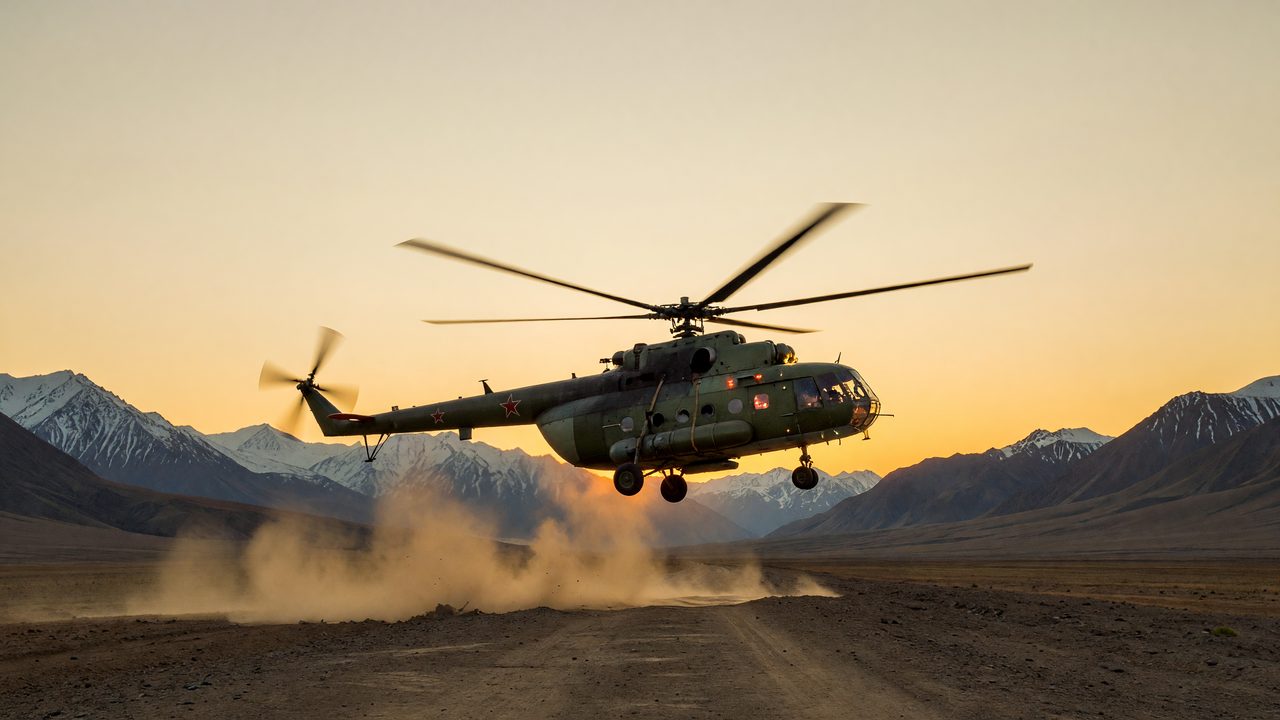
Even pilots who have never flown behind the Iron Curtain can identify a Hip at a glance. The main rotor sits high on the fuselage, clearing a long cabin with a sliding port-side door and rear clamshell loading gates. Twin engines breathe through rounded intakes above the glassed-in cockpit; external fuel pods hang low on either side of an upswept tail boom that terminates in the type’s signature cruciform tail and anti-torque rotor. The layout is not elegant in the cinematic sense. It is legible, repairable, and spacious—exactly the point.
Inside, the cabin accepts roughly two dozen troops, four metric tons of internal freight, or a dozen litters in medical configuration. A fuselage pylon can carry external loads on the order of three tons, and a cabin winch handles lighter sling work. Non-retractable tricycle gear keeps maintenance straightforward. Twin TV2-series turboshafts drive the rotor through a load-sharing system that permits continued flight on one engine under certain weight conditions—a redundancy lesson every multi-engine pilot still studies, whether the engines turn turboshaft or turboprop blades.
Every Mission, Every Theater
NATO codename “Hip” undersells the aircraft’s range. Armed Mi-8TV variants appeared in the late 1960s with rocket pods and bombs on fuselage racks; later models added machine guns, armor, and expanded weapons stations. Civil operators flew passenger layouts with comfortable seating; pipeline crews relied on the same airframe to ferry sections into roadless country. The cruciform tail and high rotor disk became fixtures in the Hindu Kush during the Soviet-Afghan war, where hot-and-high limitations forced development of the more powerful Mi-8MTV line—machines capable of operating at altitudes that would ground lesser designs. That same silhouette now lifts refugees after floods, inserts peacekeepers, and hauls generals over Siberian tundra. Combined with the export-oriented Mi-17 family, the type ranks, as of 2015, among the three most common operational military aircraft on Earth—a statistic that reflects not glamour, but availability.
The DC-3 of the Rotorcraft World
Aviation history remembers sleek gunships and record-setting speed machines. Operations officers remember what keeps sorties generating. The Mi-8 succeeded because it prioritized volume, adaptability, and a production base that could sustain hundreds of airframes a year at peak. It was not the fastest helicopter in the hangar. It was the one that could be reconfigured overnight from troop carrier to aerial crane to gun platform, then sent back out with mechanics who already knew every panel line. That is why crews and analysts alike reach for the DC-3 comparison: an unlovely, indispensable standard whose outline defines what “utility” means in its medium.
Why it matters to you
You may never log time in a Hip, but you already train against the problems it solved. Performance planning for density altitude, calculating whether a single engine can sustain climb after failure, trading fuel for payload, and briefing a cabin load that changes the center of gravity every sortie—these are not relics of Cold War rotorcraft doctrine. They are the daily work of utility flying, from turbine twins to the helicopters you rent on a checkride. The Mi-8’s enduring lesson is that engineering choices made for mass production and field repair—redundant power, generous cabin volume, conservative gear, variants instead of clean-sheet replacements—still shape the aircraft you fly today. Reliability and payload capacity do not make magazine covers. They make schedules hold. Every time you run the numbers before liftoff, you are practicing the discipline that kept the flying truck airborne across every continent for more than half a century.