The Fishbed That Outlasted Empires
"The MiG-21’s delta wing and thirsty Tumansky turbojet mad..."
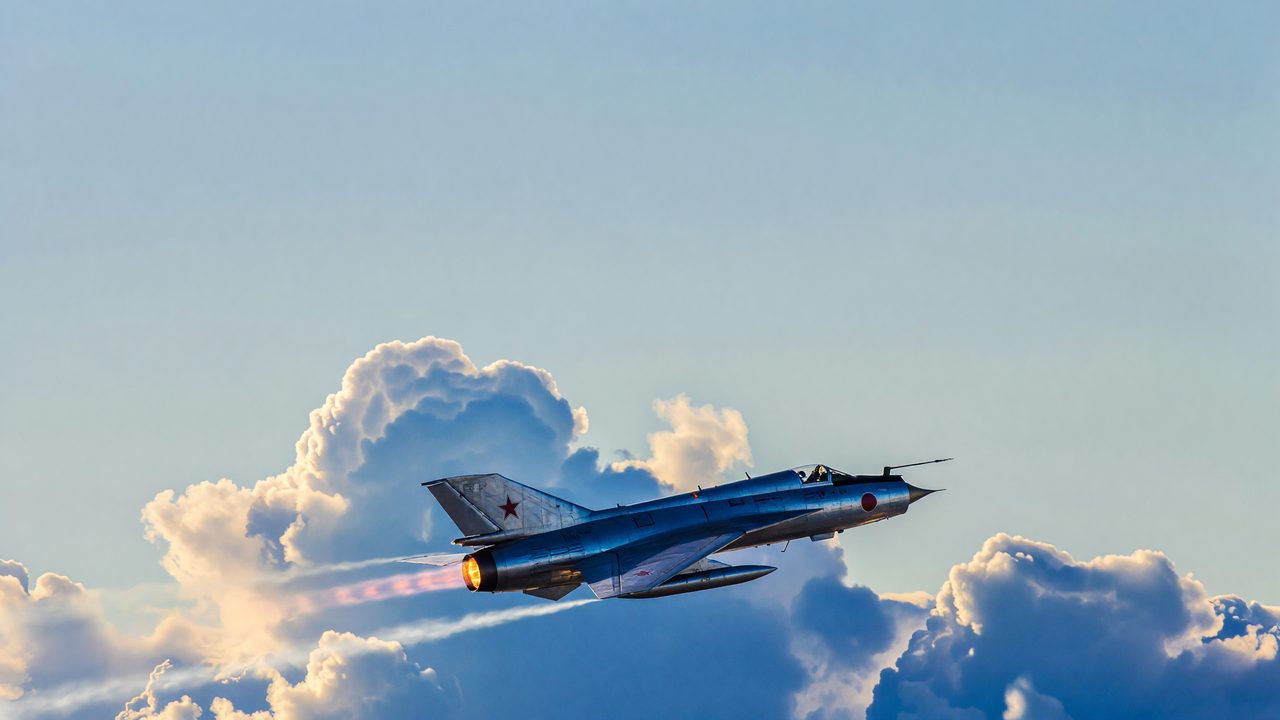
The Fishbed That Outlasted Empires
Seven decades after its first flight, the MiG-21 still proves that speed, simplicity, and sheer numbers can shape the sky as surely as stealth ever will.
On 16 June 1955, a slender prototype lifted from the Soviet test airfield at Zhukovsky and wrote the opening line of the most prolific jet-fighter story in history. What emerged from the Mikoyan-Gurevich design bureau was not a laboratory curiosity but a weapon system built for mass: a single-engine, delta-wing interceptor meant to climb fast, close quickly, and kill before the enemy could react. Pilots called it balalaika for its wing planform; NATO called it Fishbed. The world would learn both names.
Delta Wing, Thirsty Engine, Mach 2
The MiG-21’s engineering logic was brutally direct. A 57-degree swept delta wing gave the aircraft the stiffness and volume needed for supersonic flight without the weight and complexity of conventional swept wings and high-lift devices. Beneath that wing sat a Tumansky turbojet—later variants in the R-11 and R-25 families—that drank fuel with the appetite of a front-line interceptor but delivered the thrust to reach Mach 2 in level flight. The trade was explicit: range and loiter suffered; acceleration and climb did not.
That bargain defined the type’s mission. The MiG-21 was an interceptor first—designed to scramble, punch through the sound barrier, and engage with cannon and later with radar-guided missiles in the brief window before fuel reserves forced a return. Cockpit instrumentation was austere by Western standards, but the airframe rewarded pilots who mastered energy management: high speed at the merge, disciplined turn rate, and ruthless commitment to the shot. In capable hands it was lethal; in careless ones, unforgiving.
Built by the Thousands
Factory records compiled by aviation historians document a production arc that dwarfed every contemporary rival. Soviet assembly lines at Gorky—today Nizhny Novgorod—and later licensed plants in Czechoslovakia and India rolled out airframes across variants from the early Fishbed-C interceptors through the widely exported MiG-21bis and MF models. Production timelines on MiG-21.de trace serial output across decades, reflecting not a single burst of wartime manufacture but sustained, peacetime industrial rhythm.
Guinness World Records certifies the type as the most-produced jet-powered military aircraft of all time1—a distinction Simple Flying and other aviation references cite when tallying total builds that exceed 11,000 airframes. Numbers on that scale change strategy. An air force need not win every duel if it can field squadrons faster than losses can be absorbed, train pilots in weeks rather than years, and keep aircraft flying from austere strips with tools that fit in a truck.
Sixty Flags, One Airframe
Export maps read like a Cold War census. Roughly sixty nations on four continents operated the MiG-21, from Warsaw Pact allies and Middle Eastern clients to African and Asian air arms that needed credible air defense on a budget. Cuba still flies the type. India, which manufactured hundreds under license as the MiG-21 Bison, only retired its last squadron in 2025 after more than six decades of service—an operational lifespan almost unheard of for a supersonic fighter.
Longevity was never an accident. The MiG-21 was easy to build, easier to maintain, and modular enough to accept radar and weapons upgrades without redesigning the wing. Hangar floors from Hanoi to Cairo learned the same lesson: fewer systems meant fewer failures, and a simple jet that flew twice a day beat a complex one that flew once a week.
Numbers as Airpower
In an era obsessed with low observability and fused sensor pictures, the Fishbed endures as a counterargument cast in aluminum. Stealth and networking win the briefing slides; availability wins the calendar. A Mach 2 delta-wing interceptor conceived when turbojets were still young remains on patrol because pragmatic engineering outlasted political blocs, because maintenance culture mattered as much as specific excess power, and because air superiority has always been partly arithmetic.
The MiG-21 did not dominate every theater. It lost sorties it should have won and won sorties it should have lost. Yet its record is measured in continents served, pilots trained, and sorties generated—metrics that do not fade when the latest fifth-generation brochure arrives.
Why it matters to you
Every time you brief a climb profile, manage fuel against mission fuel, or feel a wing loading trade in the pattern, you are touching ideas the MiG-21 made mainstream. The delta wing and thirsty Tumansky turbojet were not historical curiosities; they were the engineering answer to a clear question—how do you intercept fast at altitude with a jet you can actually field in quantity? Modern trainers and light jets still teach the same disciplines: energy over angle, fuel as a hard limit, and airframe simplicity as a safety margin when the alternator fails or the weather closes. The Fishbed’s lesson for today’s pilot is not nostalgia. It is that performance promises written on a spec sheet mean little without the systems knowledge and disciplined handling that turn a simple airplane into a credible weapon—and that sometimes the most advanced thing in the sky is the one that shows up, again and again, on time.
Footnotes
-
Guinness World Records, “Most-produced jet-powered military aircraft,” as cited in Simple Flying, “How Many MiG-21 Fighter Jets Were Built?”; production data and timelines per MiG-21.de, “Production.” ↩