The Eye That Never Blinks
"000 feet"
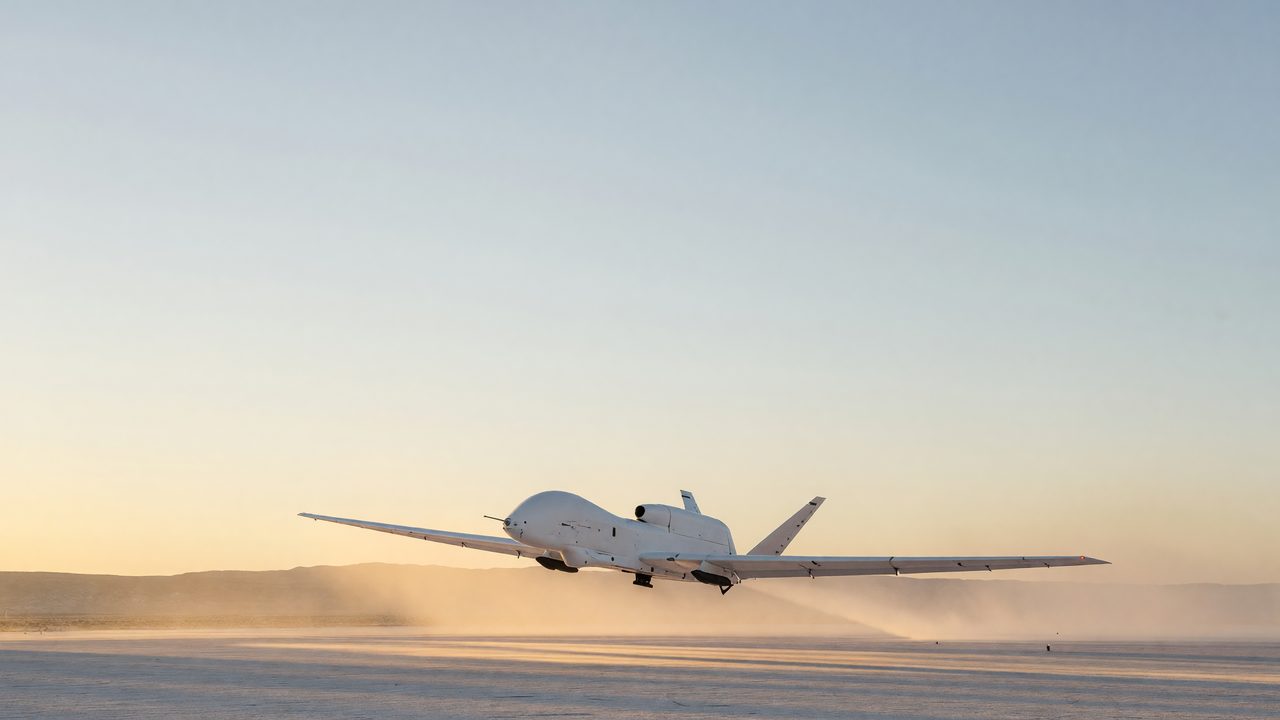
The Eye That Never Blinks
On a February morning in 1998, a sailplane-shaped machine took off from Edwards, climbed above 30,000 feet, and landed without a human hand on the stick—proving that persistence at altitude could be programmed, not merely wished for.
A Different Kind of First Flight
Most maiden flights are celebrated for what a pilot accomplishes. The RQ-4 Global Hawk’s debut was celebrated for what a pilot did not have to do.
At 7:43 a.m. Pacific Standard Time on 28 February 1998, a white, sailplane-like air vehicle rolled down the runway at Edwards Air Force Base, California. Developed by Teledyne Ryan Aeronautical under the Defense Advanced Research Projects Agency’s Advanced Concept Technology Demonstration program, the aircraft carried a 116-foot wingspan and an Allison turbofan engine. It climbed to 32,000 feet, traced a figure-eight track over the Mojave, and returned to land after fifty-six minutes. According to the U.S. Department of Defense, the entire mission—including takeoff and landing—was flown autonomously. No operator touched the controls.
For test pilots accustomed to proving new hardware from the cockpit, the event inverted the usual logic of flight test. The airplane was not merely remotely piloted; it executed a programmed mission profile as a system. That distinction would define high-altitude, long-endurance unmanned aviation for the next quarter-century.
Built to Watch, Not to Fight
The Global Hawk was conceived as a sensor platform first. As the first HALE unmanned aircraft designed to survey an area roughly the size of Illinois in a single sortie, it traded maneuverability for altitude, endurance, and sensor aperture. U.S. Air Force fact sheets describe an operational envelope reaching above 65,000 feet with endurance exceeding thirty-four hours on later production blocks—capabilities that place the aircraft in the thin, cold air where manned reconnaissance crews face crushing fatigue limits.
Its payload combined synthetic-aperture radar with electro-optical and infrared sensors, feeding near-real-time imagery to commanders separated from the battlespace by continents and time zones. Where a manned U-2 sortie might measure its value in hours, Global Hawk sorties were measured in days of continuous coverage. The aircraft did not need to blink, rest, or rotate crews mid-mission. It needed fuel, datalinks, and a clear tasking order.
From Demonstrator to Wartime Asset
Prototype maturity arrived faster than procurement paperwork. In 2001, before production models reached operational units, Global Hawk aircraft were pressed into combat over Afghanistan—an acceleration that revealed both the system’s utility and the strain of fielding technology still evolving in public view. The Air Force declared initial operational capability for the Block 30 configuration in 2011, by which time the type had already become a fixture of intelligence, surveillance, and reconnaissance tasking.
The numbers tell the story of sustained employment. In September 2013, the Global Hawk fleet surpassed 100,000 flight hours, with the U.S. Air Force reporting that roughly seventy-five percent of those hours had been flown in combat zones. Each hour represented not a stunt, but a standing watch: borders monitored, convoys tracked, patterns observed across nights and weather that would ground shorter-legged platforms.
A Family of Watchers
The Global Hawk’s engineering lineage did not end with the U.S. Air Force inventory. Northrop Grumman, which acquired Teledyne Ryan’s heritage, adapted the design for maritime surveillance as the MQ-4C Triton for the U.S. Navy and for NATO’s Alliance Ground Surveillance fleet. Different services, different sensors, different mission sets—yet the same underlying proposition: put a reliable, high-altitude sensor aloft and keep it there.
In an era when persistence rivals precision as a measure of military effect, the Global Hawk demonstrated that the unmanned eye could hold a stare across days. It did not replace human judgment in the command center. It extended human reach into airspace where duration itself becomes a weapon of awareness.
Why it matters to you
You may never hand-fly a fifty-six-minute autonomous profile at Edwards, but the engineering principles validated that February morning still shape the aircraft you train in today. Long-span wings tuned for efficiency at altitude, integrated sensor suites feeding datalinks, flight-control laws that execute programmed paths without constant human input—these ideas migrated from DARPA demonstrators into civil avionics, autopilot modes, and mission-management systems. When you brief a cross-country leg, load a flight plan, and trust the autopilot to capture altitude while you manage communications and fuel, you are practicing a narrower version of the same contract the Global Hawk proved in 1998: define the mission clearly, verify the automation, then let the system hold the tedious work while you apply judgment where it matters. Persistence is not only a military virtue. In modern flying, it is a trained skill—and it begins with understanding what the machine can watch for you, steadily, without ever blinking.