The Exhaust That Rewrote the Sky
"On 16 January 1930, a 22-year-old Royal Air Force cadet n..."
The Exhaust That Rewrote the Sky
Before radar screens glowed green and turbine gauges settled into cruise, three parallel stories—in a Rugby test cell, a German hangar, and a Junkers drawing office—turned a cadet’s patent sketch into the age you train in today.
On a winter morning in 1930, Frank Whittle was twenty-two years old and still an Royal Air Force cadet when he filed British Patent No. 347,206. The document was not a flight test report or a wind-tunnel memo; it was a declaration that an aircraft might be propelled directly by the exhaust of a gas turbine. The accompanying drawing laid out a compressor train—combustion and heating chambers feeding a multi-stage turbine coupled to the compressor. Whittle would later describe this lineage in his 1945 James Clayton Lecture to the Institution of Mechanical Engineers, and when The Engineer reproduced the patent drawing that October, readers could see the architectural DNA that still defines turbojet engines: compress air, burn fuel in continuous flow, extract work through a turbine, and accelerate what remains out the nozzle as thrust.
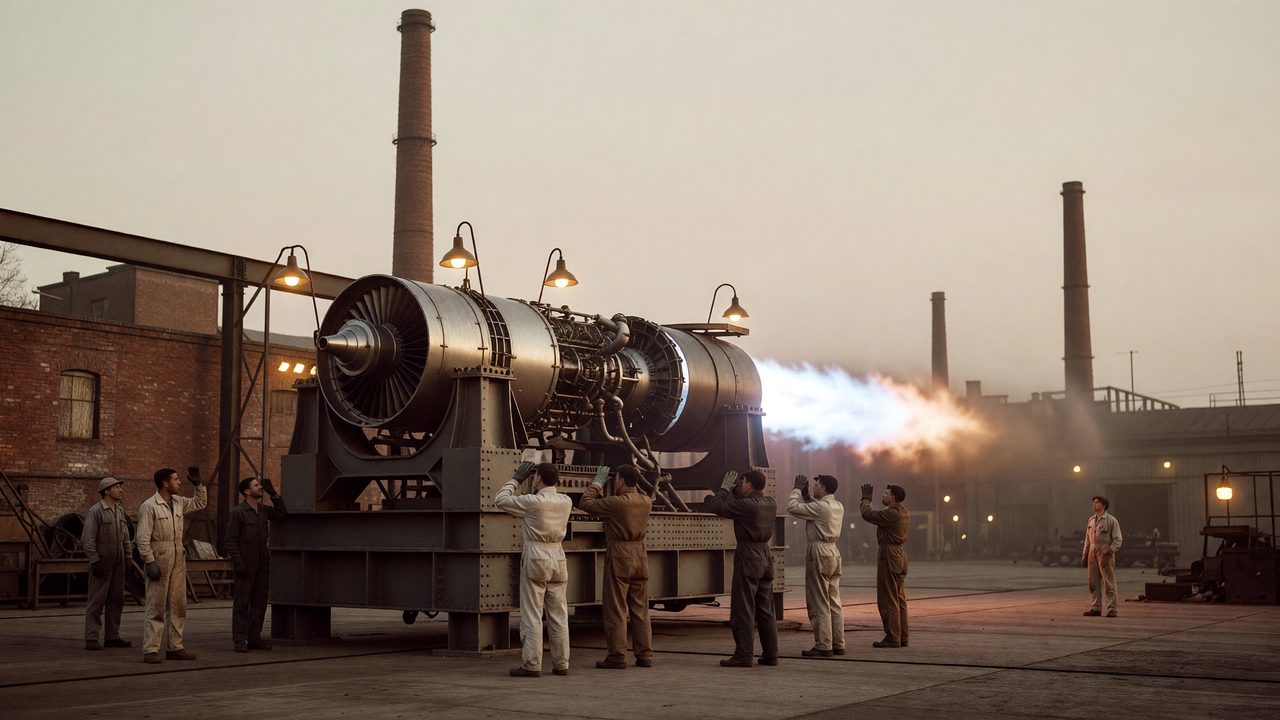
The idea did not find a warm reception at the Air Ministry, which judged it impractical for the near term. Practicality had a price tag, too. Whittle could not afford the five-pound renewal fee when the patent came due in 1934, and the protection lapsed. Yet the concept did not. In 1936, with backing from investment bankers O. T. Falk and Partners, Power Jets Ltd took shape around the very engine Whittle had sketched on paper. On 12 April 1937, the first experimental unit—designated WU—ran at the British Thomson-Houston works in Rugby. The thrust was modest by any wartime standard, but the event was unmistakable: a self-sustaining gas-turbine cycle turning steadily on a test stand, not as an industrial prime mover but as the heart of an aircraft propulsion concept.
Across the North Sea, Ernst Heinkel’s firm pursued the same physical truth along a different institutional path. Hans von Ohain’s turbojet work matured inside Heinkel’s organization, and on 27 August 1939 the Heinkel He 178 lifted from Marienehe under the thrust of the HeS 3—the world’s first aircraft to fly solely on turbojet power. Museum records of the HeS 3 family at the Smithsonian National Air and Space Museum underscore what that flight meant technically: continuous combustion, high exhaust velocity, and none of the reciprocating machinery that had defined piston aviation. Germany reached the air first; Britain reached the air with deepening rigor. Whittle’s flight-worthy W1 followed the Rugby experiments, and in 1941 the Whittle W1X crossed the Atlantic to seed General Electric’s jet work at Lynn, Massachusetts—an exchange that linked British bench learning to American production capacity just as global war accelerated every timetable.
Industrial scale arrived through Junkers. Anatol Franz’s Smithsonian account of the Jumo 004 traces how Junkers engineers wrestled the turbojet out of the laboratory and into repeatable manufacture—an eight-stage axial compressor, six can-type combustion chambers, and a single-stage turbine arranged for fighters that would need dozens of engines, not one heroic prototype. The Jumo 004 became the first turbojet produced in meaningful quantity, powering the Messerschmitt Me 262 and forcing Allied planners to confront a performance class that propellers could not match. Reliability and metallurgy lagged behind raw speed—early turbojets consumed themselves as readily as they consumed fuel—but the operational lesson was permanent: jet thrust traded the piston engine’s torque-and-propeller rhythm for mass flow and nozzle physics, and aerodynamics would never again be optional.
By 1945, Whittle could lecture as an established engineer while the institutions that had once waved him away studied his math with new urgency. Falk’s finance, Rugby’s test cells, Heinkel’s willingness to fly what others would only debate, and Junkers’ drive toward production quantity were not interchangeable stories. They were parallel proofs that the Brayton cycle belonged in the sky.
Why it matters to you
The engineering principles pioneered in Whittle’s 1930 patent—mass flow compressed and heated in continuous combustion, work extracted through a turbine, thrust produced by accelerating exhaust—still sit behind the spool gauges and EGT trends you monitor in training. When you manage a hot start, interpret a sluggish acceleration, or feel how jet thrust builds smoothly rather than in propeller pulses, you are flying the descendant of Rugby’s WU run and the drawing that lapsed for want of five pounds. High bypass ratios and FADEC have refined the hardware beyond anything Heinkel or Junkers could certify, but the pilot’s core task endures: respect the engine’s thermodynamic appetite, fly the airspeed and angle of attack the inlet and wing were designed for, and understand that your “power lever” commands fuel and flow through a machine whose first coherent blueprint was filed by a twenty-two-year-old cadet on a January day in 1930.