The Empty Cockpit: From Flying Torpedoes to Predators
"The first drones were targets. The latest ones fight wars from office chairs."
The Empty Cockpit: From Flying Torpedoes to Predators
Unmanned aircraft have spent more than a century evolving from experimental weapons to everyday tools—and they now share the sky with every pilot who files a flight plan.
Long before the word "drone" entered everyday speech, the U.S. Army was already trying to put airplanes in the air without anyone aboard. In 1918, engineer Charles Kettering and the Dayton-Wright Airplane Company delivered the Kettering Bug, an unmanned biplane the Army classified as a flying torpedo. Weighing roughly 300 pounds and driven by a 12-horsepower engine, the Bug could travel about 40 miles while carrying a 180-pound payload. A mechanical gyroscopic autopilot held course after launch from a rail car; at the calculated distance, wings detached and the fuselage plunged toward its target. The Armistice arrived before the Bug saw combat, but the concept endured. Artifacts from the program, including autopilot components, are preserved in the National Air and Space Museum's drone and UAV collection—physical evidence that the dream of pilotless flight is older than most instrument ratings.
Radio-Controlled Attack Aircraft
World War II pushed the idea from drawing boards into Pacific combat. The U.S. Navy's TDR-1 assault drone, built by Interstate Aircraft and Engineering Corporation, was a twin-engine, radio-controlled aircraft designed to carry a torpedo or 2,000-pound bomb into heavily defended areas while a control pilot remained out of harm's way. Navy crews launched TDR-1s from special air units in the Solomon Islands during 1944, guiding them toward Japanese positions by television camera and radio link. Records held by the Naval History and Heritage Command document a brief but real operational chapter: unmanned aircraft were not merely targets for gunnery practice but offensive weapons. The program was cancelled before it could reshape naval doctrine, yet it proved that remote attack was feasible decades before satellite links and flat-screen cockpits.
Real-Time Eyes Over the Battlefield
The modern unmanned era opened not with a missile but with a camera. In 1981, during the Bekaa Valley fighting in Lebanon, the Israeli Scout unmanned aircraft provided sustained, real-time reconnaissance over Syrian air-defense networks. For the first time, commanders could watch a developing air battle through an airframe that carried no crew and accepted no prisoner. The Scout's success demonstrated that persistence mattered as much as speed: an aircraft that could orbit for hours changed how planners understood surveillance. Nations that had treated drones as expendable targets began investing in systems meant to return, refuel, and fly again.
The Predator Arrives—Armed
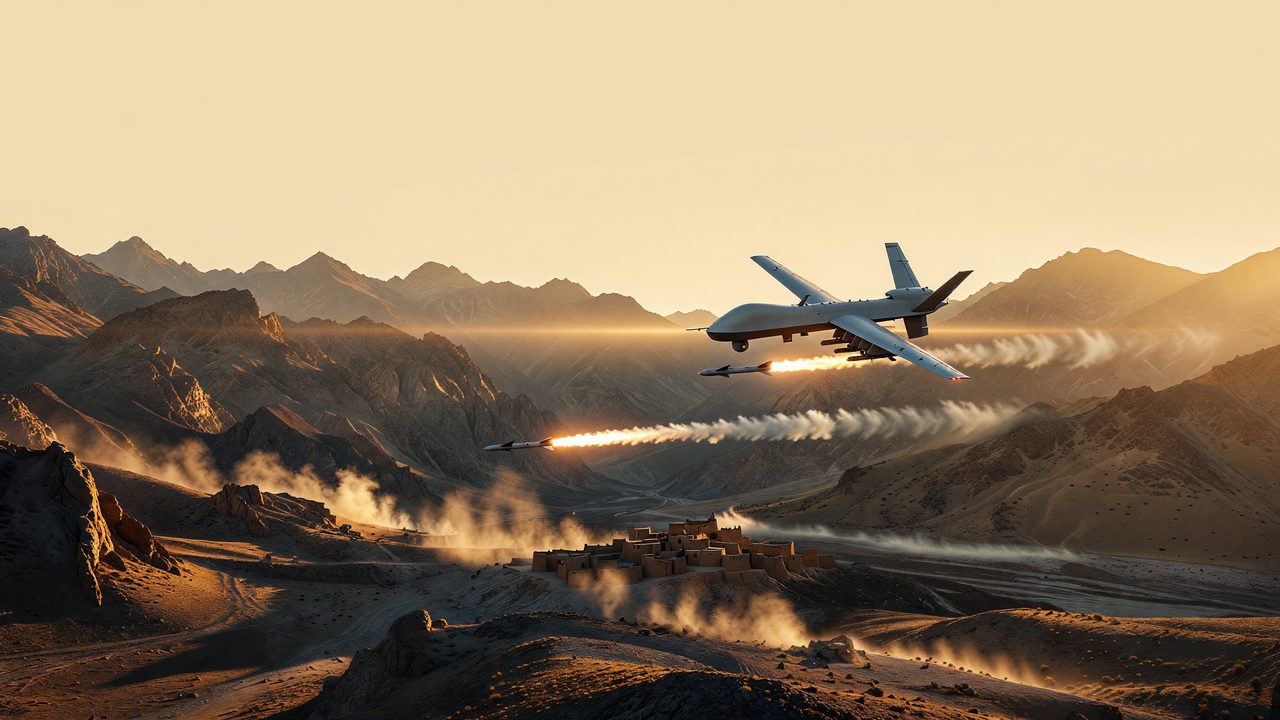
American development followed a parallel path. General Atomics flight-tested what would become the MQ-1 Predator in 1994, with the system entering operational service the following year. Initially conceived for intelligence gathering, the Predator's long endurance and stable video feed made it indispensable over the Balkans and then over Afghanistan after the attacks of September 11, 2001. Engineers adapted the platform to carry AGM-114 Hellfire missiles, and the Predator became the first armed unmanned aircraft to conduct sustained combat strikes. An MQ-1 now hangs in the Smithsonian's collection—a gray airframe that looks unremarkable on the ramp yet represents a watershed: the kill chain could run from a ground control station thousands of miles away. Reconnaissance and strike, once the province of separate airframes and crews, merged in a single remotely piloted vehicle.
A Sky Crowded with New Neighbors
The military story is only half the revolution. According to Federal Aviation Administration registration data, more than 850,000 recreational drones now operate in the United States alone—outnumbering manned aircraft by orders of magnitude. The FAA's UAS Integration historical overview and policy records from the UAS Integration Office trace a regulatory path from experimental military hardware to Part 107 commercial operations and Part 89 remote identification requirements. What began as target practice for antiaircraft gunners is now a consumer electronics category sold at shopping malls.
That transformation places unmanned aircraft in the same National Airspace System that supports flight training, crop dusting, and airline arrivals. Small quadcopters fly beneath the Class B shelves where you practice holds. Fixed-wing surveillance platforms orbit pipeline routes along your cross-country corridors. The FAA's integration framework—still evolving—attempts to give manned and unmanned operators a shared rulebook.
Why it matters to you
The history is not academic for anyone who preflights a Cessna or briefs a weather chart. Integration of unmanned aircraft into the National Airspace System means you must understand new NOTAM categories that flag active drone operations, consult UAS facility maps before flying near airports, and recognize the remote identification broadcasts that mark many small unmanned aircraft in your vicinity. These tools did not exist when the Kettering Bug rolled down its launch rail, but they define mixed airspace today. A rated pilot who treats drones as someone else's problem risks a near miss—or a regulatory violation. The empty cockpit is no longer a laboratory curiosity. It is your traffic.