The Emil's Bargain: How the Bf 109 Won the War's Opening Rounds—and Paid for It Later
"The most built fighter ever, yet its narrow track undercarriage killed more pilots than enemy gunfire."
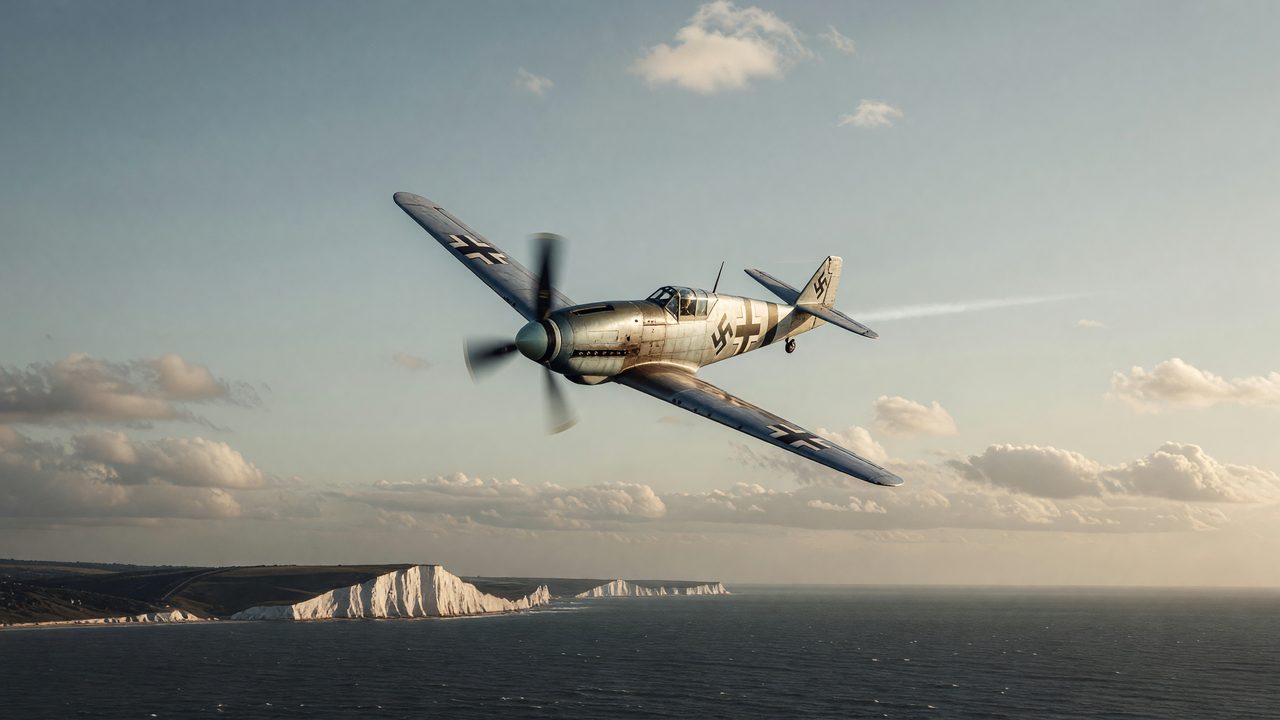
The Emil's Bargain: How the Bf 109 Won the War's Opening Rounds—and Paid for It Later
The world's most advanced fighter of 1935 was built on a simple equation: maximum horsepower, minimum weight. That philosophy made the Messerschmitt Bf 109 a legend—and a handful of contradictions every pilot had to learn the hard way.
When the Reichsluftfahrtministerium issued its 1934 requirement for a modern interceptor, Willy Messerschmitt and Robert Lusser answered with a design that looked less like contemporary biplanes and more like the future. The Bf 109 V1 lifted off on 29 May 1935 wearing a borrowed Rolls-Royce Kestrel engine because German powerplants were not yet ready—a detail that underscores how urgently Germany was racing to rearm. What flew that spring morning was, by the standards of the mid-1930s, revolutionary: an all-metal monocoque fuselage, a fully enclosed cockpit, retractable landing gear, and Handley Page automatic leading-edge slats that deployed at high angles of attack to delay the stall. Contemporary accounts from RLM meeting minutes and early unit evaluations, as compiled in Lynn Ritger's Messerschmitt Bf 109 – Origins and Evolution, describe an aircraft that officials recognized immediately as the most advanced fighter in the world.
The design philosophy was brutally direct. Messerschmitt sought the largest available engine on the lightest possible airframe. Every structural decision served that goal. The wing was relatively small, keeping weight down and permitting high roll rates. The fuselage was tight, placing the pilot high in the cockpit with his shoulders nearly brushing the canopy rails. Retractable gear saved drag but produced one of the type's most notorious traits: a narrow-track, outward-cranking main gear that gave the 109 a reputation for ground handling that ranged from demanding to treacherous, depending on who was asked.
Combat debut came in the Spanish Civil War, where early variants—soon nicknamed "Emil" after the E-series designation—proved the formula in actual fighting. Pilots praised the aircraft's responsiveness, its ability to climb and its devastating armament for the era. Front-line unit reports from that period, preserved in production and operational records cited by Ritger, show a fighter that could dictate the terms of an engagement if its pilot respected its limits. When Germany invaded Poland in September 1939 and then swept through the Low Countries and France in the spring of 1940, the Bf 109 was the spearpoint. During the Battle of Britain that summer, Emils flown by Jagdgeschwader units fought at the edge of their range over southeastern England, winning many individual combats while exposing the design's strategic constraints.
Production numbers tell the scale of the gamble. More than 33,000 Bf 109s were built across variants spanning early Jumo-powered models through the late-war Bf 109K "Kurfürst," making it the most produced fighter aircraft in history—a figure documented across factory records and variant chronologies assembled by historians including Scott Manning and Dinger Aviation's developmental narrative from Emil through Kurfürst. Each generation swapped engines and armament—DB 601, DB 605, heavier cannon, revised cowlings—while the fundamental airframe remained recognizably the same narrow, eager machine that first flew with a British engine in 1935.
Pilot opinion never found a comfortable middle ground. Veterans of JG 52 and JG 27 spoke of an aircraft that felt like an extension of the pilot's will in a turning fight, that climbed like a homesick angel and snapped onto a target with precision. Others, especially those who came to the type from wider-gear aircraft or who faced the challenge of a crosswind landing on a blasted Eastern Front field, cursed the narrow undercarriage, the swing on rollout, and the high-speed handling quirks that steepened as variants grew heavier and more powerful. Dinger Aviation's combat evolution narrative tracks how each performance gain in horsepower and firepower added weight and complexity, progressively narrowing the margin between brilliance and catastrophe on the ground.
By 1945 the Bf 109 was still killing Allied bombers and fighters, but it was no longer the world's most advanced design. Allied fighters had matched or exceeded its performance while offering more forgiving handling and, in many cases, greater range. The 109's story is not one of failure—it was, for years, the benchmark. It is the story of a design pushed to its logical extreme and then pushed again, because the war demanded it.
Why it matters to you
Every aircraft is a bundle of tradeoffs, but the Bf 109 makes those tradeoffs unusually visible. The "largest engine, lightest airframe" philosophy is not merely history; it is the same logic you weigh whenever you consider payload, fuel, climb performance, and stall behavior in your own training aircraft. A light wing loads quickly and turns tightly, but it also stalls at higher speeds and tolerates less pilot indiscipline. Short, narrow gear reduces drag and weight, but it reduces stability on the ground—exactly why your instructor drills crosswind landings and centerline discipline until they are reflex. The 109's slats were an early lesson in high-lift devices: engineered margin at the edge of the envelope, deployed automatically so the pilot had one less thing to forget. When you practice slow flight, stall recognition, and recovery, you are training the skills that separated surviving 109 pilots from statistics on muddy airfields from Spain to Stalingrad. The Emil's bargain—performance bought with narrow margins—is the bargain every light, high-performance airplane still makes. Understanding that history does not just deepen your appreciation of World War II aviation. It sharpens your read on the aircraft you fly today.