The Double-Deck Dreamliner Before Jets
"The only airliner where passengers could climb downstairs for a cocktail, then upstairs for a nap."
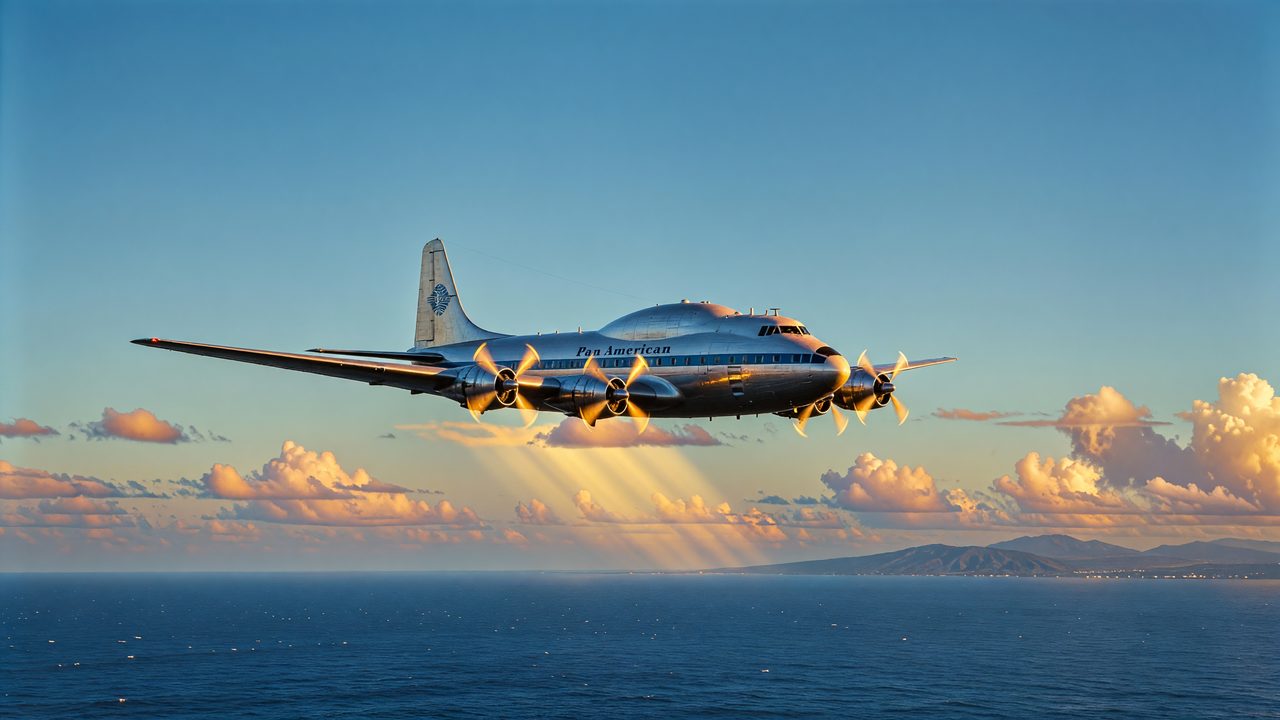
The Double-Deck Dreamliner Before Jets
How Boeing turned a World War II bomber into the most luxurious piston airliner ever built—and why its DNA still shapes how pilots think about pressurization, range, and passenger comfort.
Born in the Shadow of the Superfortress
When Pan American World Airways resumed landplane service across the Pacific after World War II, the airline needed an aircraft that could cross oceans with dignity. Boeing answered with the Model 377 Stratocruiser, a civilian transport born directly from wartime metal. During the war, Boeing had built 2,766 B-29 Superfortress bombers for the U.S. Army Air Forces. Engineers adapted the bomber’s wing, fuselage structure, and pressurization know-how into a commercial design developed from the military C-97 Stratofreighter. The result was Boeing’s first postwar airliner and, according to company historical records, a prototype that first flew on July 8, 1947.
Pan American placed the launch order—twenty aircraft valued at $24 million—and inaugurated Stratocruiser service on April 1, 1949. The route that made the type famous was San Francisco to Honolulu, the transpacific run Pan Am had pioneered with its flying boats in the 1930s. Where Clipper passengers once endured eighteen-hour hops in a Boeing 314, the Stratocruiser compressed the crossing to roughly eight or nine hours at a cruising speed near 300 mph, with range on the order of 4,600 miles.
The Inverted Figure Eight
The Stratocruiser’s silhouette was impossible to mistake. Boeing grafted a large upper fuselage onto the lower fuselage and wings inherited from the B-29 family, creating what historians describe as an inverted figure-eight cross section—two pressurized cylinders, one stacked above the other. That “double-bubble” architecture bought something no rival piston airliner could match: volume.
The upper deck seated between 55 and 100 passengers depending on configuration; Pan Am typically carried fewer than the maximum. Below, a circular staircase descended to a lower-deck lounge where passengers could sip cocktails away from their seats—a layout that prefigured the upper-deck lounges Boeing would later market on early 747s. On overnight sectors, the aircraft could be fitted with upper-and-lower sleeping berths; Pan Am brochures advertised as many as twenty-eight bunk positions on long-range flights. Flight attendants worked a galley capable of serving hot meals for dozens of travelers while the four Pratt & Whitney R-4360 radial engines, turning enormous Hamilton Standard propellers, droned outside at altitude.
Pacific Luxury at a Price
On the San Francisco–Honolulu inaugural, the Stratocruiser did more than shorten a timetable. It reframed what long-range travel could feel like. Pressurization kept cabin altitudes tolerable for hours over open water. Sleeperette reclining seats largely replaced the full berths of flying-boat days, though bunks remained available on extended routes. United Airlines joined Pan Am on Hawaiian service the following year, and British Overseas Airways Corporation, Northwest Airlines, and others operated the type on prestige routes worldwide.
For all its glamour, the Stratocruiser was an expensive machine to own. Boeing built only fifty-six examples between 1947 and 1950, and company records indicate the program lost money on every airframe sold. High operating costs were partly offset by premium fares and celebrity traffic—flight crews remembered Louis Armstrong’s band improvising a lounge concert on one Pacific crossing—but maintenance of large radials and complex pressurization systems demanded skilled personnel on the ground and in the cockpit.
The type was not without drama. Pan Am Flight 6 (Boeing 377 N90943) ditched northeast of Hawaii on 16 Oct 1956; all 31 occupants survived. Another Pan Am 377 vanished en route to Hawaii that same year, a loss that remains a subject of historical inquiry. Such events underscored what every oceanic pilot of the era understood: range and comfort never eliminated the seriousness of overwater operations.
Overtaken by the Jet Age
By the late 1950s, turbojets rewrote the economics of long-range travel. The Boeing 707 and Douglas DC-8 cut block times further and carried more passengers at lower seat-mile cost. Stratocruisers lingered on prestige routes—the New York–London run among them—but were gradually retired as jets arrived. The last Stratocruisers left the world’s premier intercontinental services as the Jet Age took hold in the early 1960s.
Yet the aircraft’s influence outlasted its production run. The double-deck concept, the insistence on lounge space, and the proof that passengers would pay for comfort on long sectors all fed directly into wide-body thinking. When Boeing designed the 747 two decades later, the idea of a secondary passenger deck reached back to the spiral staircase of the Stratocruiser.
Why it matters to you
If you are training for an airline career—or studying aircraft systems for an advanced rating—ask yourself which iconic World War II bomber provided the wing and fuselage foundation for the Boeing 377 Stratocruiser. The answer is the B-29 Superfortress. That lineage is not trivia. It is a lesson in how military programs seed civilian certification paths: pressurized structures tested under combat schedules, long-range fuel planning refined over the Pacific, and maintenance cultures built around complex radial powerplants. Modern turbine aircraft hide their heritage behind FADEC and glass cockpits, but the questions remain the same. What airframe limits drive your operational envelope? How does pressurization affect performance planning? When you brief an overwater alternate, you are walking a flight path Pan Am Stratocruiser crews mapped with sextants and conviction. Knowing where your airplane came from sharpens the judgment you bring to where you are taking it.