The Day the Rotor Answered Back
"243 feet"
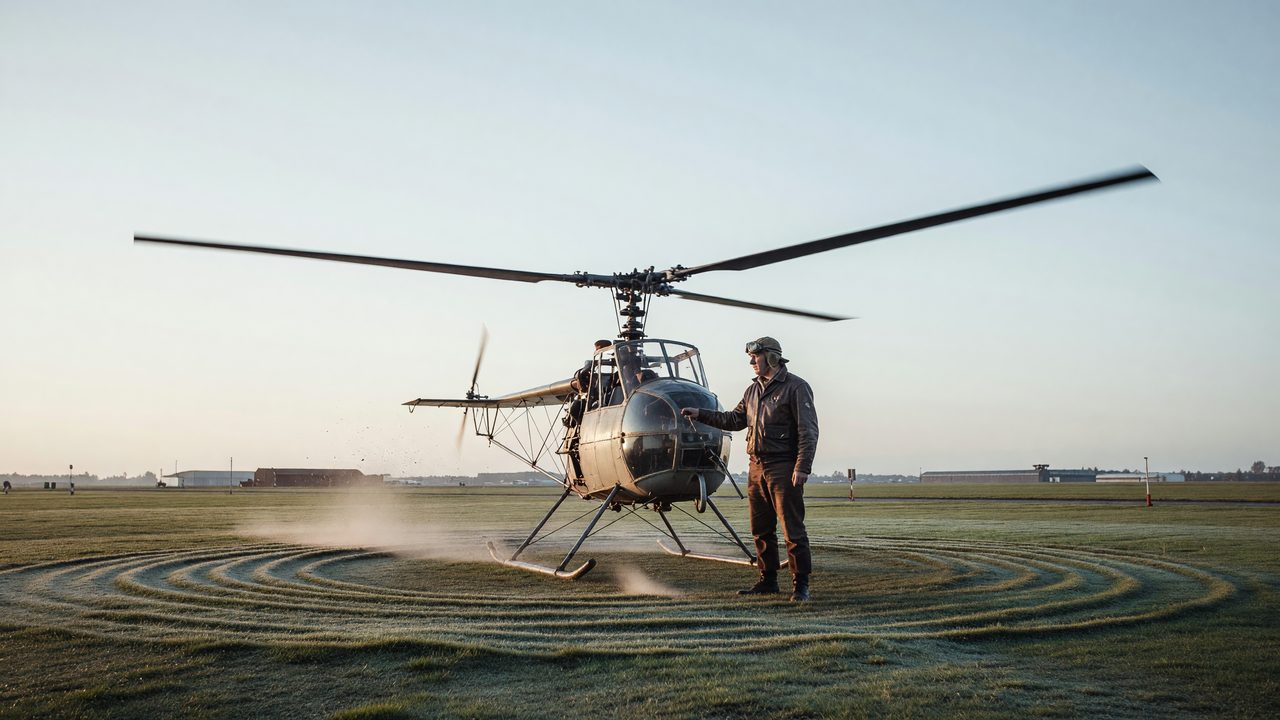
The Day the Rotor Answered Back
On a June morning in Bremen, a test pilot proved that vertical flight could be flown—not merely endured.
Before dawn broke fully over Bremen Airport on June 26, 1936, the aviation world already knew machines that could climb straight up. Autogyros spun their rotors through the air; experimental helicopters had hopped, wobbled, and sometimes crashed. What they had not done, reliably and repeatably, was give a pilot authority in roll, pitch, and yaw while hovering. That distinction—control in all three axes, sustained long enough to count as flight—is the line between curiosity and capability. On that line stood the Focke-Wulf Fw 61, registered D-EBVU, and the test pilot Ewald Rohlfs.
Henrich Focke had arrived at the problem through years of studying Cierva-style autogyros. He understood their virtues: a rotor that could generate lift at low forward speed. He also understood their limit. An autogyro’s rotor is unpowered in the usual sense; it spins because the machine moves through the air. True vertical flight demanded a driven rotor—and driven rotors brought torque. Focke’s answer was not a single main rotor with a compensating tail rotor, the arrangement American designers would later popularize, but a side-by-side pair of three-bladed rotors mounted on tubular-steel outriggers. Each rotor turned in opposite directions. Torque canceled in the airframe. The pilot gained a platform that could be trimmed, turned, and held.
The airframe itself was pragmatic engineering. Focke and his collaborator Gerd Achgelis adapted the fuselage and 160-horsepower Siemens-Halske radial engine of the Focke-Wulf Stieglitz, a familiar training biplane of the period. The wings came off; the rotors went on. The result looked part airplane, part laboratory, and wholly serious. When Rohlfs lifted D-EBVU into hover that June morning, the first free flight lasted less than a minute. Brief as it was, the event registered immediately among those who understood what they were seeing. This was not a hop constrained to one axis. The machine answered to stick and rudder.
By early 1937 a second prototype was flying, and the Fw 61 began to demonstrate maneuvers that defined helicopter utility. On May 10, 1937, Rohlfs completed the first engine-off autorotation landing in the type—a maneuver that would become non-negotiable training for every rotorcraft pilot who followed. The records that followed were not publicity stunts; they were evidence that controlled rotary-wing flight could be extended in altitude, distance, and duration. By June 1938 the aircraft had reached 3,427 meters—11,243 feet—and flown 230 kilometers, 143 miles, in a straight line, shattering benchmarks that earlier machines had only approached.
Public proof came in February 1938 inside Berlin’s Deutschlandhalle, where thousands watched Hanna Reitsch fly the Fw 61 indoors. In a stadium, with no wind to forgive mistakes and no horizon to hide behind, she hovered, turned, and pirouetted with a precision earlier rotorcraft could not match. The crowd saw what Bremen had already established: the helicopter could be flown in confined space, under human command. Photographs recovered through later museum and archival work, and technical papers Focke wrote between 1937 and 1943—preserved and translated in NASA’s Henrich Focke report on the first successful helicopter—document both the engineering and the cultural moment when vertical flight became credible.
The Fw 61 did not mass-produce into a fleet. It was a prototype pair, a proof that opened a door. Its principles—torque balance through contra-rotating rotors, cyclic and collective authority, autorotation as a safety margin—fed directly into the rotary-wing programs that accelerated as Europe moved toward war. Designers on every side would wrestle with the same physics Focke had made visible in 1936. The age of the practical helicopter had begun not when a machine first left the ground, but when a pilot could hold it there and choose what happened next.
Why it matters to you
Every hover check, every pedal correction in a weak crosswind, every autorotation briefing in your training syllabus descends from the operational principles Rohlfs demonstrated at Bremen on June 26, 1936. Three-axis control is not an advanced topic; it is the definition of flying a helicopter rather than riding one. When you practice holding a fixed position, you are exercising the same command authority that made the Fw 61 historic. When you train for engine failure, you are walking a path Rohlfs marked on May 10, 1937. The hardware has changed—most training ships now use a single main rotor and tail rotor rather than Focke’s twin outriggers—but the pilot’s problem is unchanged: manage torque, manage lift, and keep the aircraft obedient in roll, pitch, and yaw. The first practical controllable helicopter did not merely rise. It listened. That is still the standard you are held to every time you pick up the cyclic.