The Crossing the World Missed
"She flew from Dover to France in fog. The Titanic sank the next day."
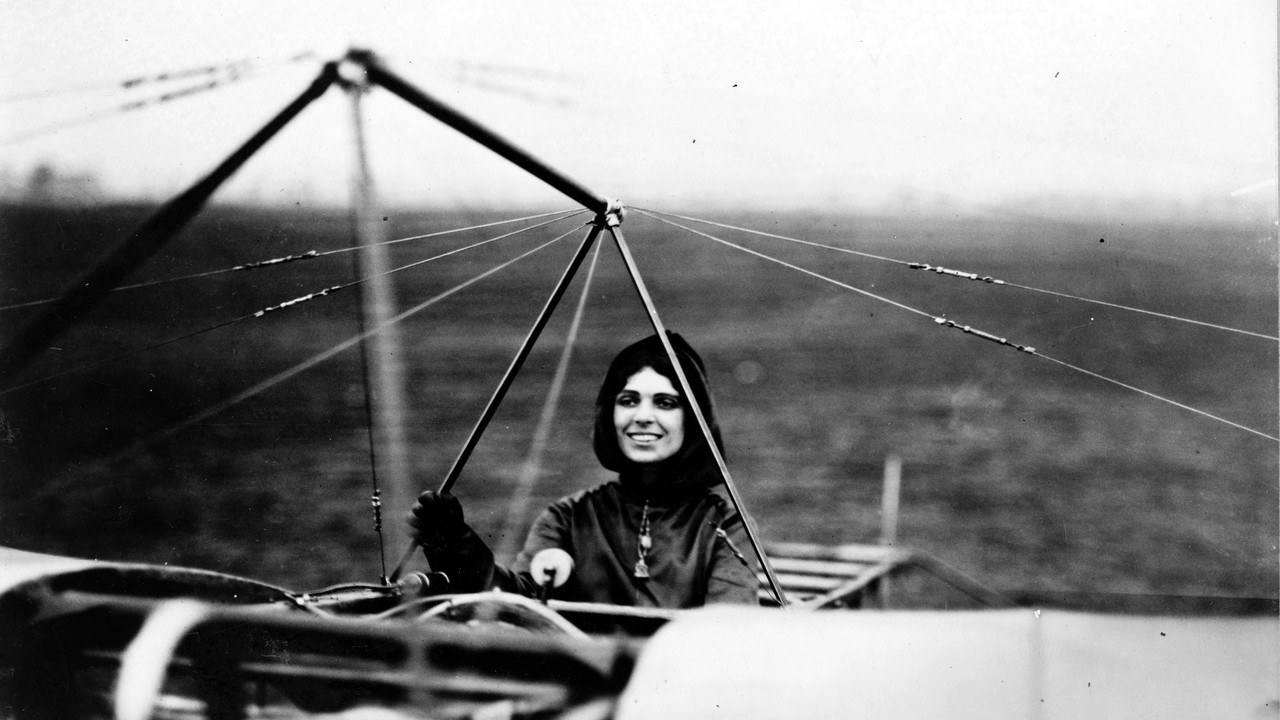
The Crossing the World Missed
On a foggy April morning in 1912, Harriet Quimby flew the English Channel with nothing but a compass, a watch, and a hot water bottle — and almost nobody was watching.
A License Barely a Year Old
Harriet Quimby had been a licensed pilot for less than eleven months when she climbed into a borrowed 50-horsepower Blériot XI at Dover on the morning of April 16, 1912. She was already a pioneer: the first American woman to earn a pilot certificate, a magazine writer who had turned celebrity aviator almost overnight. But the machine waiting on the Dover aerodrome was not the Moisant monoplane she had learned on. She had never flown this model. She had never flown over open water. And until that same morning, when British pilot Gustav Hamel pressed a compass into her hands and showed her how to read it, she had never navigated by instrument at all.
The weather offered every excuse to wait. Fog lay across the Channel like a cold gray blanket, hiding the French coast that had been plainly visible from the cliffs two days before. Hamel warned her that a drift of just five miles could put her down in the frigid water with no hope of rescue. He even offered to wear her plum-colored wool-and-satin flying suit and make the crossing himself, switching places with her after landing in France. Quimby refused. The doubting crowd gathered on the white cliffs had annoyed her, she later wrote, and that doubt only hardened her resolve.
Compass, Watch, and Mist
At 5:30 a.m., flying under the alias "Miss Craig," Quimby took off. The sky above Dover was clear, but ahead lay nothing visible. She climbed first to 1,500 feet, then higher still to 6,000, where the fog felt, she remembered, like tiny needles against her skin. Below her lay twenty-two miles of water and no landmarks. She flew on compass heading and elapsed time alone, clutching a hot water bottle someone had thrust into her hands before departure.
For the better part of an hour she hung in the mist, concentrating so hard on the compass that her head ached. The Blériot's engine began to backfire — gasoline had flooded the carburetors during descent, a design flaw that had already killed other pilots. Quimby later admitted she feared she might have to ditch in the Channel. Then the fuel burned off, the engine settled into an even purr, and she checked her watch. She had to be close.
The fog broke. Below her stretched a white-sand beach and green French farmland. She spiraled down and touched the sand at Hardelot-Plage, two miles from the hangar where Louis Blériot himself kept aircraft on the coast. The flight had lasted one hour and nine minutes. She was the first woman to fly the English Channel solo — three years after Blériot's own crossing had made the route a benchmark of aviation courage.
A Triumph Lost in the Headlines
For a minute after she shut down the engine, Quimby sat in an enormous silence. Then fishermen and their families came running from the beach, pails of sandworms in hand, and surrounded her with excitement. They understood immediately what she had done.
The rest of the world barely registered it. Two days earlier, on April 14, the RMS Titanic had struck an iceberg in the North Atlantic. By the time Quimby landed in France, newspapers on both sides of the ocean were consumed by the sinking and the loss of more than 1,500 lives. The New York Times reported her feat on April 17 — "American the First Woman to Pilot an Aeroplane Across" — but banner headlines belonged to the disaster at sea. When she returned to New York in May, fanfare was thin. The historic flight had happened; the historic attention had not.
Quimby was not finished. She had a contract to carry U.S. mail from Boston to New York, a first for a woman, scheduled for the final day of a Boston air meet in early July. Her new 70-horsepower Blériot had arrived from Europe. Stardom, and the fees that came with it, seemed within reach.
Seventy-Eight Days Later
On July 1, 1912, at the Boston Air Meet on a peninsula southeast of the city, Quimby took the meet's manager, William Willard, up for an evening flight over Dorchester Bay. Five thousand spectators watched the monoplane return against a blazing orange sky, strikingly silhouetted above the tidal flats. Without warning, the tail rose sharply. Willard was thrown from the rear seat. The two-seat Blériot was notoriously sensitive to balance, and without his weight the aircraft became unstable. Quimby appeared to regain control for a moment. Then the machine pitched forward again and she too was hurled out. Both fell roughly a thousand feet into the harbor. The airplane, empty now, righted itself and came down in shallow water with little damage.
Harriet Quimby was thirty-seven years old. She had held her pilot license for less than eleven months. In that brief span she had changed what women in aviation could aim for — and demonstrated, in a single hour over the Channel, a way of flying that did not depend on seeing the ground at all.
Why it matters to you
Quimby crossed twenty-two miles of open water with no radio, no GPS, and no horizon — only a magnetic compass, a wristwatch, and the discipline to hold heading while the world disappeared around her. That morning proved something every instrument-rated pilot trains for today: over water or in cloud, landmark flying fails, and dead reckoning backed by basic instruments is what keeps you alive. The Channel she crossed in 1912 is not so different, in principle, from the oceanic legs airline crews fly now. She had one hour and nine minutes of proof that navigation by needle and clock was not a stunt. It was the future.