The Cockpit You Can Crash
"The only place where a CFI will let you stall a 747 into downtown Chicago—twice."
The Cockpit You Can Crash
From a university thesis to planet-scale software—and FAA-certified devices that count as real flying—the flight simulator revolution rewrote what it means to train in the air.
In 1976, Bruce Artwick sat at a Digital Equipment Corporation PDP-11 minicomputer at the University of Illinois and watched a three-dimensional world unfold on screen at nine frames per second. An electrical engineering graduate student who had learned to fly through the university’s flight-instruction program, Artwick had turned his passion for aviation into a master’s thesis on real-time computer-generated flight displays. As IEEE Spectrum later documented, that academic exercise contained the DNA of an entire industry: the mathematics of perspective, the illusion of motion, and the conviction that a pilot’s eye could be faithfully reproduced in silicon long before personal computers existed.
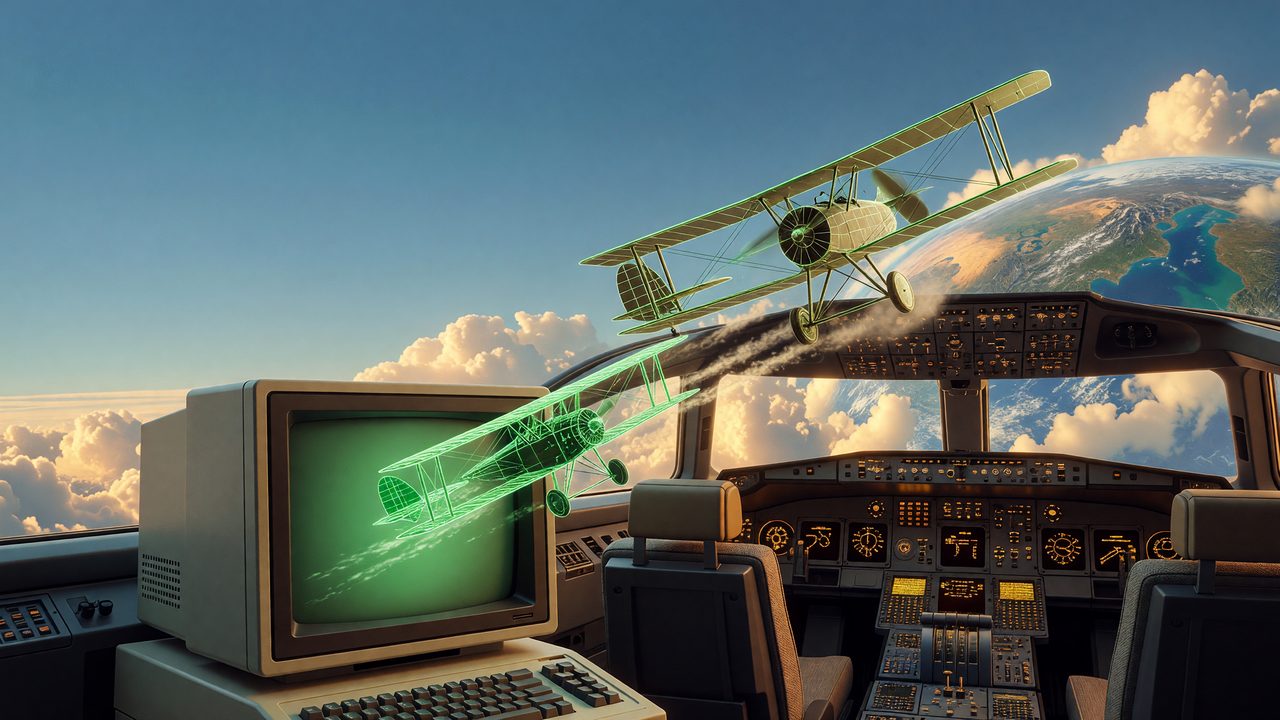
Artwick carried those ideas west to Hughes Aviation in California, then back into the garage. With his Illinois flying instructor Stu Moment, he founded SubLogic Corporation and began porting his three-dimensional graphics package to the microcomputers arriving in hobbyist magazines. When he demonstrated the software at trade shows and suggested it could power a flight simulator, audiences gasped. A screen showing the world from a cockpit seemed like science fiction. By late 1979, SubLogic had made it real. Flight Simulator for the Apple II rendered a wireframe Sopwith Camel biplane at roughly six frames per second—slow by modern standards, but revolutionary for a machine that lived on a kitchen table. Players could bank, climb, and dive through a polygon sky with no instructor aboard and no fuel bill.
IBM noticed. The new IBM PC needed software that showed what the hardware could do, and SubLogic’s simulator fit the brief. Microsoft, deep in the development of PC-DOS, offered better terms. Microsoft Flight Simulator arrived in late 1982 with a Cessna 182 over modeled terrain around Chicago and Seattle, color graphics on capable machines, and a refresh rate that reviewers called smooth at fifteen frames per second. The franchise mapped continents, added weather, adopted satellite textures, and outlasted the operating systems that launched it—surviving MS-DOS, the Windows porting wars, and even the 2009 closure of Microsoft’s Aces Game Studio, which had shepherded the series for years.
While home simulators entertained millions, a parallel revolution was codifying simulation as professional aviation infrastructure. For decades, airline training devices had been governed by a patchwork of advisory circulars and manufacturer standards. The FAA’s 2002 rulemaking on flight simulation device qualification—published in the Federal Register as “Flight Simulation Device Initial and Continuing Qualification and Use”—set out to unify those requirements into a single regulatory framework. The result, codified in 14 CFR Part 60, established formal qualification performance standards for flight simulation training devices, defined sponsor responsibilities, and created a tiered system from basic flight training devices through full-flight simulators. Level D full-flight simulators—the highest class—replicate aircraft motion, visual systems, and cockpit environments with sufficient fidelity that airlines may substitute simulator hours for aircraft hours in approved training programs. A captain can log zero flight time in the actual airplane for certain recurrent checks, provided the device meets Part 60’s continuing qualification requirements. The cockpit you can crash, it turned out, was also the cockpit you could certify.
The consumer and professional threads converged again in 2020. After a decade of silence following Aces’ demise, Microsoft released a new Flight Simulator built on satellite imagery and cloud-processed terrain—an entire planet modeled from aerial photography and artificial intelligence. The wireframe Camel of 1979 had become a photorealistic Earth. Artwick’s thesis idea, born on a university minicomputer, now spanned a billion-dollar software franchise and the regulatory architecture underpinning how the airlines train.
Why it matters to you
Which university master’s thesis spawned both a billion-dollar software franchise and modern FAA-certified flight training devices? Artwick’s 1976 work at Illinois did exactly that—and the through-line reaches your training today. When you rehearse an engine failure on a desktop sim before the lesson, or when an airline first officer steps into a Level D device for type-rating work, you are standing on the same conceptual foundation: a synthetic cockpit where mistakes cost nothing but attention. Part 60 governs the devices your future employer will trust; home simulators sharpen the scan patterns and muscle memory you bring to the real panel. The revolution is not history sitting in a museum case. It is the reason you can practice the hard parts—stall recovery, crosswind landings, emergency flows—until your hands know the sequence before the Hobbs meter ever ticks. Train in the cockpit you can crash. Fly better in the one you cannot.