The Cavalry Horse: How Kurt Tank Built the Fw 190
"A radial engine in a European fighter? Tank bet his career on it—and won."
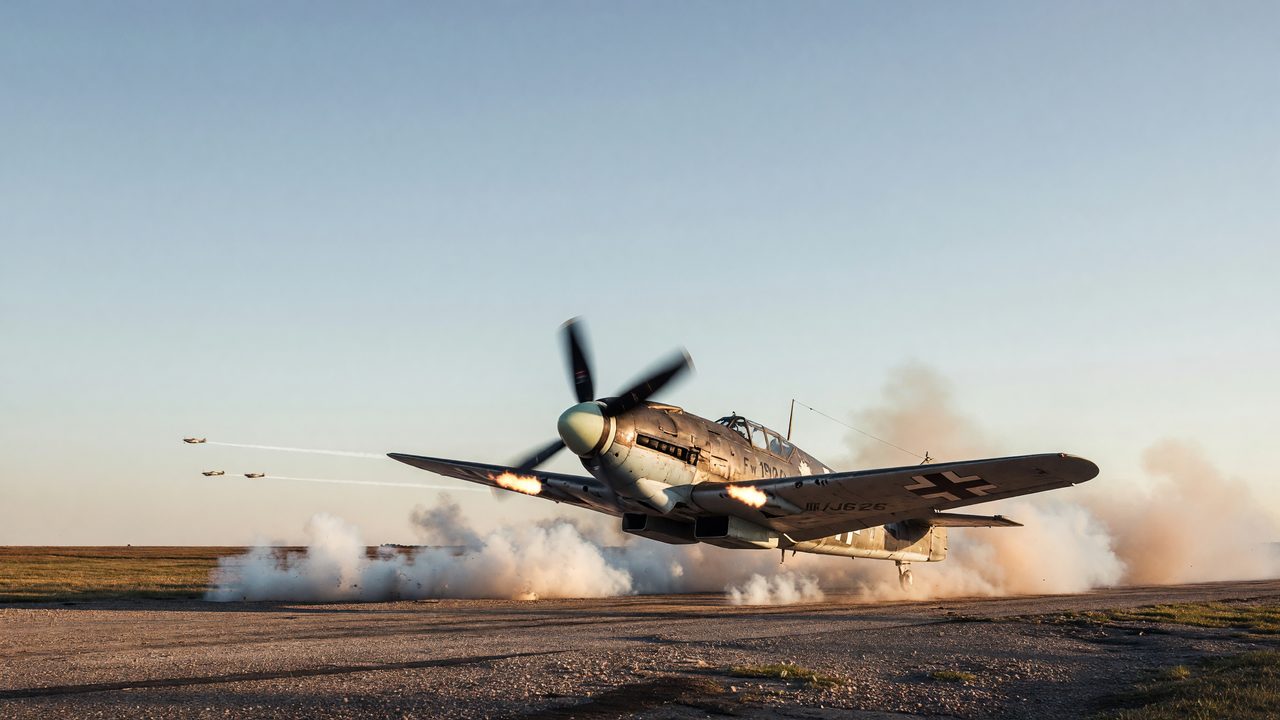
The Cavalry Horse: How Kurt Tank Built the Fw 190
When the Luftwaffe needed a partner for the Bf 109, one designer chose durability over dazzle — and changed the air war over Western Europe.
In the autumn of 1937, the Reichsluftfahrtministerium issued a tender for a new fighter to serve alongside the Messerschmitt Bf 109. Kurt Tank, chief designer at Focke-Wulf, answered with a proposal that broke from German orthodoxy. Where Willy Messerschmitt had refined a lightweight, inline-engine formula optimized for speed and climb, Tank argued for a radial-engine fighter built around a different metaphor entirely. He did not want a racehorse. He wanted a Dienstpferd — a cavalry horse: an aircraft that could operate from rough forward strips, absorb punishment, and bring its pilot home.
The Warbirds Resource Group’s Luftwaffe Resource Center documents Tank’s radial-engine rationale in detail. A radial offered structural advantages that an inline could not match. The engine block itself formed part of the airframe’s forward structure, spreading impact loads across a broad frontal area. Cylinders arranged in a circle presented a more forgiving target than a long, vulnerable liquid-cooled inline and its plumbing. Tank envisioned a fighter that could survive ground fire, shrug off shrapnel, and keep flying with systems degraded — qualities that mattered as much on the Eastern Front’s muddy strips as over the English Channel.
The Fw 190 V1 lifted off on 1 June 1939, according to HandWiki’s engineering record of the type. Power came from a BMW 139 radial — and immediately exposed the design’s greatest early weakness. The engine ran hot, and the tight cowling that gave the Würger its distinctive silhouette trapped heat around the cockpit. Chief test pilot Hans Sander described the experience bluntly: it was “like sitting with both feet in the fireplace.” For a fighter destined to fight at low altitude over summer battlefields, that was not an acceptable trade.
The solution arrived with the BMW 801 and its associated engine-management hardware. Martin Derry and Neil Robinson’s study of the BMW-engined A through G series describes how the larger, more capable 801 addressed the thermal crisis while delivering the horsepower the airframe demanded. Central to its operation was the Kommandogerät — an engine-control computer that automated mixture, propeller pitch, and boost settings that would otherwise have overwhelmed a pilot under combat stress. The pilot selected a power lever position; the system handled the rest. That integration freed mental bandwidth for gunnery and navigation while keeping the big radial within its operating limits.
When the Fw 190 entered front-line service in 1941, Allied pilots discovered quickly that Tank’s cavalry horse could fight. In level combat the new fighter out-climbed and out-rolled the Supermarine Spitfire Mk V — the RAF’s standard mount at the time. The Fw 190’s wide-track landing gear, another consequence of the radial layout, gave it a stable, forgiving ground presence and contributed to its superior roll rate in the air. The Royal Air Force responded with urgency, rushing the Merlin 61 into production to field the Spitfire Mk IX and restore a competitive edge.
Production exceeded 20,000 airframes across fighter, fighter-bomber, and ground-attack variants. The type served as an interceptor, a fighter-bomber over the Normandy beachhead, and a low-level attacker on the Eastern Front. Tank’s philosophy — rugged structure, wide gear, automated engine management, and firepower concentrated in the nose — proved adaptable across roles that would have strained a more delicate design.
Why it matters to you
Tank’s Dienstpferd philosophy and Messerschmitt’s racehorse approach represent two valid design philosophies, and the contrast maps directly onto how pilots think about aircraft selection and survivability today. The Bf 109 prioritized weight, climb, and aerodynamic cleanliness; the Fw 190 prioritized structural redundancy, systems automation, and operational flexibility. Wide-track gear, a radial engine that could keep running with cylinders damaged, and the Kommandogerät offloading cognitive tasks under stress were not incidental details — they were deliberate choices that made the Würger a tougher combat aircraft. Modern training emphasizes many of the same instincts: know your aircraft’s failure modes, understand what systems protect you when attention is divided, and respect that the airplane built to come home from a bad day is not always the one that wins the airshow. Tank understood that a fighter’s job is to complete the mission and return to fly again. That is a lesson every rated pilot carries into every preflight briefing.