The Camel That Bit Back — And Won the Sky
"It killed novices and crowned legends—sometimes on the same day"
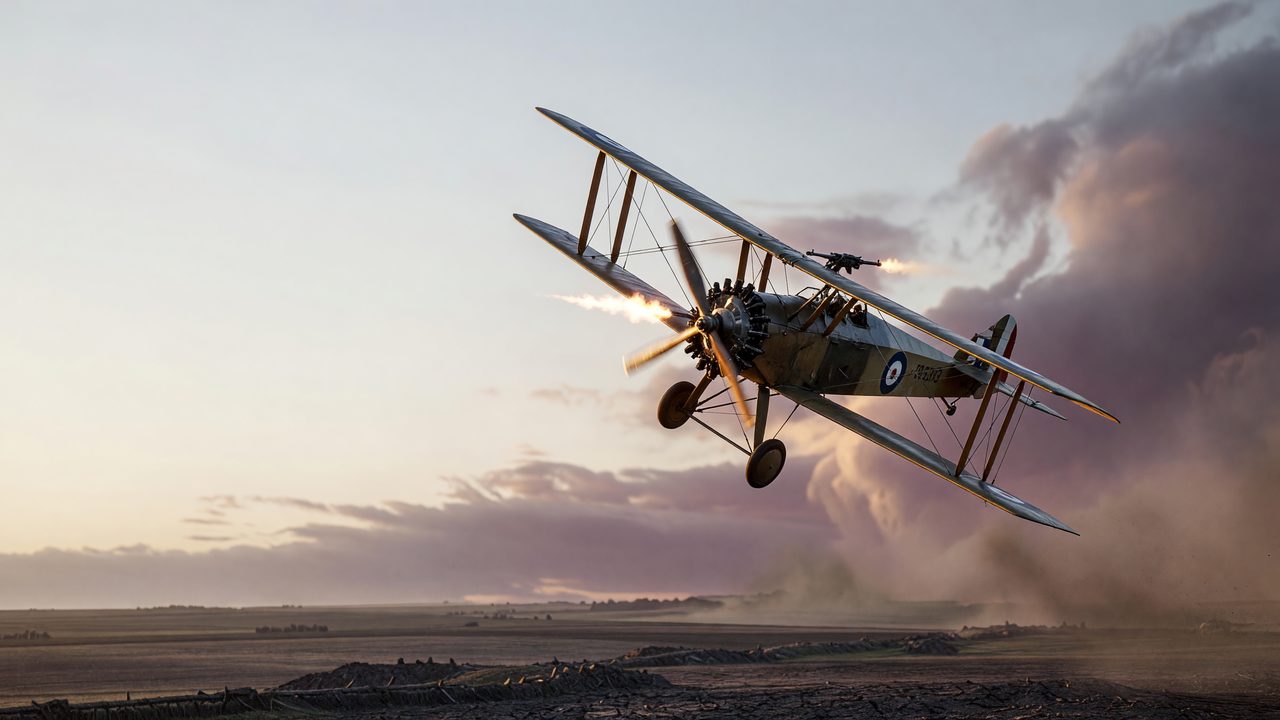
The Camel That Bit Back — And Won the Sky
Herbert Smith’s answer to the Sopwith Pup became the most victory-rich Allied fighter of the Great War — but only after it nearly killed the pilots who first strapped in.
When Herbert Smith set out to replace the gentle Sopwith Pup, he aimed for something faster, harder-hitting, and better suited to the Western Front’s tightening air war. What emerged from the Sopwith Aviation Company’s Kingston works in December 1916 bore the designation F.1 and a silhouette pilots would soon know by a blunt nickname: the Camel, for the hump over its twin Vickers machine guns. Chief test pilot Harry Hawker lifted the prototype from Brooklands on 22 December 1916. Within six months, the first production machines were crossing the Channel to No. 4 Squadron, Royal Naval Air Service, near Dunkirk — and the Allied training crisis began in earnest.
The Camel was not an evolution of the Pup so much as a deliberate concentration of mass. Contemporary analysis by aviation historian J.M. Bruce, drawing on wartime engineering records, notes that roughly ninety per cent of the aeroplane’s weight — rotary engine, pilot, armament, and fuel — lay within the forward seven feet of a fuselage barely eighteen feet long. That compactness gave the Camel a ferocious rate of roll and the ability to snap inside almost any German scout in a turning fight, a quality pilots prized when combat still meant hunting in the horizontal plane. The same geometry made the machine unforgiving. The Clerget, Le Rhône, or Bentley rotary up front did not merely pull the Camel forward; its spinning mass produced powerful gyroscopic precession. A clumsy right turn could slam an unwary aviator into the ground before his brain caught up with his hands. Training squadrons logged sobering attrition. The Camel killed inexperienced pilots at a rate that troubled commanders — yet veterans learned to ride the torque, using it to whip the nose around faster than an opponent could react.
In the gunsight, those handling extremes translated into lethal advantage. Bruce’s British Aeroplanes 1914–18 documents the standard armament: two belt-fed .303-inch Vickers guns synchronized to fire through the propeller arc, converging their streams ahead of the cockpit rather than wasting weight on a flexible observer’s mount. That forward concentration of firepower meant a short burst on target was often decisive. Only the Fokker Dr.I triplane, with its own fearsome pivot, could reliably out-turn a Camel in a classic dogfight — and even then, the Camel’s speed in the dive and its willingness to flick from one attitude to another kept it competitive through 1917, the year it became the defining Allied fighter.
Numbers tell the scale of that dominance. According to production and victory tallies compiled in Jon Guttman’s monograph Sopwith Camel and cross-checked against serial and unit records in Ray Sturtivant and Gordon Page’s The Camel File, pilots flying Camels were credited with 1,294 enemy aircraft destroyed by the Armistice — more than any other Allied type. Approximately 5,490 Camels of all marks rolled off British production lines, including the shipboard 2F.1 “Ship’s Camel” with its split armament of a Vickers and a Lewis on the upper wing, and the “Comic” night-fighter variants fitted for home-defence work against German bombers. Individual machines entered legend. Canadian ace William Barker scored forty-six victories in a single Camel, serial B6313 — the highest tally attributed to one airframe in the war, a record that still speaks to both pilot skill and an airframe that stayed deadly month after month.
The Camel was a killer, a champion, and — in the right hands — the most lethal fighting machine over the trenches in 1917. In the wrong hands, it was a coffin with wings. That duality is the aircraft’s enduring story.
Why it matters to you
Modern flight training still wrestles with the same question the Camel forces upon historians: when an aircraft racks up an extraordinary record, how much credit belongs to the machine and how much to volume and training pipeline? The Camel’s 1,294 victories are undeniable, yet nearly 5,490 were built — far more than any contemporary German fighter. A type that is merely adequate, flown often enough by pilots who learn its quirks, will outscore a brilliant design that never reaches the front in numbers. For today’s student and rated pilot, the lesson is not nostalgia for rotary engines. It is systems thinking. Handling characteristics, energy management, and aircraft-specific procedures — whether in a Camel or a modern trainer — are not trivia; they are the difference between exploiting an airframe’s strengths and becoming a statistic. The Camel did not forgive pilots who treated it like a Pup. Those who mastered its concentrated mass and gyroscopic temperament gained a weapon no German scout except the Dr.I could safely ignore. Evaluate every aeroplane you fly on its own terms, not its brochure — because history’s ace-maker was also its grave-digger, and the line between the two was skill.