The Buzz That Ended a Battle: RQ-2 Pioneer and History's Strangest Surrender
"The Pioneer gained its place in aviation folklore during ..."
The Buzz That Ended a Battle: RQ-2 Pioneer and History's Strangest Surrender
Before pilots worried about sharing the sky with drones, a two-stroke robot flying off a battleship taught the world that unmanned aircraft could change the outcome of a firefight—and receive a white flag.
An Interim Aircraft That Stayed
The RQ-2 Pioneer was never supposed to become a legend. According to U.S. Navy and Federation of American Scientists program histories, the Pentagon bought it as an interim unmanned aerial vehicle beginning in 1985, impressed by Israeli battlefield experience with remotely piloted reconnaissance in the early 1980s. Nine systems—each with eight air vehicles—entered service on an expedited timeline, skipping much of the usual development cycle, at a cost of roughly $87.7 million. The mission was practical and narrow: give tactical commanders and naval gunfire spotters real-time imagery from over the horizon.
First deployed aboard the battleship USS Iowa in December 1986, the Pioneer extended the eyes of 16-inch gun batteries that could reach targets beyond 24 miles. The Navy, Marine Corps, and Army would all fly it. Crashes, shipboard recovery problems, and electromagnetic interference plagued early operations; the service later spent tens of millions of dollars lifting the fleet to what officials called a "minimum essential capability." Imperfect as it was, the Pioneer kept showing up—Haiti, Somalia, Bosnia, Kosovo, and Iraq—until retirement in 2007, accumulating more than 20,000 flight hours across every major U.S. contingency of its era.
A Small Airplane With a Loud Argument
The Pioneer looked less like a weapon and more like an oversized model aircraft. AAI Corporation and Israeli industry partners built a twin-boom pusher with composite and metal construction, a 26-horsepower two-stroke engine, and a cruise speed around 65 knots. Launched by rocket assist from a battleship deck or by catapult ashore, it was recovered into a net or arrested by wire—tasks that demanded precise control from operators working through a ground control station linked by line-of-sight C-band radio out to roughly 115 miles.
Day or night, it carried a gimbaled sensor package—television or infrared—and streamed analog video to commanders who needed to see first and shoot second. For Marine and Army artillery units, that meant adjusting fire without exposing a human forward air controller. For the Navy's last active battleships, it meant spotting fall of shot for weapons that threw 2,000-pound projectiles. The airframe was deliberately small and largely non-metallic, harder to see and harder to track. What it lacked in grace it compensated for in persistence: endurance of several hours on a modest fuel load, enough to loiter while a fleet worked a coastline.
Faylaka Island, February 1991
Operation Desert Storm gave the Pioneer its defining scene. Navy records and FAS operational summaries credit the UAV with more than 300 combat reconnaissance missions across the Gulf War, including 71 Navy sorties totaling 232 flight hours. Gunfire support was among its finest work. Off Kuwait City, Faylaka Island's Iraqi defenders had already absorbed the message of modern naval gunnery when USS Missouri's 16-inch rifles, spotted by a Pioneer, tore into their positions.
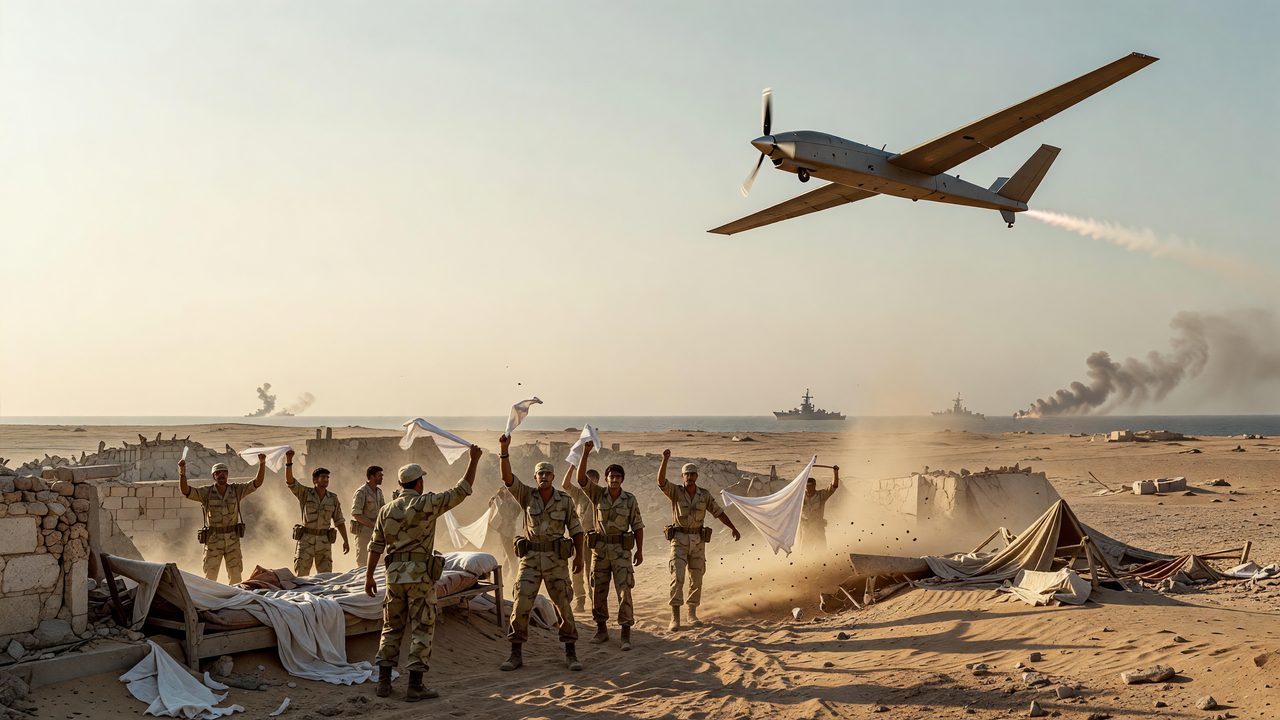
Still over the horizon and invisible to troops ashore, USS Wisconsin launched her own Pioneer on a low pass over the island. The aircraft was flown deliberately low so defenders would hear the distinctive rasp of its two-cycle engine overhead and understand what followed that sound: precisely aimed naval gunfire with little warning. National Air and Space Museum records describe what happened next. Iraqi soldiers waved white flags—handkerchiefs, undershirts, bedsheets—signaling surrender to an aircraft with no one aboard to accept it. The bewildered Pioneer aircrew radioed their commanding officer: "Sir, they want to surrender, what should I do with them?" U.S. Marines landed shortly afterward and took the prisoners. Museum curators later asked specifically for that air vehicle—Pioneer number 159—for the national collection, marking the episode as the first known instance of combatants surrendering to a robot.
From Curiosity to Fleet Habit
The Faylaka moment was theater, but the Pioneer’s war was statistical. Across Desert Shield and Desert Storm, Navy, Marine, and Army units logged nearly 1,700 flight hours on more than 500 sorties. The UAV spotted targets, assessed battle damage, helped vector forces against Iraqi patrol boats, and kept human crews out of range of hostile fire at a fraction of the cost of manned reconnaissance aircraft. Losses were real—combat and accidents claimed a dozen Navy and Marine air vehicles in the Gulf alone—yet commanders kept requesting the feed.
That pattern outlasted the battleships. Pioneers flew from amphibious ships and land bases through the 1990s and into the Global War on Terror era before the Navy replaced them with the RQ-7 Shadow. By then the argument was settled: unmanned aircraft were not experimental curiosities parked in the back of a hangar briefing. They were part of how the fleet and the field force understood the battlespace.
Why it matters to you
Every time you brief a traffic pattern, interpret another aircraft’s intentions, or coordinate with a controller who sees more than you do, you are practicing the same operational logic the Pioneer made vivid: the pilot who wins is often the one with the better picture, not the louder engine. Remote sensing, disciplined communications, and precise fire—or precise maneuver—all depend on trusting information you did not gather with your own eyes. The Pioneer’s crude two-stroke buzz over Faylaka Island was an early lesson in that chain. Whether your cockpit is manned or, one day, supplemented by systems watching your six from miles away, the skill is unchanged: read the scene correctly, confirm what you think you see, and act before the other aircraft—or the other battery—acts first.