The Butterfly That Outlasted a Century
"The V-tail that outlived every fashion trend in aviation."
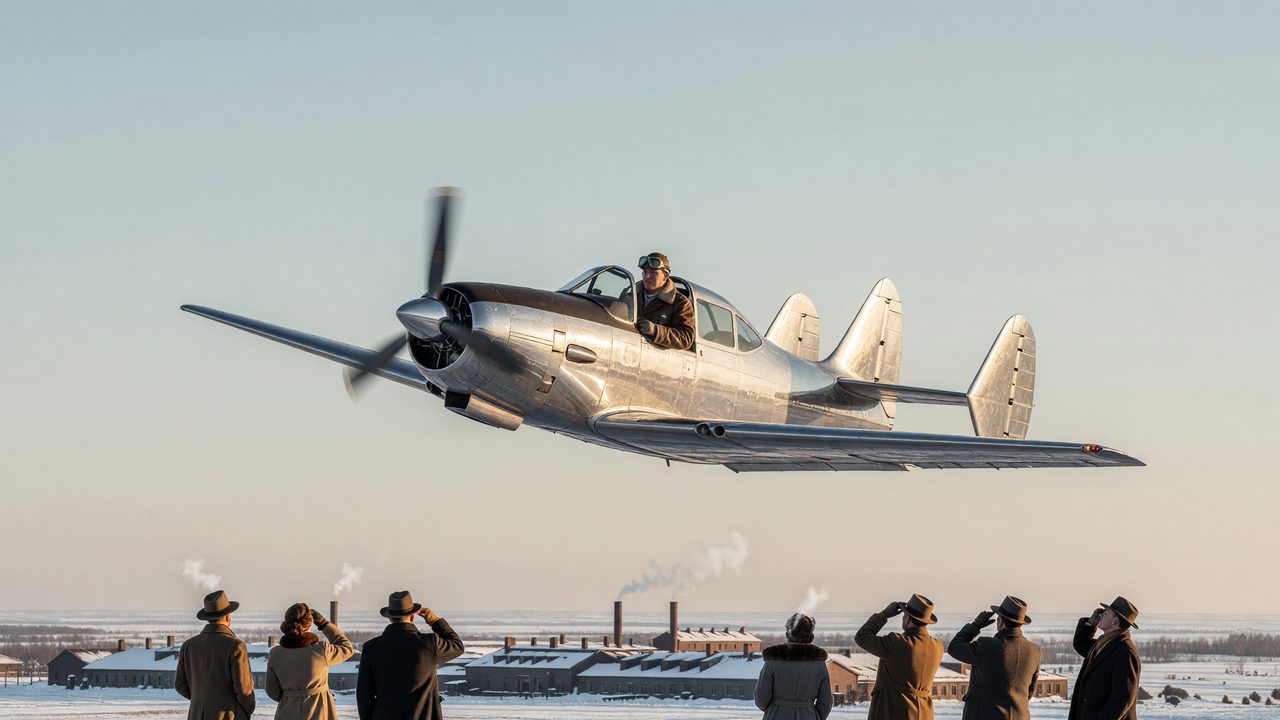
The Butterfly That Outlasted a Century
On a winter morning in Wichita, a single-engine airplane with a tail shaped like a V introduced a design language pilots still recognize eight decades later—and a lesson about elegance, speed, and the limits of both.
A City Stopped to Watch
Wichita had spent the war building bombers and trainers by the thousands, and when peace returned, Beech Aircraft needed a civilian flagship worthy of that industrial muscle. Walter Beech envisioned something closer to a flying luxury sedan than a tube-and-fabric trainer: an all-metal, four-seat monoplane with retractable gear, car-like cabin comfort, and genuine cross-country speed. Engineer Ralph Harmon’s team, including aerodynamicist Jerry Gordon, pursued every drag-saving idea the slide rule allowed. The most visible became the empennage: two surfaces canted upward in a shallow V, nicknamed the “butterfly,” doing the work of a conventional three-surface tail while shedding weight and wetted area.
On 22 December 1945, with much of the city reportedly pausing to watch, company test pilot Vern Carstens lifted the Model 35 into a cold Kansas sky. His 40-minute evaluation exceeded paper predictions—cruise near 175 mph—and his verdict to Beech was blunt praise: the best airplane the company had yet built. Certification was not painless. During aggressive high-speed dive tests in 1946, a pre-production Bonanza suffered an in-flight breakup when balance weights separated and the V-tail fluttered free of the fuselage, killing the pilot. Walter Beech ordered the program to continue; engineers stiffened the empennage, and the test fleet eventually logged more than 1,500 hours without recurrence. When the Civil Aeronautics Administration issued Approved Type Certificate A-777 on 25 March 1947, demand had already outrun the factory: roughly 1,500 firm orders waited, and the first production ships left Wichita at $7,975—a price that bought 180-mph travel in an era when most light airplanes still felt like prewar relics.
Orders, Oceans, and a Reputation
The Bonanza was not merely fast; it was marketed as fast. In March 1949, William Odom flew a specially modified A35 nicknamed Waikiki Beech from Hawaii to Teterboro, New Jersey—5,273 miles in just over 36 hours on 272 gallons of fuel. The flight was a deliberate statement about range and reliability, and the airplane later entered the Smithsonian’s collection. Back in the hangar, the type evolved through decades of incremental refinement: longer fuselages, fuel injection, higher-horsepower Continentals. The U.S. Air Force adapted the basic design into the T-34 Mentor trainer. More than 10,400 V-tailed Model 35 variants rolled out before production ended in 1982; add the straight-tail Model 33/36 line, and total Bonanza-family production exceeds 17,000 airframes—the longest continuous production run in single-engine general aviation history.
When the Tail Became the Story
From the first public glimpse, the V-tail divided opinion. Pilots admired its clean lines and crisp control response; insurers, accident investigators, and eventually the manufacturer grew uneasy. Independent analyses cited in FAA and industry literature noted that V-tail Bonanzas suffered in-flight structural failures at rates dramatically higher than their conventional-tail siblings, particularly when pilots combined high airspeed with aggressive maneuvering or when maintenance let ruddervator hardware degrade. Beech itself introduced the Model 33 Debonair in 1959 with a straight tail—same Bonanza bones, different aft end—and by 1982 discontinued V-tail production entirely, citing safety and liability concerns alongside market preference.
The controversy never erased the airplane’s achievement. Fortune magazine named the Bonanza among America’s best-designed mass-produced products in 1959. Generations of pilots treated it as the default answer to the question, “What single-engine airplane will get me there?”
Still Flying, Still Teaching
Today, Bonanzas—mostly straight-tail Model 36 variants—remain cross-country machines in flight schools, flying clubs, and corporate shuttle roles. The V-tail survives in smaller numbers, maintained by owners who accept its history along with its silhouette. What began as a postwar gamble on efficiency became a benchmark: proof that general aviation could build an all-metal traveling machine with turbine-like ambition on piston power.
Why it matters to you
The Bonanza’s V-tail was aerodynamically clever on paper—two surfaces, less drag, equivalent authority—but operational reality compounded across thousands of flight hours. High maneuvering loads stressed a structure that combined pitch and yaw control in each ruddervator; maintenance lapses, corrosion, and speed excursions that might be survivable in a conventional tail could become catastrophic. That gap between wind-tunnel elegance and fleet-wide safety data is exactly what your training asks you to close. When you evaluate any aircraft system—high-performance approach speeds, unfamiliar control mixing, supplemental type certificates, or an AD you have been putting off—you are practicing the same discipline Beech eventually embraced: respect the certificate’s limits, verify hardware condition, and treat design novelty as a factor in risk, not a substitute for judgment. The Bonanza did not endure because its tail was perfect. It endured because pilots learned, sometimes painfully, where perfection ended and procedure had to begin.