The Bug That Flew Before the Pilot Left the Cockpit
"Conceived by automotive inventor **Charles F"
The Bug That Flew Before the Pilot Left the Cockpit
In the final year of the Great War, a team of American inventors built a pilotless biplane that aimed its own warhead—fifteen years after Kitty Hawk, and a quarter-century before the weapons we recognize today.
A Problem Too Big for a Cockpit
By 1918, the United States Army faced a brutal arithmetic problem over France. It needed aircraft in numbers its infant aviation industry could not supply, and every sortie risked a trained pilot the nation could scarcely replace. Brigadier General George Owen Squier, the Signal Corps officer who had helped the Army buy its first Wright Flyer a decade earlier, watched a Navy demonstration of Elmer Sperry’s pilotless “aerial torpedo” on Long Island in November 1917 and came away convinced the Army needed its own answer: a flying bomb cheap enough to rival artillery shells, yet able to reach targets beyond gun range.
Squier turned to Charles F. “Boss” Kettering, the Dayton engineer whose electric automobile starter had already reshaped everyday transportation. Kettering and his industrial partner Edward Deeds channeled the work through the Dayton-Wright Airplane Company under the secret codename Liberty Eagle. Contracts signed on January 25, 1918, set an audacious target price—roughly five hundred seventy-five dollars per airframe in mass production—for a weapon carrying a 180-pound high-explosive warhead across roughly fifty miles of sky.
The Barn Gang Meets the Wright Legacy
What Kettering assembled was less a factory line than a salon of American technical genius working under wartime pressure. Orville Wright served as aeronautical consultant on the miniature airframe. Elmer Sperry, whose gyroscopic stabilizers had revolutionized naval gunnery, supplied the guidance philosophy Kettering had studied firsthand at the Navy’s Amityville trials. Thomas Midgley, later famous for other chemical breakthroughs, engineered the pneumatic autopilot. A young Major Henry H. “Hap” Arnold, deputy director of the Aviation Section, represented the Army’s stake in a program whose daily progress was logged by a tiny Signal Corps team quartered in downtown Dayton.
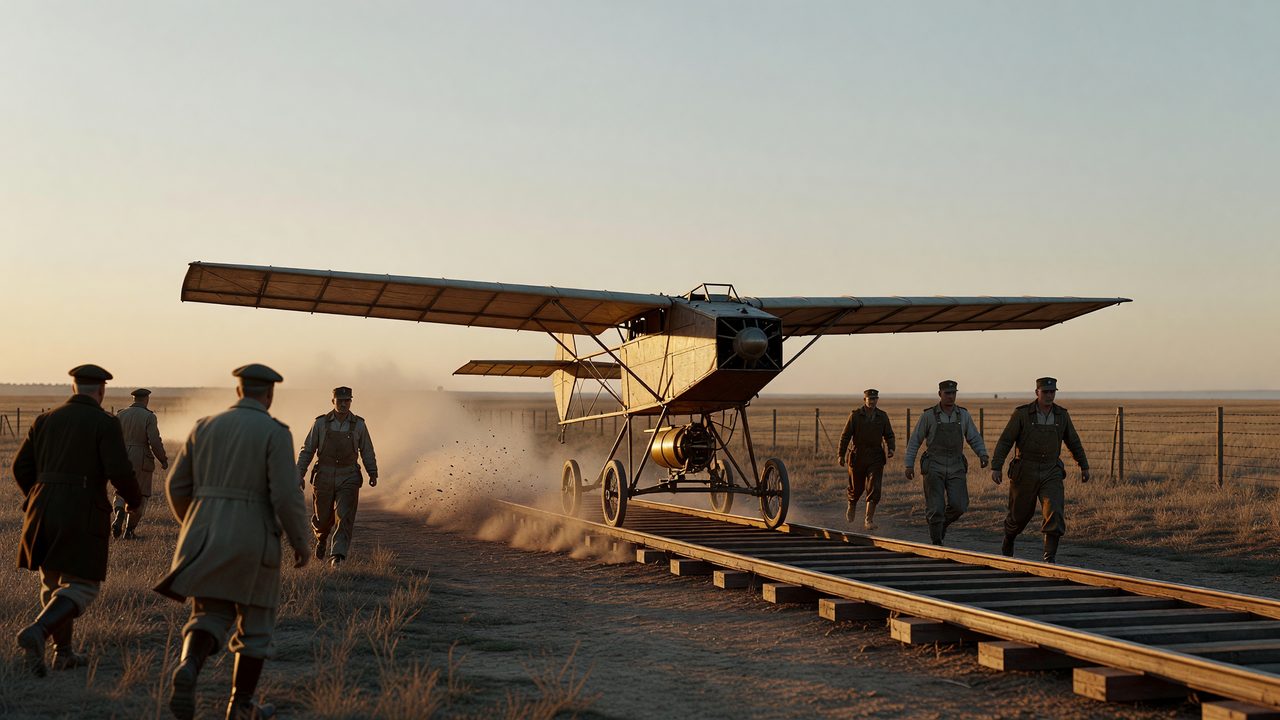
The airframe itself was deliberately humble: a twelve-foot biplane with roughly a fifteen-foot wingspan, built from scrap wood, cardboard, and even papier-mâché to keep weight down. A lightweight two-stroke, four-cylinder engine—developed outside Dayton with ties to Ford’s engineering world—provided thrust. There was no landing gear. Instead, the Bug rode a four-wheeled dolly down a portable track aimed at the target, echoing the Wright brothers’ rail-launched beginnings at Kitty Hawk fifteen years before. Once the engine reached flying speed, the craft lifted free and climbed.
Gyroscopes, Barometers, and Player-Piano Logic
The Bug’s genius lay not in its wings but in what happened after launch. A pneumatic gyroscope gave the system a stable reference for heading. A supersensitive aneroid barometer watched altitude, signaling small flight-control surfaces through a mechanical network of cranks and bellows—components Kettering reportedly scavenged from his own pipe organ and player piano before subcontracting similar parts from a keyboard-instrument manufacturer. Suction from the engine crankcase powered the closed-loop pneumatic system. A mechanical counter tracked engine revolutions, translating preset distance into counted turns of the propeller.
When the counter reached its setting, the sequence was brutally simple: the engine shut off, the wings folded back, and the fuselage with its 180-pound warhead tipped into a dive toward whatever lay along the launch azimuth. Directional stability initially depended heavily on wing dihedral; after an early test near Dayton in which a Bug swung toward a grandstand of Army officers—sending brass hats scrambling under the bleachers—engineers added lateral controls to correct the instability.
Tests, Flu, and a War That Ended Too Soon
Successful flights followed at remote sand dunes along the Florida coast, terrain that would later become part of Eglin Air Force Base. Arnold, convinced the weapon could alter the battlefield, lobbied to bring the Bug to General John J. Pershing in France. He crossed the Atlantic only to be waylaid by the Spanish influenza epidemic, then reached the Western Front in November 1918, days before the Armistice. Weather and timing denied combat employment. Roughly fifty Bugs were built; the program faded with the peace, though Arnold would later judge the device “twenty-five years ahead of its time,” comparing it favorably to the German V-1 that terrorized Britain a generation later.
Why it matters to you
Every time you engage an autopilot, trust a gyroscopic attitude indicator, or fly a stabilized approach on barometric altitude, you are exercising principles the Kettering Bug helped prove before most pilots had ever heard of instrument flight. The Bug’s designers solved a problem you still train for: maintaining heading and altitude without human hands on the controls, using sensors to close a feedback loop that moves control surfaces. Their solution was pneumatic and mechanical; yours is electronic and digital. The architecture, however, is recognizably the same—sense, compare, correct. The Kettering Aerial Torpedo never dropped a warhead on a European target, but it demonstrated that an aircraft could be entrusted to fly a predetermined path through the air. That idea outlived the wood-and-papier-mâché prototypes on the museum floor, and it lives in the avionics stack of the airplane you fly today.
Sources: National Museum of the U.S. Air Force, “Kettering Aerial Torpedo ‘Bug’ — Fact Sheet,” accessed 2026; Michael H. Taint, “Twenty-Five Years Ahead of Its Time: The American Aerial Torpedo in World War I,” Proceedings of the Ohio Academy of History, 2018; National Air and Space Museum, “Gyroscope, Autopilot, Kettering Liberty Eagle ‘Bug’ — Collection Record.”