The Bird That Answers Back
" Ground controllers began telling pilots to "
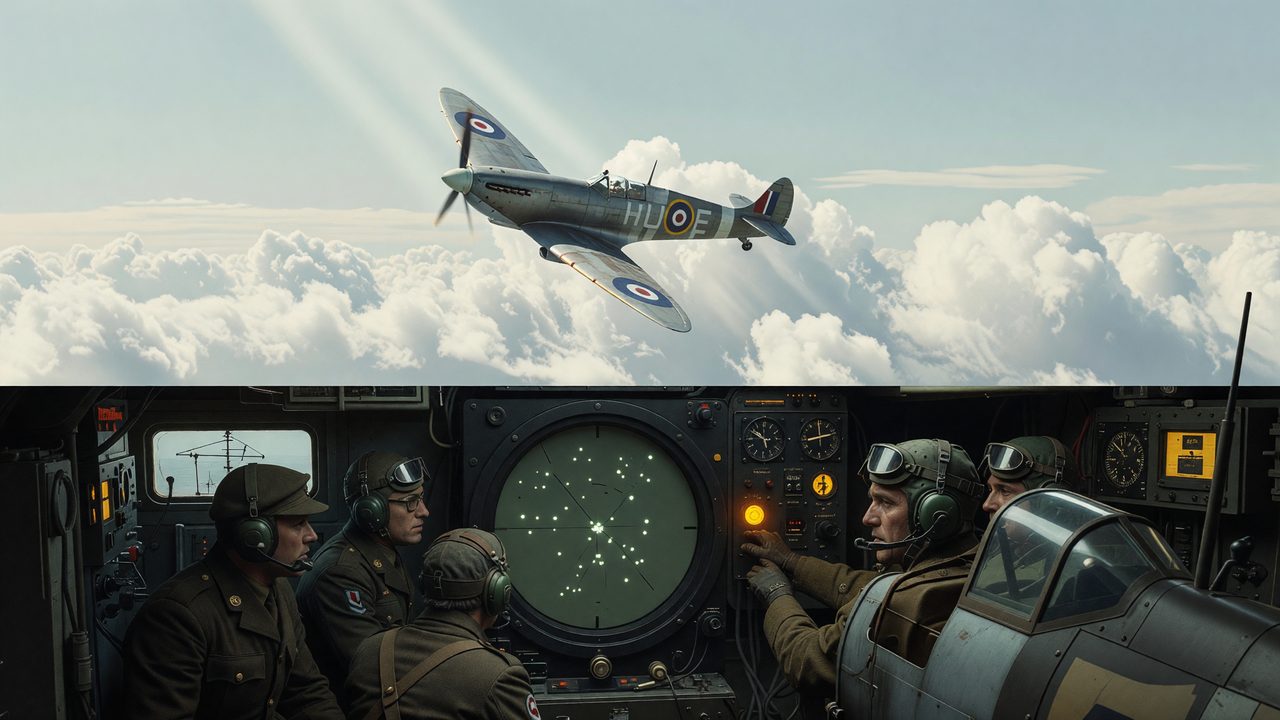
The Bird That Answers Back
Every time a controller says "squawk," you are speaking a dialect born in the Battle of Britain—when radar could see aircraft but could not yet name them.
Blips Without Names
In the summer of 1940, Britain's Chain Home radar stations gave Fighter Command something unprecedented: early warning of incoming formations. Operators watched cathode-ray tubes fill with returns—echoes from metal moving through the sky. The technology worked. The interpretation did not. A blip might be a Spitfire returning from a sortie, a Heinkel bomber climbing through cloud, or friendly traffic on a training leg. Controllers needed to vector fighters toward enemies without firing on their own. Radar alone could not supply that judgment. It could only report that something reflective was out there.
The answer was IFF—Identification Friend or Foe. Friendly aircraft carried equipment that listened for a radar interrogation and answered with a coded reply. Ground sets could then separate cooperative returns from those that stayed silent. The concept appears in period training material, including the Royal Air Force's 1943 film IFF MK III — Identification of Friend or Foe (Imperial War Museums, Object No. AMY 171), which walks operators through the logic of challenge and response. What radar had begun as a primary detection tool gained a second layer: aircraft that could identify themselves on demand.
Squawk Your Parrot
British engineers gave the airborne piece a code name that would outlive the hardware. They called it Parrot. When a controller wanted the identification circuit active, the instruction was to "squawk your Parrot"—make the bird answer. When silence was required, perhaps to avoid revealing position or to prevent enemy forces from learning the code's behavior, the order was to "strangle your Parrot." The bird metaphor was wartime brevity: vivid, memorable, and fast on a congested frequency.
After 1945, the nickname disappeared from cockpits and manuals. The verb did not. As researchers have noted in accessible histories of the term—including discussions tracing the etymology from "Parrot" to modern phraseology—"squawk" migrated into civil air traffic control along with the underlying technology. Controllers still use it when they want a pilot to set a transponder code. The parrot is gone. The squawk remains.
Mark III and the Secondary Reply
The IFF Mark III system, introduced in 1943, gave the idea engineering form. It operated in a dedicated band between 157 and 187 MHz. A ground interrogator transmitted a challenge; an aircraft transponder received it and transmitted a coded reply. U.S. Navy technical literature from the period, including HyperWar: The Capabilities and Limitations of Shipborne Radar (COMINCH P-08-09, Chapter 9), describes Mark III IFF and transponder operation in the context of shipborne radar—another environment where friend-or-foe ambiguity could prove fatal.
That architecture—interrogate on the ground, reply from the air—is secondary radar. It does not replace primary radar's range and track picture; it annotates it. The civil transponder system that supports modern ATC grew from this wartime pattern. When commercial aviation expanded after the Second World War, the equipment changed, but the contract between pilot and controller did not: when asked, you answer back.
Four Digits, Forty Years of Weight
Today a controller's "Squawk 7421" asks the pilot to enter a four-digit octal code—one of 4,096 possible combinations assigned for a flight or sector. Certain codes carry meaning no briefing card needs to explain. Seven-seven-zero-zero signals a general emergency. Seven-six-zero-zero means radio failure. Seven-five-zero-zero indicates unlawful interference. They are spoken in the same clipped shorthand forged when a missed identification might have meant confusing a Spitfire for a Stuka.
Academic summaries of how squawk codes entered civil use consistently point to this military lineage: a secondary system built because primary radar could not, by itself, declare intent or allegiance.
Why it matters to you
The engineering principles pioneered over the English Channel—interrogate, reply, discriminate—still sit in the transponder beside you. Primary radar paints your aircraft; your squawk tells the system who you are claiming to be. That is why training treats code entry as more than bookkeeping. A wrong code can tag you as someone else's flight; a deliberate emergency code triggers a response chain designed decades ago for a different kind of threat. When you verify assigned codes, know the hijack and lost-comm procedures, and understand what disappears from a controller's screen when the transponder is off, you are practicing the same discipline radar operators demanded in 1940: make the blip answer back, correctly and on time. The battlefield is quieter now. The cost of a silent or lying reply is not.