The Beauty That Lost the Prom
"The stealth supermodel that never made the runway."
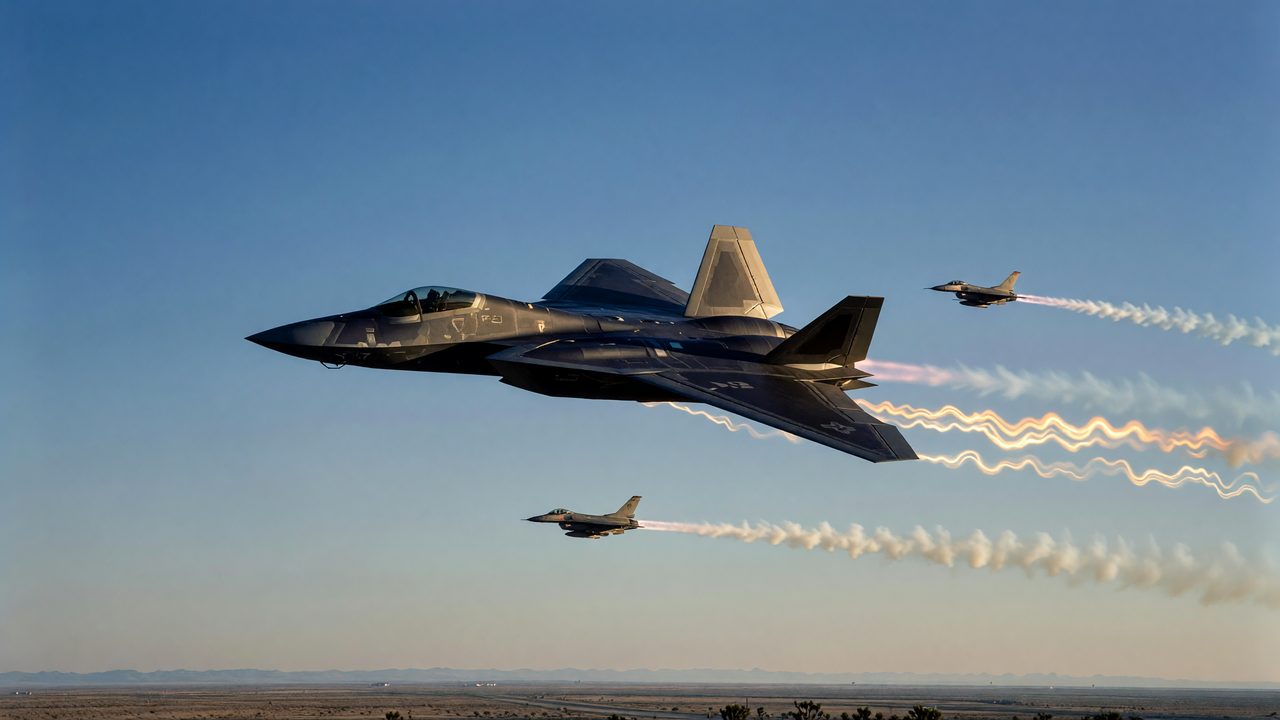
The Beauty That Lost the Prom
On a flawless Edwards morning in 1990, Northrop’s YF-23 Black Widow II proved she could outrun a chase F-16 without afterburner—and still lost the fighter contract that shaped a generation.
The Advanced Tactical Fighter program of the late 1980s asked for something no operational fighter had yet delivered: a machine that could cruise above Mach 1 without lighting the burners, vanish from enemy radars, and still dogfight when cornered. Two contractor teams answered. Lockheed, Boeing, and General Dynamics built the YF-22. Northrop and McDonnell Douglas built the YF-23, nicknamed Black Widow II in homage to Northrop’s P-61 night fighter of World War II.
On 27 August 1990, Northrop test pilot Paul Metz lifted the first prototype, PAV-1, off the Edwards runway into a near-perfect sky. The hour-long maiden flight was brisk enough that the F-16 chase aircraft, running in military power, had to engage afterburner simply to stay in position. For a first outing of an experimental stealth fighter, the pace was remarkable. A second prototype followed in October, flown by Jim Sandberg. Between them, the pair would log fifty flights and 65.2 hours before the program ended.
Shape Over Showmanship
Where the competing YF-22 leaned on two-dimensional thrust-vectoring nozzles to sharpen its low-speed handling, Northrop bet on geometry. The Black Widow II wore a diamond planform—wings and tail surfaces aligned so that radar energy reflected in predictable directions rather than back toward the emitter. S-duct inlets scooped air from beneath the wing, then routed it upward and inward through the structure before it reached the engine faces, shielding the spinning compressor disks that would otherwise flash on a hostile scope. Exhaust gases exited through submerged troughs along a serrated beavertail, a layout borrowed from Northrop’s B-2 experience and chosen because stealth and drag mattered more to the team than vectoring thrust.
The result was an aircraft that needed no thrust-vectoring to meet the Air Force’s handling requirements. Fly-by-wire tamed an intentionally unstable airframe, while canted “ruddervators”—combined rudder-elevator surfaces set at roughly forty-five degrees—trimmed the tail’s radar signature compared with a conventional four-surface empennage. When engineers plotted the design’s radar cross-section, the pattern resembled a spider’s eight lobes: energy scattered into discrete sectors rather than concentrated in a single blinding return. According to test pilot Paul Metz’s account in Northrop YF-23 ATF (Air Force Legends No. 220), and historian Tony R. Landis’s Defense Media Activity retrospective, the Black Widow II was stealthier in signature and faster in supercruise than its rival.
Numbers That Weren’t Enough
During demonstration flights, the YF-23 supercruised to Mach 1.72 without afterburner—evidence that Northrop’s low-drag, blended-fuselage philosophy worked in the real atmosphere, not merely in wind tunnels. Both prototypes, one fitted with Pratt & Whitney YF119 engines and the other with General Electric YF120s, satisfied every stated ATF performance requirement. The aircraft was larger than an F-15, carried more internal fuel, and projected longer unrefueled range—attributes that mattered for sustained combat air patrols over distant theaters.
Yet on 23 April 1991, Secretary of the Air Force Donald Rice announced that Lockheed’s YF-22 had won the Engineering and Manufacturing Development contract. Rice emphasized confidence in the Lockheed team’s management structure, production planning, and cost projections—not a claim that either prototype had clearly outflown the other. The decision, as Landis documents and the National Museum of the United States Air Force fact sheet on the YF-23A records, reflected institutional trust in a program office that had already shepherded the F-117 and was positioned to integrate the ATF into a Navy carrier variant the service still contemplated. Northrop’s technical elegance could not overcome a procurement culture that weighted schedule discipline and manufacturing risk as heavily as kinematic scores.
Two Ghosts in Plain Sight
The ATF flyoff ended with two airframes, no production line, and a single enduring question: what if the faster, stealthier jet had been chosen? PAV-1 eventually joined the collection at the National Museum of the United States Air Force at Wright-Patterson; PAV-2 went to the Western Museum of Flight in Hawthorne, California, not far from where Northrop had built the empennage. Neither flies again. They remain museum pieces—polished reminders that a fighter competition is never a pure time trial.
Why it matters to you
The YF-23 story is a caution for anyone who assumes the best aircraft wins the contract. Program management, production readiness, contractor track record, lifecycle cost estimates, and the Air Force’s confidence that a design can evolve through decades of upgrades routinely outweigh a single point of performance. As a pilot, you already know that checkride outcomes depend on more than raw stick-and-rudder skill: preparation, paperwork, judgment calls, and how convincingly you communicate your plan matter equally. The Black Widow II met every flight-test requirement and still lost the prom. When you evaluate an aircraft purchase, an airline interview, or even a go/no-go weather decision, train yourself to ask what non-performance factors might decide the outcome. Speed and stealth opened the door; trust in the team behind the airplane closed it.