The Beast of Kandahar: When a Blurry Photo Broke the Stealth Drone’s Silence
"Beast of Kandahar,"
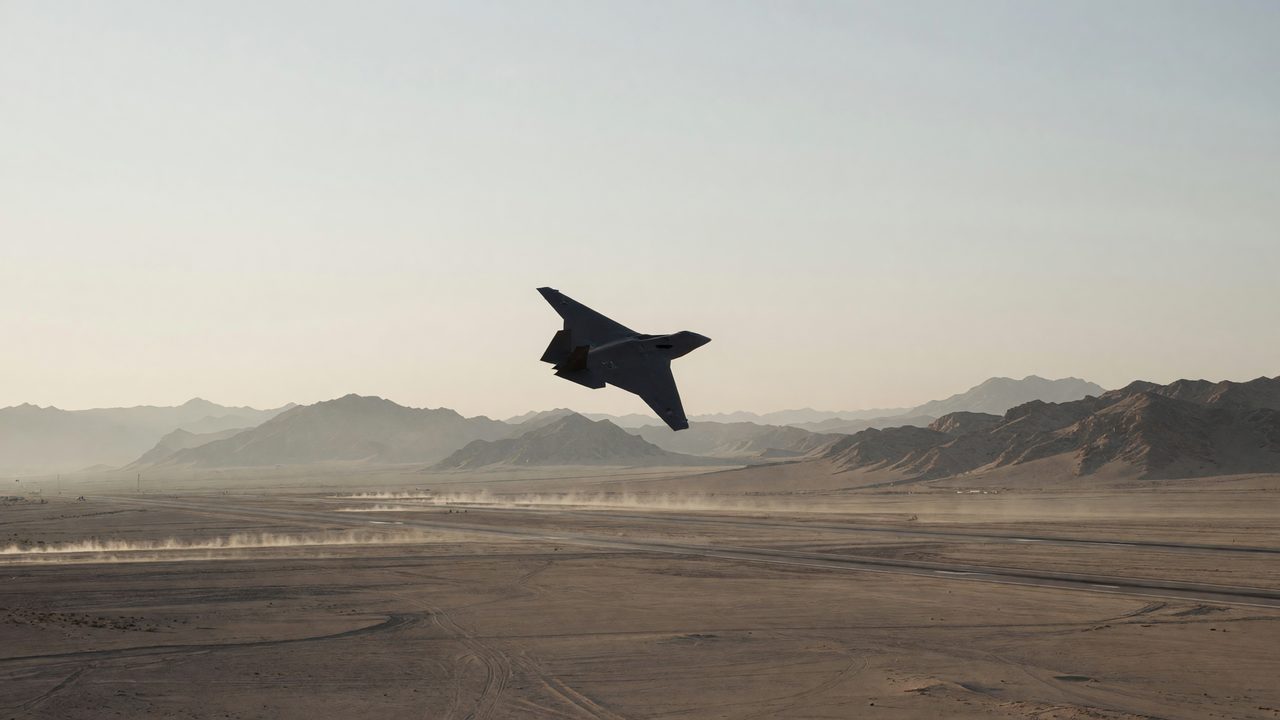
The Beast of Kandahar: When a Blurry Photo Broke the Stealth Drone’s Silence
In the age of satellite imagery and social media, one grainy photograph from Afghanistan did what billions in classified budgets could not: it forced the U.S. Air Force to admit that its most secretive reconnaissance aircraft had been overhead for years.
A Shape in the Desert Sky
The photograph was not much to look at. Taken from the ground near Kandahar Air Base in late 2009, the image showed a tailless, bat-winged aircraft climbing through the Afghan sky, its silhouette blurred by distance and heat shimmer. Within days, the picture circulated through aviation forums and a blog linked to the French newspaper Libération, and the guessing began in earnest. Enthusiasts recognized the hallmarks of low-observable design: no vertical stabilizers, a blended fuselage, and the broad, curved planform of a true flying wing.
The U.S. Air Force ended the speculation on 4 December 2009. In a brief statement corroborated by Aviation Week & Space Technology, the service confirmed operations of the RQ-170 Sentinel—a stealth unmanned aircraft system developed by Lockheed Martin’s Skunk Works. The aircraft had been flying since 2007, the Air Force acknowledged, though open-source reporting places its first flight around late 2005 at Groom Lake (Area 51); Afghanistan was its early operational deployment theater, not its documented first-flight site. Almost overnight, the anonymous shape in the desert photograph acquired a nickname that would stick: the “Beast of Kandahar.”
Skunk Works and the Flying-Wing Lineage
The Sentinel did not emerge from a vacuum. Lockheed’s Advanced Development Programs division—the Skunk Works—had spent decades refining the aerodynamic and material science of radar-evading aircraft. The RQ-170’s planform bore a clear familial resemblance to the B-2 Spirit bomber and to earlier company demonstrators such as the RQ-3 DarkStar and the Polecat, both of which explored tailless, low-observable unmanned flight in the 1990s and 2000s.
According to GlobalSecurity.org’s open-source compilation of program history, the Sentinel’s lineage also traces to an effort known as Desert Prowler, a classified reconnaissance initiative that predated the aircraft’s public debut. The 30th Reconnaissance Squadron, which operated the fleet, had been activated on 1 September 2005—two years before the RQ-170’s reported first deployment—suggesting that the organizational infrastructure for a covert unmanned reconnaissance force was laid well before the airframe ever appeared over Afghanistan.
The Air Force Fact Sheet on the RQ-170 describes it as a low-observable unmanned aircraft system designed to provide intelligence, surveillance, and reconnaissance support to joint force commanders. Unlike the propeller-driven MQ-1 Predator and MQ-9 Reaper that prowled the same battlespace at lower altitudes, the Sentinel was built to penetrate contested airspace and observe without announcing its presence.
Tonopah and the Culture of Secrecy
Where the Beast lived when it was not over Afghanistan was itself a statement. The 30th Reconnaissance Squadron operated from Tonopah Test Range, Nevada, under the 432nd Wing—the same remote desert complex that once concealed the F-117 Nighthawk during its own classified years. Tonopah’s geography and security culture made it a natural home for aircraft the public was not supposed to know existed.
For pilots and aviation historians, the parallel was instructive. The F-117 had been photographed years before the Air Force acknowledged it, earning the nickname “Hopeless Diamond” long before its 1988 unveiling. The RQ-170 followed the same pattern: years of operational flying, a single compromising image, and then a carefully worded confirmation that revealed only what secrecy no longer permitted the service to deny.
The Iran Incident and What Remained Hidden
The Sentinel’s cloak of secrecy was torn further in December 2011, when an RQ-170 was lost during a covert surveillance mission over Iran. Iranian state media broadcast images of the captured airframe, offering the public its clearest view yet of the aircraft’s dorsal intake, wing planform, and sensor fairings. The incident raised hard questions about mission planning, communications links, and the limits of unmanned penetration in denied airspace—questions the Air Force addressed only in general terms.
Yet the loss did not retire the type. Open-source reporting and official references indicate the Sentinel remains in service, continuing the quiet reconnaissance role for which it was designed. The Beast of Kandahar, once a rumor confirmed by a blog photograph, became a fixture of modern ISR architecture—present, capable, and largely invisible until something went wrong.
Why it matters to you
The engineering principles behind the RQ-170 are not confined to classified hangars. Every time you study how wing planform affects induced drag, how sweep and twist distribute lift across a span, or how engine placement influences both stability and radar cross-section, you are touching the same aerodynamic vocabulary that made the Sentinel possible. The flying wing is a demanding shape to fly—pilots of the B-2 train extensively on low-observable handling qualities, and the automation that keeps tailless aircraft stable informs the flight-control laws in many modern aircraft you will encounter. Beyond aerodynamics, the Sentinel’s story is a case study in mission planning: penetrating airspace, managing fuel and routing for endurance, and integrating ISR products into a joint picture. Whether you fly a Cessna 172 or a turboprop on an IFR cross-country, the habit of building a picture from limited information—of asking what you cannot see and planning accordingly—is the same discipline that kept the Beast of Kandahar aloft over Kandahar for two years before the world caught on. The most important aircraft in the sky are often the ones you never notice. Learning to think about what is absent from your windscreen is a skill no rating can confer and no autopilot can replace.