The Bait That Bit Back: How Operation Bolo Rewrote the Rules Over Hanoi
"the Wolf Pack"
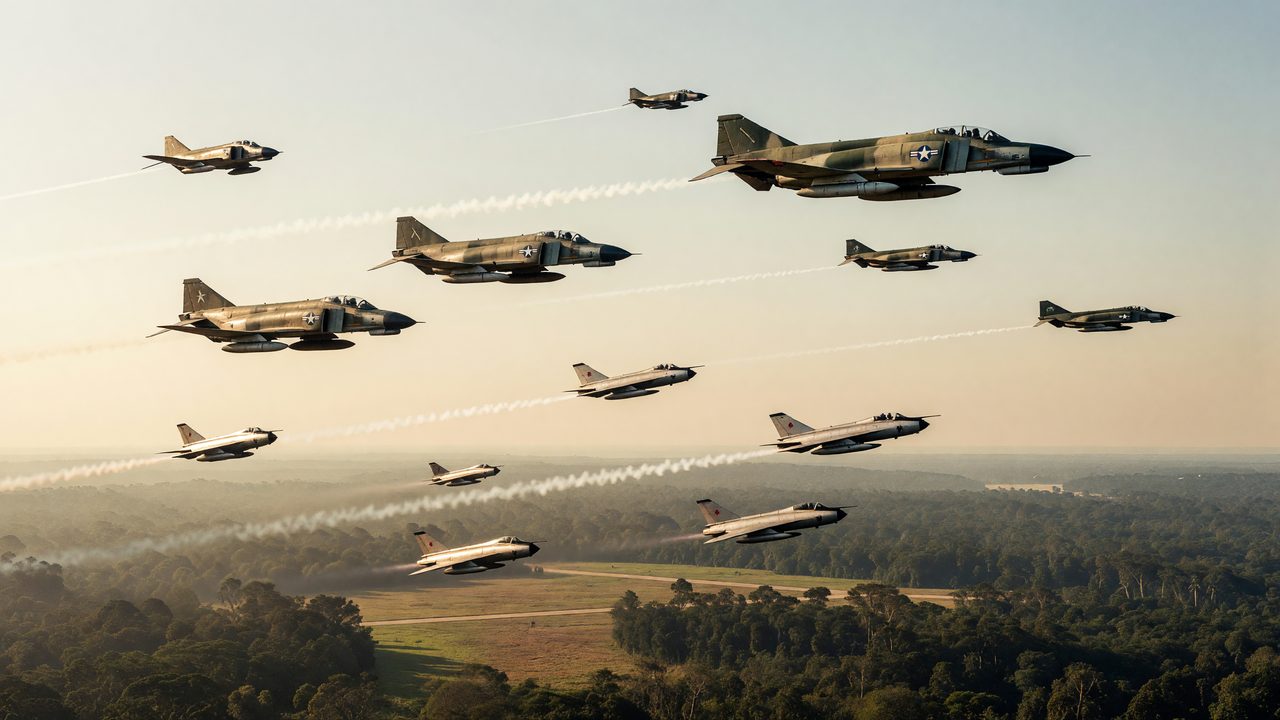
The Bait That Bit Back: How Operation Bolo Rewrote the Rules Over Hanoi
On 2 January 1967, American Phantoms dressed as Thunderchiefs—and turned North Vietnam’s MiG hunters into the hunted.
For months in late 1966, the air war over North Vietnam had settled into a grim arithmetic. Republic F-105 Thunderchiefs bore the weight of the bombing campaign, threading radar-guided missiles and MiG interceptors on the way to their targets. When the “Thuds” came, North Vietnamese controllers knew what to expect: strike call signs, familiar ingress routes, characteristic altitudes and speeds—and, critically, the electronic chatter of QRC-160 countermeasures pods carried only by the F-105 force. MiG-21 pilots had learned to rise against those packages with growing confidence.
Colonel Robin Olds, commanding the 8th Tactical Fighter Wing at Ubon Royal Thai Air Force Base, studied that pattern and saw opportunity where others saw frustration. His wing flew the McDonnell F-4C Phantom II, a superb fighter that had yet to prove itself against Hanoi’s MiG-21s in the numbers American commanders wanted. The problem was not the airplane; it was the script. MiGs rarely engaged Phantoms on American terms. Olds proposed something bolder than a standard fighter sweep: a deception so complete that North Vietnamese defenders would believe they were facing another routine Thunderchief strike—until it was far too late.
The planning, documented in the declassified History of Special 7th Air Force Mission, Operation Bolo, 2 January 1967 (released through the Freedom of Information Act in November 2014), was painstaking. Olds’s F-4s would fly the same routes, altitudes, airspeeds, and radio call signs that F-105 formations used on typical missions into the Red River Valley. Ground-controlled intercept operators listening on American frequencies would hear a familiar strike package taking shape. More subtly, the Phantoms carried QRC-160 electronic countermeasures pods—equipment previously associated almost exclusively with Thunderchiefs—so their radar and electronic emissions would match the signature defenders had come to associate with an incoming Thud raid. General William W. Momyer, who commanded Seventh Air Force during this period, later assessed the campaign’s air-superiority challenge in Air Power in Three Wars (1978); the Bolo concept fit his broader insistence that controlling the skies required forcing the enemy to fight on unfavorable terms, not merely reacting to MiG ambushes.
On 2 January 1967, the trap sprung. Instead of pressing toward fixed targets and bomb release points, the disguised Phantom formations orbited in the engagement zones near North Vietnamese airfields—presenting the profile of a strike force while remaining free to maneuver as pure fighters. Believing they were intercepting vulnerable bomb-laden Thunderchiefs, MiG-21s climbed to engage. They met eight-ship F-4 elements of the 8th TFW configured for air-to-air combat, supported by additional forces including the 366th Tactical Fighter Wing positioned to cover withdrawal routes against secondary threats.
The ensuing fights were swift and one-sided. Official tallies credit the 8th TFW with seven MiG-21 kills that day; some accounts cite higher figures, but the operational shock was undeniable regardless of the exact count. Not a single American aircraft was lost in the engagement. Olds himself claimed one of the MiGs, adding to a combat record that already spanned two wars. In his Corona Harvest interview with the USAF Historical Research Agency on 29 September 1969, he described the wing’s mindset that winter: patience, discipline, and a willingness to let the enemy’s own habits become the fuse. Pacific Air Forces historians, in a later commentary on the mission, note that it was on this day Olds dubbed the 8th TFW “the Wolf Pack”—a name that outlived the man and the war.
The aftershocks rippled through the North Vietnamese Air Force for months. MiG units were pulled back, retrained, and reorganized; the easy harvest of Thunderchiefs on predictable timelines had suddenly become a lethal trap. Bolo did not end the air war over the North, but it shattered a defensive rhythm that had cost American airmen dearly.
Why it matters to you
Operation Bolo endures in pilot training not as nostalgia but as a case study in operational design. The mission succeeded because planners aligned every observable cue—route, altitude, speed, call sign, electronic signature—with what the adversary expected, then deliberately broke the pattern at the decisive moment. Modern crews still live inside that logic whenever they brief threat reactions, emission control, formation integrity, or the difference between appearing predictable and actually being vulnerable. Deception in aviation is not theatrics; it is disciplined consistency across every channel an opponent can monitor, followed by a controlled deviation when the situation favors you. Olds and the Wolf Pack proved that the most dangerous trap looks exactly like yesterday’s routine flight—until the fighters orbiting overhead were never Thuds at all.