The Airborne Highway: Nine Days Over Holland
"**THE FLIGHT** On 17 September 1944, three airborne div..."
The Airborne Highway: Nine Days Over Holland
On 17 September 1944, the largest daylight airborne assault in history turned the Dutch sky into a supply corridor—and tested every principle of air movement planning that modern pilots still study.
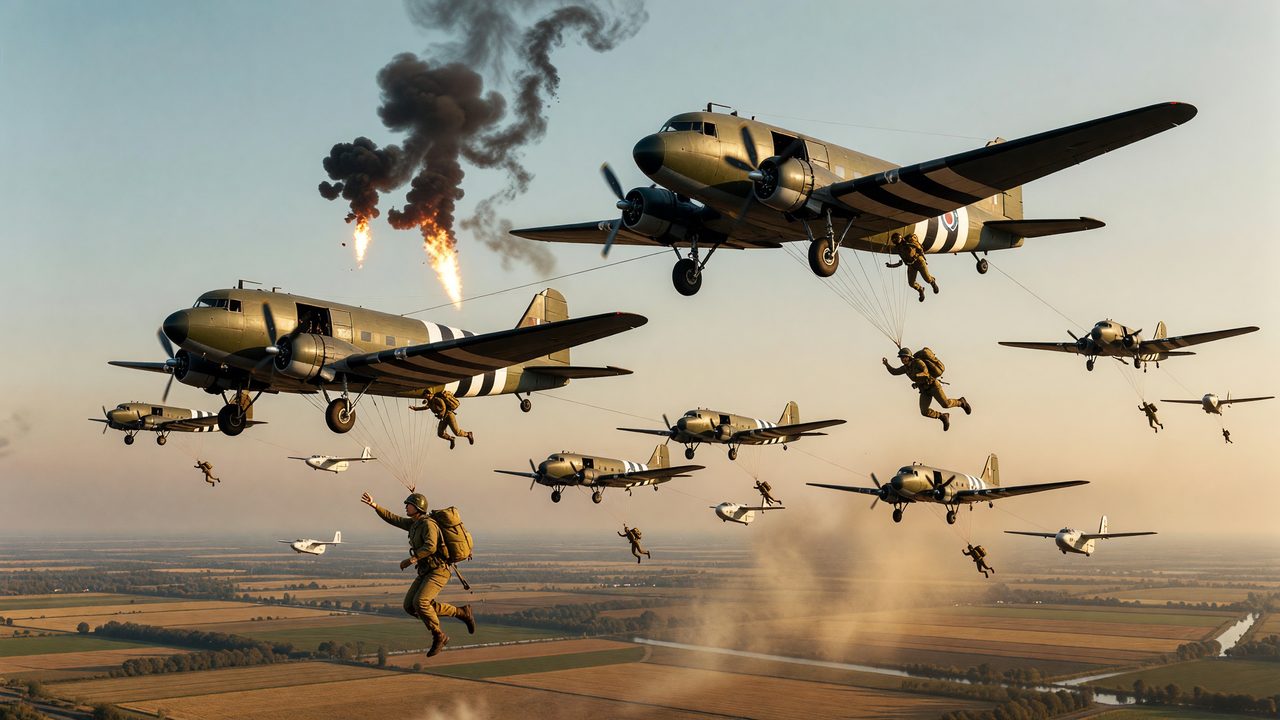
The morning of 17 September 1944 broke clear over the Netherlands, and for the first time in the war, three entire airborne divisions were committed to battle in full daylight. Operation Market Garden was Montgomery’s bold gamble to seize a chain of bridges from Eindhoven to Arnhem and open a corridor into Germany before winter. The airborne phase—Market—would seize the crossings; the ground phase—Garden—would race up the single road behind them. What pilots and planners called the “airborne highway” was not a road at all, but a meticulously timed stream of transports, gliders, and fighters threading through occupied airspace at treetop height.
The U.S. 101st Airborne Division dropped around Eindhoven, where the corridor began. Its paratroopers were tasked with securing the bridges and road junctions that British XXX Corps tanks would need within hours. Farther north, the 82nd Airborne took the Groesbeek Heights east of Nijmegen and fought for the Waal bridges—the corridor’s midsection. At the far end, the British 1st Airborne Division, reinforced by the Polish 1st Independent Parachute Brigade, landed in the orchards and heath around Arnhem, eight miles from the great Rhine crossing that would make or break the entire operation.
The scale of the air movement is difficult to grasp without the tables. The Combined Arms Research Library’s U.S. Air Movement Table for 17 September 1944 records serial after serial of C-47 Skytrains, Waco and Horsa gliders, and escorting fighters assigned to specific drop zones and landing zones with clockwork precision. The British 1st Airborne Division alone put 358 gliders on the ground on the first day, 301 on the second, and 35 on the third—a cumulative torrent of men, jeeps, anti-tank guns, and ammunition delivered under fire. RAF Stirling and Halifax tugs hauled Horsas alongside aircraft of the U.S. IX Troop Carrier Command; crews flew repeated sorties through flak that thickened as the Germans recovered from the initial shock.
What distinguished the American effort was preparation that began before the mission existed on paper. The Cornelius Ryan Collection at Ohio University Libraries preserves the 82nd Airborne Division’s daily plans for Operation Market, and they reveal an administrative and air-supply apparatus already built: resupply schedules, DZ/LZ assignments, and liaison channels with Troop Carrier units worked out in advance. When Market Garden was finally ordered, the division did not invent its air plan—it activated one. That foresight allowed the 82nd to fight at Nijmegen while still receiving bundles and glider loads on a timetable measured in hours.
Arnhem was where the highway ended. Major General Robert Urquhart, commanding the 1st Airborne, had expected light opposition. Instead, refitting elements of the German II SS Panzer Corps were resting near the drop zones. Urquhart’s own account, supported by the 1st Airborne Division’s operational orders and the British National Archives report CAB 106/962, “Report on Operation Market Garden, Airborne Operations at Arnhem, 17–26 September 1944,” describes nine days of brutal house-to-house fighting for a bridgehead on the north bank of the Rhine. Polish reinforcements dropped south of the river on 21 September; glider-borne anti-tank guns and jeeps arrived piecemeal. Ground fog and flak disrupted later lifts. Of the roughly 10,000 British and Polish soldiers who landed at Arnhem, fewer than 2,400 crossed the Rhine in the final night withdrawal. The last bridge had proved one bridge too far.
The air operation itself succeeded in its immediate task—troops and equipment arrived where planners intended, often on schedule. The failure was intelligence, timing, and the physical limits of a single road. Yet for aviators, Market Garden remains a case study in mass air movement under threat: serial integrity, escort coordination, glider tow release geometry, and the ruthless mathematics of lift capacity versus ground demand.
Why it matters to you
Every preflight briefing that weighs fuel, alternates, and threat corridors echoes decisions made over Holland in September 1944. The Air Movement Table was the era’s equivalent of a load manifest married to a flow program: each aircraft had a place in a sequence, and breaking that sequence stranded soldiers without jeeps or guns. The 82nd’s pre-built air-supply apparatus is a lesson in not improvising logistics when the mission order finally drops—prepare the administrative backbone before you need it. Flying in daylight through defended airspace demanded disciplined formation flying, clear comms, and acceptance that some losses were priced into the plan, much as today’s training stresses threat awareness without losing sight of the objective. Market Garden did not teach pilots to be reckless; it taught them that large-scale air operations are won in the planning room days before the first engine starts. Whether you are moving skydivers, running a regional cargo schedule, or studying military airlift history, the airborne highway over Arnhem is a reminder that precision, preparation, and sequence are not paperwork—they are the flight itself.