The Ace They Kept in the Classroom
"The only Allied pilot to claim over 60 confirmed kills—and he did it after being held back for two years as an instructor."
The Ace They Kept in the Classroom
Born in a Ukrainian village and held back as an instructor for two years, Ivan Kozhedub became the highest-scoring Allied fighter pilot of World War II—and the first Soviet aviator to down a German jet in combat.
Too Good to Risk
Ivan Kozhedub entered the world on 8 June 1920 in Obrazhiivka, a village in what is now Ukraine’s Sumy Oblast. He trained at the Chuguev Military Aviation School for Pilots and graduated in 1941, just as Germany invaded the Soviet Union. His instructors saw something rare in the young Ukrainian: precise stick-and-rudder work, calm under pressure, and an instinct for three-dimensional geometry that could not be taught from a syllabus. Rather than feed him into the meat grinder of the early Eastern Front, they kept him at the school as a flight instructor while the regiment evacuated eastward. For roughly two years, Kozhedub shaped other pilots’ hands and habits while combat consumed men faster than academies could replace them. He finally reached an operational fighter regiment in March 1943. Contemporary records place his first combat sortie on 26 March of that year—two years after his classmates began dying over the steppe.
Sorties, Battles, and the Lavochkin Line
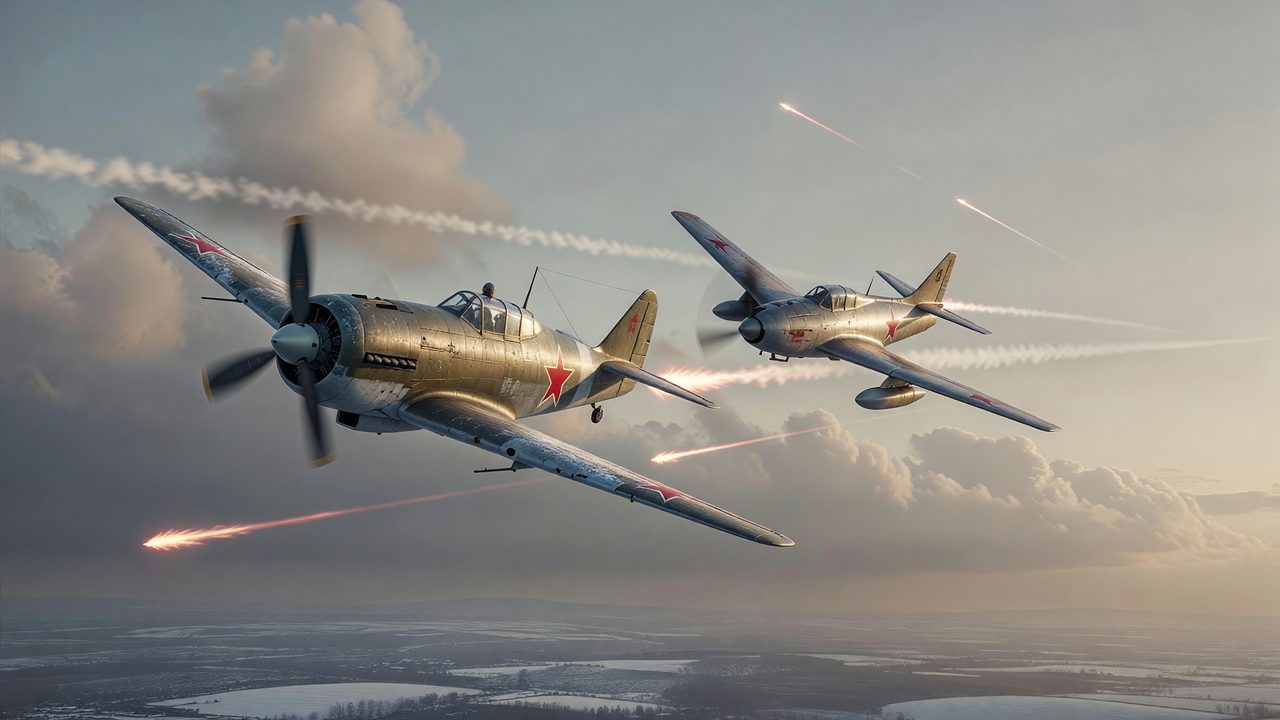
Kozhedub flew Lavochkin La-5FNs and, later, La-7s on the Voronezh, Steppe, Second Ukrainian, and First Byelorussian fronts. The Great Soviet Encyclopedia and later reference compilations credit him with 330 combat sorties, 120 air battles, and 62 confirmed aerial victories—the highest Allied tally of the war. He rose from senior pilot to flight commander, squadron commander, and deputy regiment commander, earning his first Hero of the Soviet Union gold star in February 1944. Soviet newspapers marked the milestones as they came. Vechernyaya Moskva, reporting on his career in April 1965, treated each victory as a matter of public record in a nation that measured wartime aviation in numbers as well as medals.
Kozhedub preferred short, violent engagements. He closed from below, held fire until the target filled his gunsight, and struck once. The tactic demanded patience and geometry, not sustained turning fights that bled energy and invited return fire. It worked especially well against Ju 87 dive bombers, a type that demanded respect for its forward armament but punished predictable approaches.
Free Hunting and the Tally That Followed
In July 1944, Kozhedub transferred to the 176th Guards Fighter Aviation Regiment—a unit organized for what Soviet commanders called “free hunting.” Rather than tying experienced pilots to standing escort or ground-attack schedules, the regiment sent pairs and flights to roam the front, intercepting whatever the enemy put aloft. Kozhedub, in a 1991 interview published by HistoryNet, described the assignment as a turning point: freed from rigid tasking, he could apply judgment, fuel state, and weather to where the Luftwaffe was most vulnerable. The La-7 gave him the power to exploit those choices. Victories that had accumulated steadily now came in clusters. By the time the Red Army pushed into Germany, he was among the most dangerous men in the sky over Central Europe.
A Jet, a Turn, and a First
On 19 February 1945, Kozhedub and his wingman Dmitry Titarenko were free-hunting south of Frankfurt when an Me 262 jet crossed their path. The Messerschmitt held a speed advantage in level flight, but jets of that era bled energy in the turn. Kozhedub attacked from below—the same geometry he had refined against propeller aircraft—closing as the 262 banked and slowed. Titarenko’s tracers may have helped fix the German pilot’s attention; Kozhedub’s burst did the rest. The kill made him the first Soviet pilot to destroy a German jet in combat, a footnote in the jet age that underscored an older truth: the machine’s envelope still had corners, and the pilot who saw them first usually wrote the logbook entry.
When the war ended, Kozhedub wore three Hero of the Soviet Union gold stars—a distinction shared in Soviet aviation only with Aleksandr Pokryshkin. He remained in uniform for decades, commanded fighter units through the Korean War era, and eventually rose to Marshal of Aviation. The village boy who had been judged too valuable to lose became the ace the Allies could not surpass.
Why it matters to you
Kozhedub’s instructors kept him in the cockpit but off the front because proficiency, judgment, and teachable habit matter as much as raw aggression—and those qualities are perishable without repetition. Two years of instruction did not dull him; they gave him a foundation so solid that 330 sorties and 120 dogfights produced a record that still stands among Allied pilots. His 1944 free-hunting assignment is the sharper lesson for today’s training: when a capable aviator is released from rigid tasking and trusted to read the sky, energy, and enemy behavior, decision-making accelerates faster than any checklist can simulate. Modern pilots practice the same transfer—moving from scripted maneuvers and supervised solos to scenarios that demand initiative, whether in formation lead, cross-country planning, or threat-aware intercept geometry. Kozhedub did not win 62 fights by waiting for permission to turn. He won them by studying the problem until the turn was obvious. That is still the job.