Tethered to Tomorrow
"Okay, I'm out,"
Tethered to Tomorrow
On June 3, 1965, Edward White became the first American to leave his spacecraft—and proved that human beings could work in the void with discipline, not just daring.
When a Titan II booster lifted Gemini IV from Cape Kennedy on the morning of June 3, 1965, NASA was no longer merely proving that Americans could survive orbit. Command pilot James McDivitt and pilot Edward H. White II were tasked with staying aloft four days—longer than any U.S. crew had yet endured—and with demonstrating skills Apollo would demand: precise navigation, sustained life support, and, most dramatically, extravehicular activity. Ten weeks earlier, Soviet cosmonaut Alexei Leonov had floated outside Voskhod 2 during a one-day flight. The space race had a new benchmark. Gemini IV was America's answer.
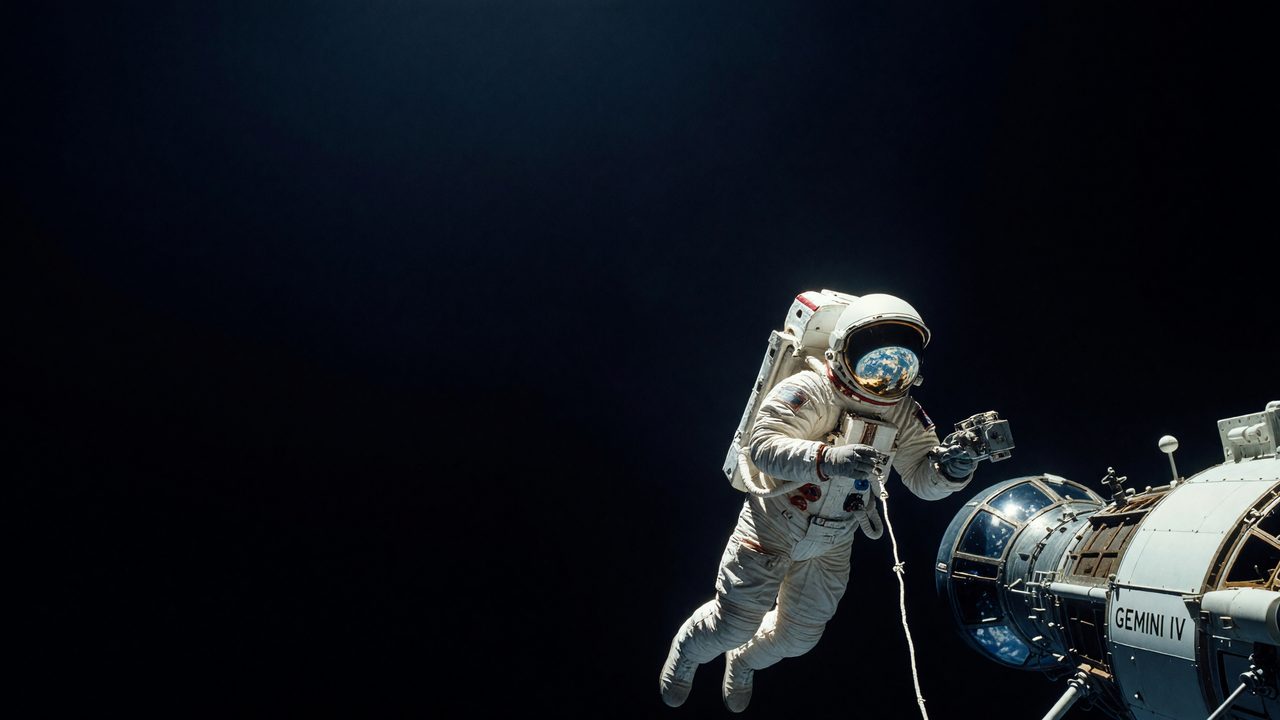
The spacewalk did not wait until the mission's final hours. On the afternoon of launch day, as the spacecraft passed above a Pacific tracking station during its third revolution, White pressurized his G4C spacesuit, McDivitt depressurized the cabin, and the hatch swung open. According to NASA's Gemini IV PAO commentary transcript, White reported simply, "Okay, I'm out." For roughly twenty-three minutes he remained outside, secured by a twenty-five-foot umbilical that carried oxygen and communications lines. A Hand-Held Maneuvering Unit—a pressurized oxygen "zip gun"—let him translate along the spacecraft. He told McDivitt the device worked well and that maneuvering felt easy. Photographs from the flight show White's gold-faced visor catching sunlight above a vivid Earth: coastlines, cloud decks, and open ocean wheeling beneath a man who was, in the most literal sense, walking in space.
Leonov's pioneering egress had been harrowing; his suit stiffened and he struggled to re-enter his capsule. White's outing, by contrast, projected control. He moved with purpose, tested the maneuvering gun, and clearly relished the view—so much so that McDivitt eventually had to call him back when flight controllers ordered the EVA ended. The contrast mattered politically and operationally. NASA could tell the world that an American astronaut had operated outside his vehicle with confidence, not desperation. Yet the achievement was not showmanship. Every Gemini flight was a classroom, and EVA was coursework for lunar surface work and in-flight repairs still years away.
Gemini IV carried eleven experiments outlined in the mission press kit, ranging from medical monitoring to Earth photography and spacecraft systems tests. Among the most forward-looking was celestial navigation with a sextant—practice for cislunar trips when ground tracking alone would not suffice. The crew also attempted to rendezvous with the spent Titan II second stage, a rehearsal for the docking maneuvers future lunar missions would require. Without onboard radar, the task proved far harder than training had suggested. McDivitt and White could see the booster, but closing distance and judging relative motion by eye turned out to be a subtle art. They burned fuel without achieving a true rendezvous. The disappointment was valuable. Subsequent Gemini crews received sharper coaching in pilot-controlled closure, and planners gained respect for what sensors—not instinct alone—must provide in the closing phase of a intercept.
The four-day mission ended with a controlled splashdown on June 7, 1965, after more than ninety-six hours in orbit. White's golden figure against the planet below became one of the defining images of the 1960s: exploration as a human silhouette, linked to a fragile machine by nothing more than a line and nerve. Less photogenic but equally important were the quiet corrections written into training schedules afterward—better rendezvous procedures, harder questions about what a pilot can see, measure, and trust.
Why it matters to you
The legacy of Gemini IV lives in every cockpit where two pilots must divide attention under pressure. McDivitt flew the spacecraft, monitored systems, and enforced timelines while White—euphoric, task-saturated, physically working outside normal references—needed firm, calm guidance to come back inside. That is crew resource management in its elemental form: one crew member lost in the wonder of the moment, the other protecting the mission clock. The failed rendezvous teaches a lesson every student pilot meets in gentler form: visual contact with a target does not equal controlled closure. Judging closure rate, lead angles, and energy state without the right instruments is a recipe for wasted fuel and missed objectives—whether you are closing on a spent rocket stage at 17,000 miles per hour or aligning with final approach in a Cessna. And White's sextant work reminds rated aviators that electronic navigation is magnificent until it isn't; backing up GPS with pilotage, timing, and celestial logic remains a professional habit. Four days after Edward White opened that hatch, the photograph still glows. The training it bought still shows up in how we brief, divide duties, and fly the procedure when the view is magnificent and the margin is thin.