Sunlight at the Controls: Solar Impulse 2’s Round-the-World Flight
"117 hours"
Sunlight at the Controls: Solar Impulse 2’s Round-the-World Flight
In 2015–2016, a Swiss solar airplane circled the globe without fuel—and rewrote what pilots could ask of energy, endurance, and weather.
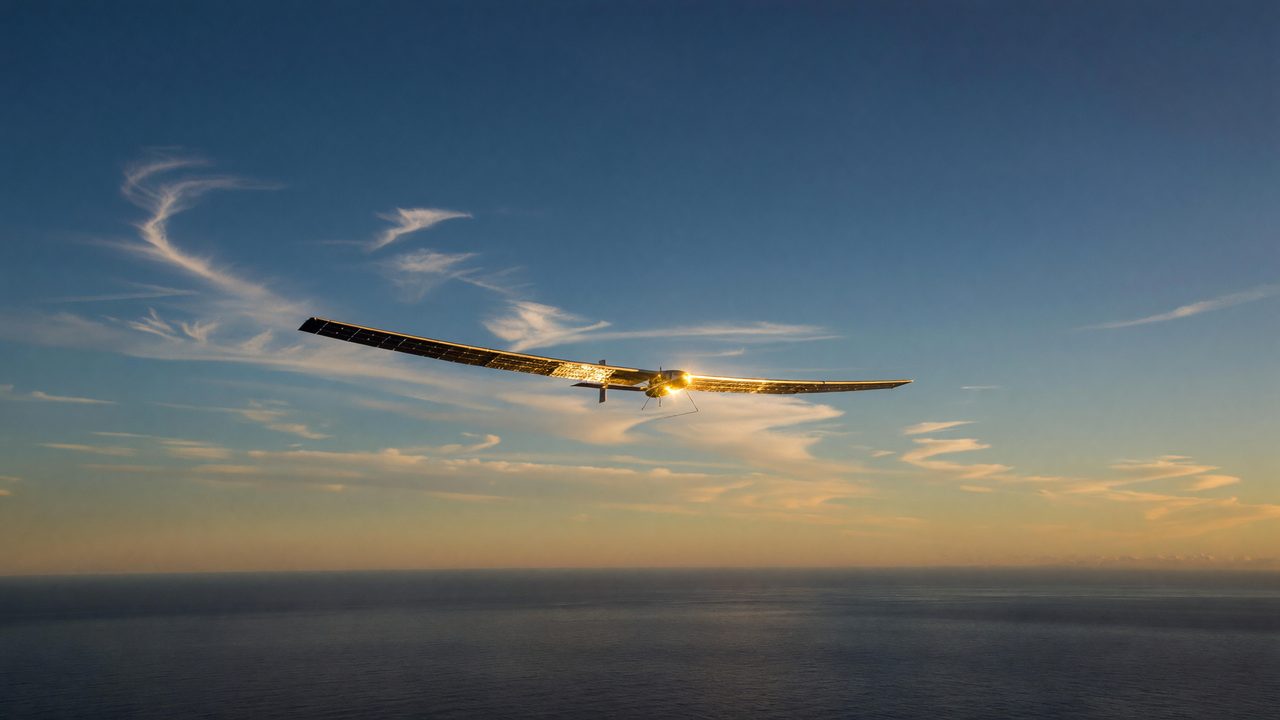
On the morning of March 9, 2015, Solar Impulse 2 rolled onto the runway at Abu Dhabi’s Al Bateen Executive Airport and lifted into a sky that would become both propellant and proving ground. The aircraft’s 72-meter wingspan—wider than a Boeing 747’s—was draped with roughly 17,000 photovoltaic cells. Beneath that luminous surface lay a carbon-fiber airframe lighter than a family car, four electric motors, and lithium-polymer batteries sized to carry the machine through darkness as well as daylight. The mission was blunt in its ambition: circle the Earth without burning a drop of conventional fuel.
At the controls were two Swiss pioneers who had spent thirteen years turning a laboratory dream into an operational airplane. Bertrand Piccard, psychiatrist and balloonist, brought the vision; André Borschberg, engineer and former fighter pilot, brought the systems discipline. Solar Impulse 2 was never meant to be a prototype for tomorrow’s airline fleet. It was a flying laboratory—an argument made in altitude and amp-hours that clean technologies could achieve what skeptics called impossible.
The route unfolded in seventeen stages across four continents, three seas, and two oceans. Each leg demanded a pilot’s attention to energy state the way a piston pilot watches fuel: climb only when the sun could repay the debt, trade altitude for range when headwinds thickened, and treat battery temperature as seriously as any red-line limitation. Weather was not background scenery but mission-critical infrastructure. The team routed around storms, waited on favorable synoptic patterns, and accepted that a solar airplane’s “cruise speed” was sometimes measured in patience as much as knots.
The flight’s decisive chapter opened in July 2015. Borschberg departed Nagoya, Japan, pointed east across the Pacific, and did not land for 117 hours and 52 minutes—nearly five days and five nights aloft. The Fédération Aéronautique Internationale later ratified that effort among nineteen world-record claims tied to the project, including the absolute record for longest uninterrupted solo flight. BBC News coverage of the completed circumnavigation placed that Pacific crossing at the heart of the achievement: one human, one fragile electric ship, holding station between sunrise and sunrise while the ocean offered no alternate aerodrome.
Success on the water came at a cost. Battery damage discovered after the Hawaii arrival forced a layover measured not in weeks but in months—nearly ten months of repair and recertification before the journey could resume. The interruption underscored a truth every long-distance pilot learns in softer form: the airplane can be flawless on paper and still grounded by a single exceeded thermal limit. When Solar Impulse 2 returned to the sky in 2016, the team flew the remaining stages with the caution of people who had already felt how narrow the margin could be.
Piccard brought the expedition home. On July 26, 2016, he touched down again at Abu Dhabi after roughly 42,000 kilometers and 555 hours of flight time spread across seventeen months. Solar Impulse’s official blog logged the landing in UTC and framed the moment as the completion of a dream first voiced years earlier. That same day, the FAI’s record notification listed nineteen ratified claims—distance, duration, and solar-aviation “firsts” compiled into a single dossier of evidence. Secretary-General Ban Ki-moon, quoted in a United Nations message on July 25, 2016, captured the paradox in plain language: Solar Impulse had flown roughly 40,000 kilometers without fuel, yet arrived with “much energy”—a diplomatic compliment that was also technically accurate.
What Solar Impulse proved was not merely that a solar airplane could fly, but that a renewable-energy future could take wing in operational terms: store energy when conditions allow, spend it only when mission necessity demands, and plan the entire enterprise around the atmosphere’s daily rhythm. The globe was circled not by brute horsepower but by disciplined energy accounting.
Why it matters to you
You will never hand-fly a 72-meter solar glider across the Pacific, but the operational principles Solar Impulse demonstrated on that Abu Dhabi ramp in March 2015 still shape how rated pilots are trained to think. Energy management—whether measured in kilowatt-hours or gallons—rewards the same habits: know your state before you commit, understand that climb is a loan that must be repaid, and treat thermal limits as hard stops rather than suggestions. Long-range and oceanic planning still hinge on weather routing and honest contingency timing; Borschberg’s 117-hour solo leg is an extreme lesson in what it means when diversion is not an option. And the ten-month battery layover is a reminder that maintenance findings can override the best schedule. Solar Impulse did not replace jet fuel in your tanks. It reinforced the oldest aviation contract: respect the machine’s limits, read the sky as part of your fuel system, and finish only when the airplane—not the calendar—says you can.