Stick and Sky: Shults at FL320
"She brought 148 people down on one engine and a prayer."
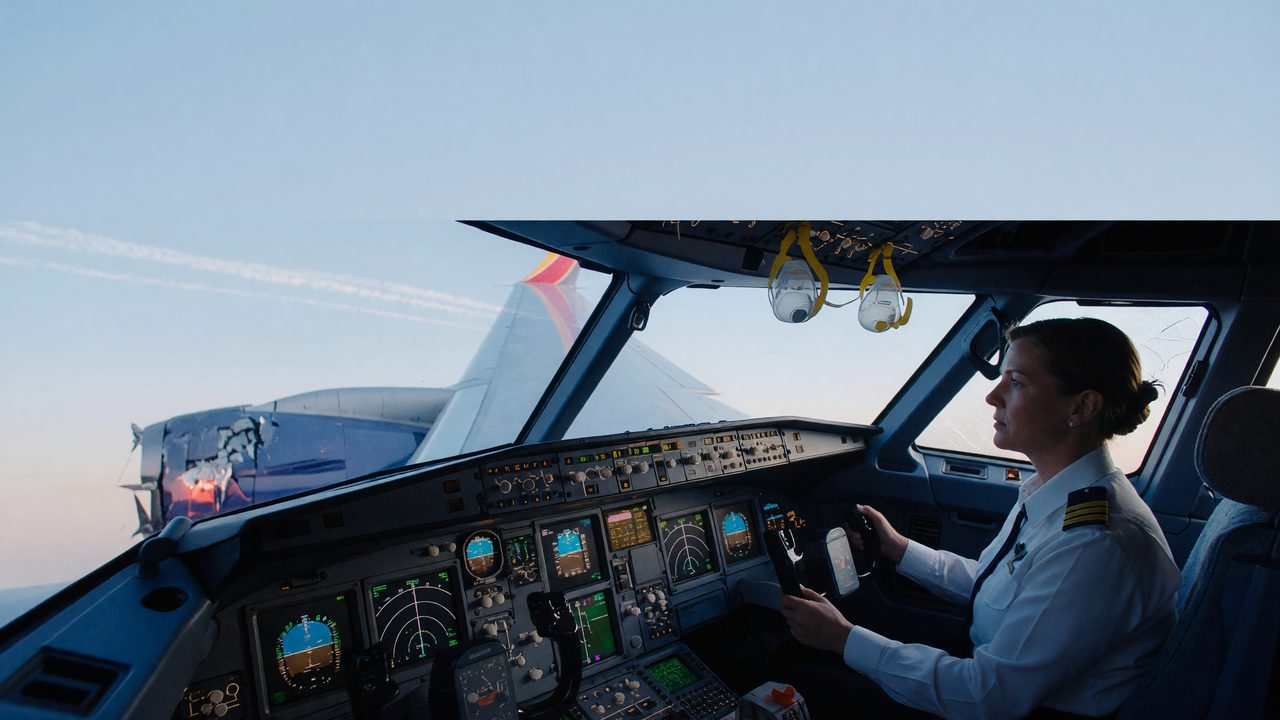
Stick and Sky: Shults at FL320
When a fan blade let go over Pennsylvania, a former Navy fighter pilot turned a decompression into a textbook emergency descent — by hand.
At 10:43 a.m. on April 17, 2018, Southwest Airlines Flight 1380 lifted off from New York LaGuardia bound for Dallas Love Field with 144 passengers and five crew members aboard. The Boeing 737-700 was thirty minutes into its climb when the left CFM56-7B engine did something no checklist can rehearse in full: it came apart in the sky.
According to the National Transportation Safety Board’s accident report, DCA18MA142, the failure began inside the engine’s fan section. A single fan blade, stressed past its design limits, cracked and separated. The released blade tore through the inlet and fan cowl. Shrapnel peppered the fuselage. A fragment of cowling struck the window at row 14 with enough force to destroy the acrylic pane. The cabin depressurized in an instant.
The physics at 32,000 feet are unforgiving. Air rushed out through the breach. One passenger, Jennifer Riordan, was partially pulled through the opening before fellow travelers and crew pulled her back inside. She would later die of her injuries — the first passenger fatality aboard a U.S. airline in nearly a decade. The aircraft rolled hard to the left, reaching 41 degrees of bank before Captain Tammie Jo Shults took the yoke.
Shults was not a stranger to high-workload flying. Before Southwest, she had flown the F/A-18 Hornet for the U.S. Navy — one of the first women to fly fighters in naval aviation. That background mattered in the next seventeen minutes.
First Officer Darren Ellisor worked the QRH while Shults hand-flew. She donned her oxygen mask, stabilized the roll, and began an emergency descent toward breathable altitude. On the radio, her voice stayed measured: she told air traffic control they had “part of the aircraft missing” and needed to divert. Controllers offered options. Shults evaluated them in seconds and chose Philadelphia International — long enough runway, capable emergency services, and a route she could fly while managing a damaged, depressurized jet.
The NTSB would later describe the crew’s actions as exemplary. That word carries weight from an agency that parses accidents for months. In its November 19, 2019 press release issuing seven safety recommendations from the investigation, the board highlighted both the immediate response and the longer failure chain that made the emergency necessary.
The engineering story lived inside the engine. CFM International’s party submission to the NTSB docket described a fan blade that had cracked from low-cycle fatigue after roughly 33,000 cycles — a failure mode the industry had seen before on the CFM56-7B fleet, but not yet on this particular blade in a way that mandatory inspection had caught. Service bulletins existed. They had not yet required the inspection that might have found the crack before takeoff that morning.
The recommendations that followed pushed the FAA and manufacturers toward more aggressive blade inspection intervals and better tracking of life-limited parts. For pilots, the lesson split in two: a mechanical world that can fail despite decades of reliable turbofan operation, and a human world that still decides the outcome once metal lets go.
Flight 1380 landed at Philadelphia seventeen minutes after the engine failure. Passengers evacuated. Riordan’s loss shadowed every account of survival. Shults and Ellisor had delivered their aircraft to the ground controllable, configured, and in one piece — the outcome every emergency procedure is written to produce, but few crews ever have to prove at flight level three-two-zero with a hole in the fuselage and a dead engine.
Why it matters to you
Automation does extraordinary work on a routine line flight — until the airplane stops being routine. Shults’ choice to hand-fly through the descent and approach, rather than lean on the autopilot under crushing workload, is the kind of decision flight training is supposed to prepare: aviate first, trust your hands when the airplane’s behavior is the problem, and let the other pilot run the checklists and radios. Fighter training did not make her calm; it gave her a reflex for unstable flight that commercial syllabus hours alone sometimes do not. Whether you fly a Cessna or a jet, the principle is the same: stick-and-rudder skill is not nostalgia. It is the reserve you draw on when the cabin pressure light, the asymmetric thrust, and the bank angle all demand an answer at once — and the only one who can give it is the pilot holding the controls.